
Commercial fires cost the UK economy more than £2 billion every year, according to the Cheshire Fire & Rescue Service's guidance on active and passive fire protection. That figure is the reason the question below matters today: if you cannot say who signs off the emergency lighting test in each of your warehouses, the answer is currently nobody, and that lands on your name.
Emergency lighting is an active measure. It reacts when the power fails, which is exactly when a warehouse full of racking, forklifts and people who do not know the layout needs it most. The testing regime is short, monthly and annual, and it is the easiest thing in the portfolio to let slide because nothing visibly breaks when you skip it.
The responsible person owns the duty, not the contractor
In UK non-domestic premises, the duty to keep emergency lighting in working order belongs to the responsible person for the building. That is the person who controls the premises, and in a multi-let industrial estate it is usually the landlord or the managing agent, not the tenant and not the electrician. The contractor tests. The contractor does not carry the duty.
So when someone asks who is responsible for emergency lighting testing, the honest answer is: the named responsible person for that building, and the person who answers to the board when the record is missing. The contractor's certificate is evidence that a test happened. It is not the duty itself.
BS 5266 sets out the design, commissioning and maintenance expectations, and BS EN 50172 sits alongside it. The Cheshire guidance is blunt about the minimum: emergency lighting systems should be tested monthly and subject to an annual service and test. Two frequencies, two owners, and a paper trail that has to survive a fire and rescue authority visit or an insurer's questions.
What falls due, month by month
Here is the run-down as it actually plays out across an industrial portfolio. The frequencies come from the source guidance; the ownership column is the part most portfolios get wrong.
Every month: the short functional test
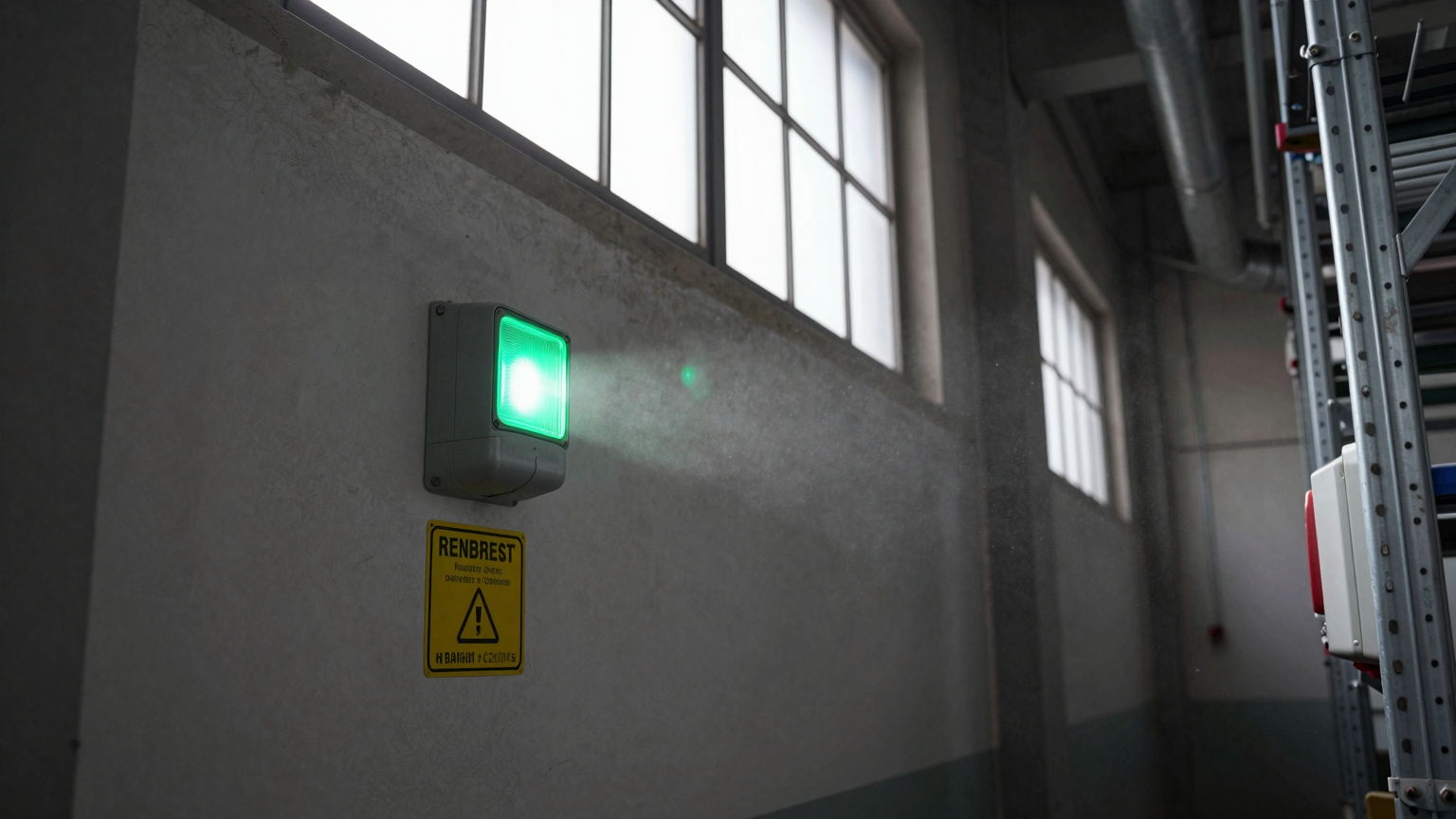
Each month, every emergency luminaire on the escape route should be checked to confirm it illuminates when the normal supply is interrupted. In a warehouse this is not a five-minute job. It covers escape routes, each emergency exit point, stairwells, corridor intersections, toilet areas over 8m², and the external lighting outside final exits. On a site with multiple units and long racking aisles, that is a walk with a clipboard and a key switch, done by someone who knows which fittings are maintained and which are non-maintained.
Owner: the building manager or facilities manager on site, with the result logged the same day. If the log lives in a folder in a plant room and nowhere else, the portfolio manager cannot see it, which is the same as it not existing.
Every year: the full duration test and service
The annual service and test is the one that proves the batteries will carry the load for the rated duration, not just flick on for a moment. It is a competent-person task, usually the maintaining contractor, and it produces the certificate that an insurer, a buyer's surveyor or a fire and rescue authority officer will ask to see.
Owner: the responsible person commissions it and holds the certificate; the contractor performs it. The failure mode here is a certificate that exists for the building but cannot be matched to the current tenant, the current layout or the current escape route after a racking reconfiguration.
On change: fit-out, re-racking, change of use
Emergency lighting is designed around escape routes. Move the racking, add a mezzanine, subdivide a unit, and the design assumptions change. BS 5266 covers design and commissioning as well as maintenance, so a material change to the layout is the moment to revisit the scheme rather than assume last year's certificate still describes the building.
Owner: whoever signs off the fit-out, with the responsible person confirming the commissioning record is updated before the unit goes live.
What the inspector actually looks at in a warehouse
On an industrial site, the officer is not only checking that a light comes on. They are checking that the escape route the lighting serves is still the escape route people would use, that the exit signs are illuminated to the required lux under BS 5266, and that the record of monthly and annual testing is current and signed. A missing month in the log is a finding even if every fitting works.
The same logic runs through the rest of your fire regime. If the emergency lighting log is thin, the fire alarm testing record under BS 5839 is usually thin in the same way, because both depend on the same person remembering to do the walk.
There is a wider regulatory backdrop worth naming. The Building Safety Regulator oversees the safety and standards of all buildings and runs the more stringent regime for higher-risk buildings under the Building Safety Act 2022, and its charging scheme for 2026 to 2027 sets out how it recovers the cost of its chargeable functions. Most warehouses will not be higher-risk buildings, but the direction of travel is clear: the regulator expects records, and it charges for the time it spends looking.
For a sense of how quickly a single missed duty becomes a board item, the duty that landed on building owners in January 2023 is the pattern to keep in mind.
The portfolio problem: many buildings, many logs
The monthly test is simple in one building and hard across forty. Each site has its own log, its own contractor, its own tenant changes and its own idea of where the certificate is filed. The portfolio manager is then asked, in a board pack or a due diligence pack, to confirm that every building is current. That is a records question before it is a technical one.
What a regulator, insurer or buyer will want to see is not a promise that testing happens. They will want the dated monthly entries and the current annual certificate, per building, matched to the current layout. If you cannot produce that today, you have found your exposure before someone else did.
Your 60-second self-check
- Could you produce the last twelve monthly emergency lighting test entries for every industrial building in your portfolio, today?
- Is the current annual service certificate matched to the building's present layout and tenant, not last year's?
- Can you name the responsible person for each site, in writing, rather than assuming it is the contractor?
If any of those is a no, the fastest next step is to send the free 5-minute Director's Risk Check to the colleague who actually holds the records, and have the board-ready briefing come back to you. It gives you the portfolio's breach exposure against official sources, so the conversation moves from reassurance to evidence.
Herman's verdict
The emergency lighting certificate is not proof that the building is safe. It is proof that someone walked the escape route on a known date and wrote it down, and a portfolio that cannot show that walk is asking the board to take the risk on trust.
— Herman
Until next time — keep the evidence closer than the deadline.
Walk into your next senior management meeting with the answers
The free Director's Risk Check for UK portfolios takes five minutes. No sign-up to see your score.
- Your control score across compliance, evidence, oversight, cost and renewals
- The breach exposure in your portfolio, with the official source for each penalty
- A board-ready briefing with your three priorities and a 30/60/90-day plan
About HermanWa
HermanWa is a building compliance and operations platform for property and facilities teams in the United Kingdom and Singapore, with portfolios across the Gulf. It keeps one auditable file per building — statutory deadlines, inspection evidence, contractor work, energy and carbon — and its AI assistant, Herman, answers questions about your buildings in plain English. HermanWa tracks obligations including fire risk assessments and fire door checks, Building Safety Act duties, Legionella (ACOP L8), EICR, gas safety and EPC in the UK, and SCDF fire certificates, Periodic Facade and Structural Inspections, lift permits and Green Mark in Singapore. Directors can check their exposure with the free Director's Risk Check.