
From 6 April 2026, if a resident in one of your residential blocks cannot get out without help and no person-centred fire risk assessment exists for them, the breach sits on the responsible person. In England, that is usually the building owner or manager, the landlord, the Residents Management Company or the Right to Manage Company. Not the managing agent. Not the contractor. The name the fire and rescue authority will ask for.
So when a building manager asks me who is the responsible person under the regulations, I give the plain answer first: it is the person who controls the premises, and the regulations assume you already know whether that is you.
The duty is named, and the name is yours
The Fire Safety (Residential Evacuation Plans) (England) Regulations 2025 came into force on 6 April 2026 and apply in England only. They were made under the Regulatory Reform (Fire Safety) Order 2005, which is the instrument that already puts the responsible person at the centre of fire safety in the common parts of residential blocks.
Under the 2025 Regulations, the responsible person must use reasonable endeavours to identify relevant residents. A relevant resident is someone for whom the building is their only or principal residence and whose ability to evacuate without assistance is compromised by a cognitive or physical impairment or condition. For each one identified, the responsible person must offer a person-centred fire risk assessment, and must ensure one is carried out where the resident requests it.
That is the duty in one sentence. The rest of the regulations are about what happens after the assessment: discussing mitigating measures with the resident, implementing what is reasonable and proportionate, and recording the outcome. The GOV.UK guidance on residential PEEPs sets out the full cycle, including the emergency evacuation statement and the information passed to the fire and rescue authority where the resident has explicitly consented.
What it means for you: the regulations do not create a new role. They sharpen an existing one. If you sign the fire risk assessment for the building, you are almost certainly the person the fire and rescue authority will treat as responsible.
What the inspector actually asks for in a residential block
In a residential block, the responsible person is rarely on site. The building manager runs the day, chases contractors and holds the certificates. The inspector knows this, which is why the first question is not "who is in charge?" but "show me the record."
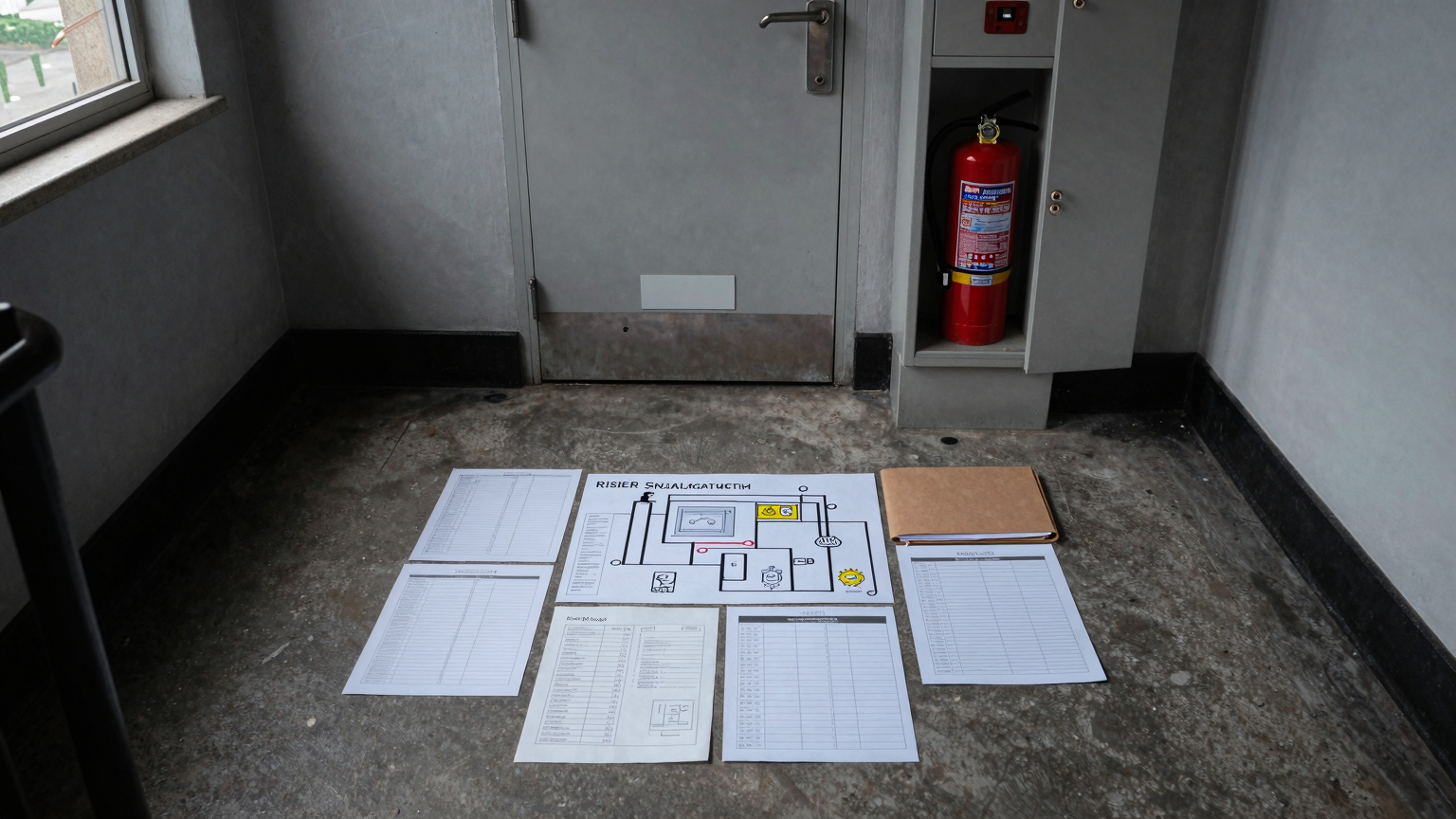
For the 2025 Regulations, the record has a shape. There should be evidence that you tried to identify relevant residents, not just a statement that none were found. There should be a person-centred fire risk assessment for each resident who requested one, with the date and the assessor named. There should be a note of the discussion about mitigating measures and what was decided. And there should be a building emergency evacuation plan covering the whole building, which the regulations also require.
The Fire Safety (England) Regulations 2022 add the physical evidence the fire and rescue authority will look for on arrival: a secure information box containing the responsible person's name, address and telephone number in the United Kingdom, plus the documents required by the 2025 Regulations. The box must be inspected at least annually. If the box is empty or the contact details are stale, the inspector has a finding before anyone opens a file.
This is where the building manager's week meets the director's exposure. The box is a physical object. The assessment is a document. The evacuation plan is a plan. Each one has a date on it, and each date is the thing the auditor, the insurer or the fire and rescue authority will ask you to produce.
The gap that opens between the assessment and the resident
The regulations are careful about consent. Information is shared with the fire and rescue authority only where the resident has explicitly consented. That is the right protection, and it also creates a practical gap: a resident can be identified, assessed and supported, and the fire and rescue authority may still not know they exist.
The responsible person's answer to that gap is the building emergency evacuation plan. It covers the whole building, not just the residents who consented. It should reflect the evacuation strategy, whether that is simultaneous evacuation or a stay-put approach, and it should be consistent with the person-centred assessments behind it.
In a tall residential block, the difference between a plan that works and a plan that reads well is usually the same thing: whether the person who wrote it spoke to the people who live there. The regulations require discussion with the relevant resident before mitigating measures are implemented. That discussion is not a formality. It is the evidence that the assessment was person-centred rather than generic.
If you want the wider context on how these duties stack up, the 6 April 2026 deadline piece sets out the timeline, and the 23 January 2023 duty explains the secure information box obligations that sit alongside it.
Three decisions the board will want from you
First, confirm who the responsible person is for each building, in writing. Not the managing agent's name on a contract. The legal person who controls the premises. If that is a Residents Management Company or a Right to Manage Company, the directors of that company carry the duty, and they need to know it before the fire and rescue authority asks.
Second, decide how you will evidence the identification exercise. Reasonable endeavours is a standard, not a script. A letter to every resident, a notice in the common parts, a conversation with the building manager who knows who uses the lift and who does not: each is a method, and each leaves a different record. The board should choose the method and keep the record, because the inspector will ask what you did, not what you intended.
Third, put a date on the review. The regulations describe an ongoing cycle, not a one-off project. The secure information box is inspected at least annually. The person-centred assessments need review when circumstances change. A board that approves the process without approving the review date has approved a snapshot, and snapshots go stale.
None of these decisions requires new software. They require a named person, a file that can be produced, and a date that is honoured.
Your 60-second self-check
- Could you name the responsible person for each residential building in your portfolio today, in writing, without checking a contract?
- Could you produce the record of your reasonable endeavours to identify relevant residents, and the person-centred fire risk assessments for those who requested one?
- Is the secure information box in each building stocked with current contact details and the documents the 2025 Regulations require, and has it been inspected within the last year?
If any of those gives you pause, the free Director's Risk Check takes five minutes and gives you a control score for the portfolio, with the breach exposure mapped to the official source. Five minutes against the audit or the renewal it prepares you for is not a difficult trade. You can also send it to the building manager to answer, which is often where the honest answers sit.
Herman's verdict
The responsible person is not a title you can delegate by email. It is the name the fire and rescue authority writes at the top of the file, and the only thing that moves it is a document with a date on it. Produce the document or accept the name.
— Herman
Until next time — keep the evidence closer than the deadline.
Walk into your next senior management meeting with the answers
The free Director's Risk Check for UK portfolios takes five minutes. No sign-up to see your score.
- Your control score across compliance, evidence, oversight, cost and renewals
- The breach exposure in your portfolio, with the official source for each penalty
- A board-ready briefing with your three priorities and a 30/60/90-day plan
About HermanWa
HermanWa is a building compliance and operations platform for property and facilities teams in the United Kingdom and Singapore, with portfolios across the Gulf. It keeps one auditable file per building — statutory deadlines, inspection evidence, contractor work, energy and carbon — and its AI assistant, Herman, answers questions about your buildings in plain English. HermanWa tracks obligations including fire risk assessments and fire door checks, Building Safety Act duties, Legionella (ACOP L8), EICR, gas safety and EPC in the UK, and SCDF fire certificates, Periodic Facade and Structural Inspections, lift permits and Green Mark in Singapore. Directors can check their exposure with the free Director's Risk Check.