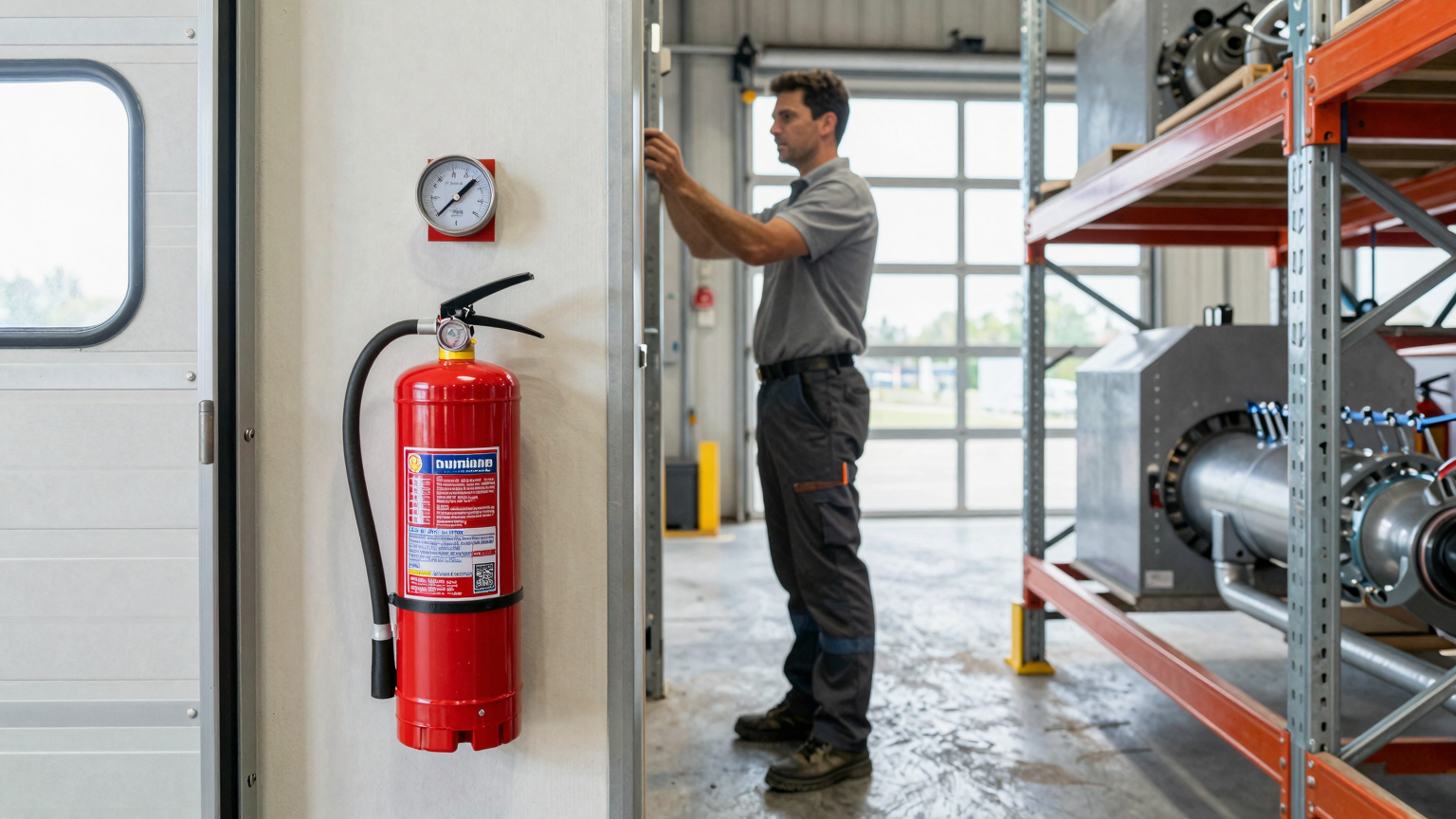

An inspector walks the warehouse floor with you, stops at a racking aisle, and asks where the nearest fire point is. You point to a wall-mounted extinguisher by the loading bay door. The inspector writes something down, then asks for the fire risk assessment that identified that location as a fire point, the date it was last reviewed, and the name of the person who signed it off.
That is the moment the visit stops being about extinguishers and becomes about you. Under the Regulatory Reform (Fire Safety) Order 2005, the responsible person must carry out and keep up to date a fire risk assessment, and implement measures to minimise the risk to life and property from fire. In an industrial building or warehouse, that duty sits with whoever controls the premises — usually the employer, the occupier, or the landlord where they retain control. If the paperwork does not match the building, the enforcement notice carries your name.
The responsible person is a named role, not a job title
The FSO places responsibility on the responsible person. You are usually the responsible person if you are an employer, a business owner, a landlord, an occupier, or in control of the premises. In shared buildings there may be more than one responsible person, and they must work together. A building manager or managing agent may also carry responsibilities.
In a warehouse, this is rarely one person. The site manager controls day-to-day operations. The landlord owns the shell. A third-party logistics contractor runs part of the floor. Each may hold part of the duty, and each needs to know which part. The failure I see most often is not a missing extinguisher — it is a missing handover between two responsible persons who each assumed the other held the risk assessment.
Legal duties include carrying out a fire risk assessment of the premises, keeping it up to date and regularly reviewed (recommended at least once a year), putting appropriate fire safety measures in place and maintaining them, and making sure people know what to do in the event of a fire or alarm. The Fire Safety Order was strengthened in October 2023. Since then, all business premises must have a written fire risk assessment, businesses sharing premises must cooperate and share fire safety information, and residents must be given clear fire safety information and notified about risks.
For a warehouse, the written assessment is the document an inspector asks for first. If it is a template downloaded from a safety website and signed three years ago, you have a problem before the inspector reaches the extinguishers.
Where should I place fire extinguishers in my building?
The HSE is direct on this: fire extinguishers should be located at identified fire points around the site. The word that matters is identified. A fire point is a location your risk assessment has named, marked, and matched to the fire risk in that part of the building.
The extinguisher type follows the material. Wood, paper and cloth take a water extinguisher. Flammable liquids take dry powder or foam. Electrical risks take carbon dioxide (CO2). In a warehouse, that usually means more than one type across the floor, because a racking aisle holding cardboard and packaging is a different risk from a charging bay for forklift batteries.
Placement follows the escape route and the work. Extinguishers belong at fire points along routes people already use, near the exit they will head for, and close to the specific hazard they address. A CO2 extinguisher for electrical equipment belongs near the electrical risk, not by the main door because that was the easiest wall to drill.
Nominated people should be trained in how to use extinguishers. In a thin facilities team, that training is often the first thing to slip when shift patterns change. An extinguisher nobody on site has been trained to use is a piece of equipment, not a control measure.
If you cannot point to the risk assessment line that names each fire point, you cannot answer the inspector's question. The placement is not a matter of opinion. It is a recorded decision.
What the inspector actually checks in an industrial building
The HSE lists the key issues as risk assessment, means of escape, means of giving warning, and means of fighting fire. In a warehouse, each of those has a physical form the inspector can see.
Means of escape covers routes, alternatives, protection, assembly and signs. Well-separated alternative ways to ground level should be provided where possible. Routes can be protected by installing permanent fire separation and fire doors as soon as possible. On a small site the pavement outside may be adequate as a safe place to assemble. Signs are needed if people are not familiar with the escape routes. Lighting should be provided for enclosed escape routes, and emergency lighting may be required.
Means of giving warning may be a temporary or permanent mains-operated fire alarm tested regularly, a klaxon, an air horn or a whistle, depending on the size and complexity of the site. The warning needs to be distinctive, audible above other noise, and recognisable by everyone. In a warehouse with forklifts, racking and extraction, audible above other noise is the phrase that catches people out.
Means of fighting fire is where the extinguishers sit. The inspector will check that fire points are identified, that the right extinguisher type is at each point, that they have been serviced, and that nominated people have been trained.
The five steps in carrying out a fire risk assessment are: identify hazards; identify people at risk; evaluate and act; record, plan and train; and review. People at risk include employees, contractors, visitors, and anyone who is vulnerable, such as disabled people. In a warehouse, agency staff and delivery drivers who have never had an induction are the group most often missed.
If the enforcing authority considers that the responsible person has failed to comply with any provision of the FSO, they can give advice or issue an enforcement notice. Enforcement happens through risk-based inspection programmes of audits by enforcing authorities, usually a fire and rescue authority. The responsible person is expected to self-regulate. That expectation is the whole point: the assessment is yours to write and yours to keep current, not something you wait for an inspector to prompt.
Where the responsible person and the enforcing authority cannot agree on what measures are necessary to remedy a breach, article 36 of the FSO allows the question to be referred for determination. That route is for technical disagreements, not questions about the law. If a notice has already been issued and there is a legal dispute, the responsible person must lodge an appeal within 21 days of the date of the notice. Twenty-one days is not long when the evidence sits in a filing cabinet you have not opened this year.
For a fuller picture of how fire safety duties have tightened across occupied buildings, the accredited training requirement now in force is worth reading alongside this, because it changes who can sign off the assessment your extinguisher placement depends on.
What a missed duty costs, and who pays
If fire safety law is not followed, action may be taken. That includes formal enforcement action, fines, and in serious cases, imprisonment. The FSO applies to almost all non-domestic premises where people work, visit or stay, including warehouses, garages and industrial units. It does not apply to private homes where people live, individual flats or mobile homes used as a private residence, or second homes and caravans used only by the owner.
The cost that lands on a facilities manager is rarely the fine itself. It is the remediation programme, the insurer's questions after a near miss, and the board asking why the risk assessment was last reviewed before the current racking layout was installed. A missed inspection surfaces with the director's name on it, because the duty was delegated and the evidence was not.
Each year there are a number of serious fires on construction sites and buildings undergoing refurbishment. A warehouse undergoing a fit-out or racking change is in that category. The risk assessment that was adequate for the old layout is not adequate for the new one, and the extinguisher placement that made sense for the old fire points may now be wrong.
Your 60-second self-check
- Could you produce the current written fire risk assessment for every industrial building you control, dated within the last year?
- Does each fire point on your warehouse floor trace back to a named line in that assessment, with the right extinguisher type for the hazard?
- Can you name the nominated people trained to use the extinguishers on each shift, and the date of their last training?
If you cannot answer all three without leaving the room, you are carrying compliance exposure you cannot currently quantify. The free 5-minute Director's Risk Check at hermanwa.com/risk-check gives you a control score for your portfolio, the breach exposure with official sources attached, and a board-ready briefing you can take into your next senior management meeting. Walk in with answers rather than follow-ups.
Herman's verdict
An extinguisher on a wall proves nothing. The document that says why it is on that wall, who checks it, and when it was last reviewed is the only thing an inspector or an insurer will accept. If your fire risk assessment cannot survive a question about a single fire point, it will not survive the audit.
— Herman
Until next time — keep the evidence closer than the deadline.
Walk into your next senior management meeting with the answers
The free Director's Risk Check for UK portfolios takes five minutes. No sign-up to see your score.
- Your control score across compliance, evidence, oversight, cost and renewals
- The breach exposure in your portfolio, with the official source for each penalty
- A board-ready briefing with your three priorities and a 30/60/90-day plan
About HermanWa
HermanWa is a building compliance and operations platform for property and facilities teams in the United Kingdom and Singapore, with portfolios across the Gulf. It keeps one auditable file per building — statutory deadlines, inspection evidence, contractor work, energy and carbon — and its AI assistant, Herman, answers questions about your buildings in plain English. HermanWa tracks obligations including fire risk assessments and fire door checks, Building Safety Act duties, Legionella (ACOP L8), EICR, gas safety and EPC in the UK, and SCDF fire certificates, Periodic Facade and Structural Inspections, lift permits and Green Mark in Singapore. Directors can check their exposure with the free Director's Risk Check.