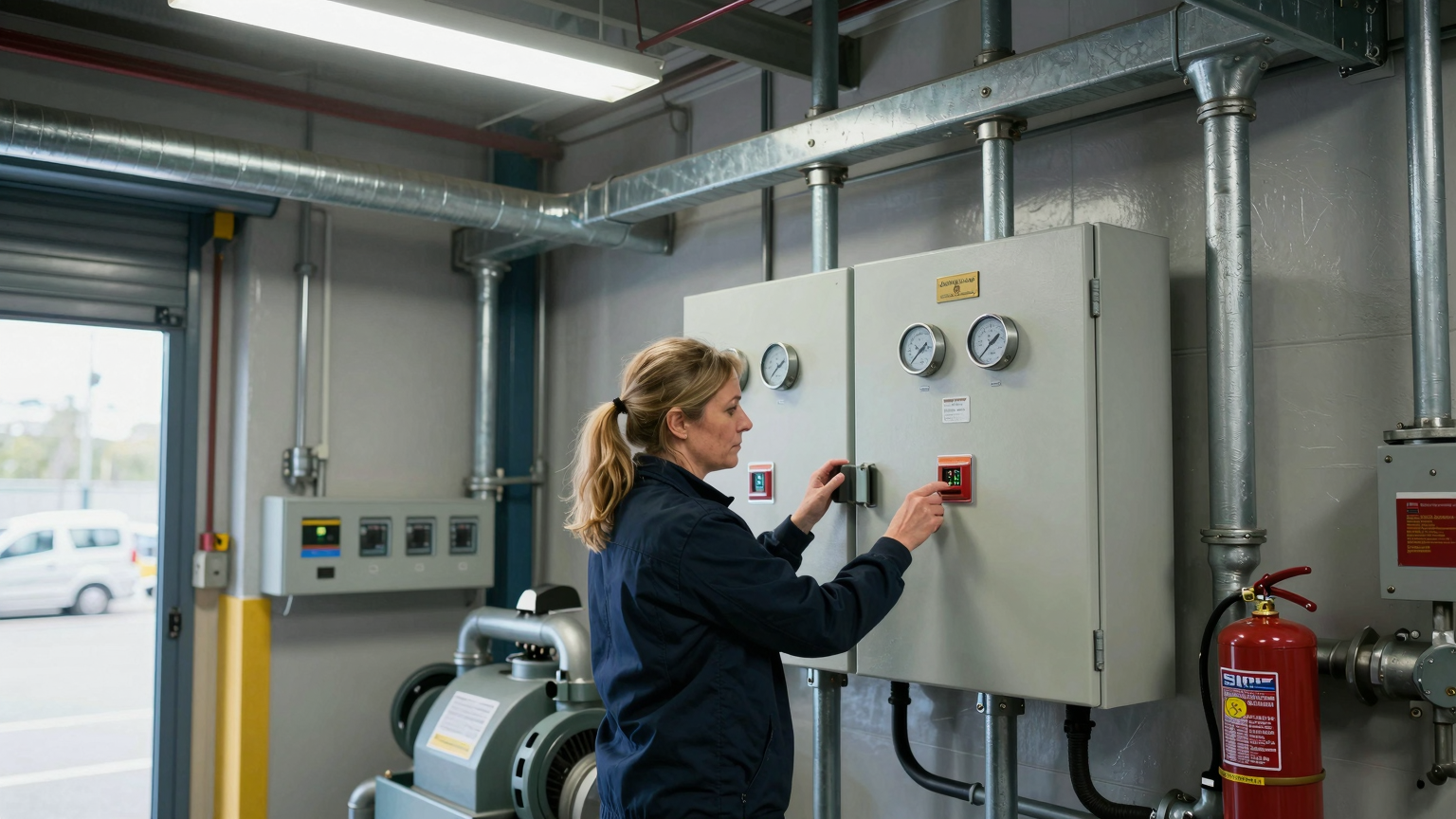

Can you name the last date your warehouse fire alarm panel was serviced, and produce the certificate today?
Most facilities managers I speak to can describe the panel. Fewer can put the paperwork in front of me without a search. That gap is the one a fire and rescue authority inspector, an insurer or a buyer will find first, because it is the easiest thing in the building to check and the hardest to explain away.
Responsibility belongs to a named person, not a contractor
Under the Fire Safety Order, responsibility for fire safety in a building always remains with the Responsible Person. That is the wording used in the Interim Measures Alarm Fund guidance, and it applies whether the alarm was installed last month or fifteen years ago. Your alarm contractor services the system. They do not carry the duty.
For an industrial unit or a distribution warehouse, the Responsible Person is usually the occupier or the landlord, depending on the lease. In practice, the facilities manager holds the evidence on their behalf. When the inspector asks for the servicing record and it is not there, the conversation moves quickly from the plant room to the boardroom.
What an inspector examines in a warehouse
Industrial buildings have a particular pattern. The alarm system is often a Category L5 or L4 arrangement, designed around life safety in specific areas rather than full coverage. High racking, dust, vehicle movements and temperature swings all affect detectors. So does the fact that the site is rarely empty: contractors, drivers, agency staff and shift workers move through it, and each of them can trigger or mask a fault.
The inspector will ask for the log book, the last service certificate, the cause-and-effect matrix, and the record of weekly tests. They will look at whether the panel is showing faults that nobody has cleared. They will check whether the detectors above the racking have been accessed and cleaned, because a detector that has never been reached is a detector that has never been tested properly.
BS 5839-1 sets the recommendations for design, installation, commissioning and servicing. The standard is not law in itself, but it is the benchmark an inspector, an insurer and a court will use to judge whether you did what a competent person would do. If your servicing regime does not follow it, you need a documented reason why.
The evidence the board will ask for
When a fire alarm failure reaches a board agenda, three documents get requested. The first is the current service certificate, signed by a competent person, showing the date and the scope of the visit. The second is the log book, with weekly test entries and any faults recorded and closed out. The third is the fire risk assessment, updated to reflect the alarm system as it actually is, not as it was designed.
If the building has been through any change, a new tenant, a racking reconfiguration, a change of use in part of the unit, the fire risk assessment should show that the alarm coverage was reviewed. The research published by the Building Safety Regulator on fire safety in specialised housing found a recurring disconnect between how buildings are designed and how they are actually managed. That same disconnect shows up in industrial buildings when the alarm system is left as installed while the operation around it changes.
There is a second layer here that catches people out. If your BS 5839-1 scope was set before the 2025 revision, your insurance review may not reflect the current standard. I wrote about that gap in what changed in BS 5839-1:2025 and what your insurance review missed, and it deserves a place beside this piece because the servicing record is only as good as the scope it was written against.
Three decisions to take before the next board meeting
First, confirm who is the Responsible Person for each building and whether the servicing contract names them. A contract that says "the client" is not evidence. The duty holder needs to be identifiable in the paperwork, because that is the name the inspector will write down.
Second, check that the service interval and scope match the standard your system was designed to. A Category L5 system in a warehouse with high racking needs a servicing regime that reaches the detectors, not just the panel. If the last service certificate lists only a panel check, ask the contractor what was physically tested and get it in writing.
Third, decide how the log book is kept and who owns it. A paper log book that lives in a cabinet is fine until the person who writes in it leaves. A digital record that nobody updates is worse, because it looks like a system. The question is not which format you use. It is whether you could produce the last twelve months of entries today, for every building, without asking anyone.
If the answer to that last question is no, plenty of facilities managers are in the same position. Most portfolios I see have at least one building where the alarm records are held together by one person's memory and a filing cabinet. The problem is not the filing cabinet. The problem is what happens when that person is on leave and the inspector arrives.
Your 60-second self-check
- Could you produce the current fire alarm service certificate today, for every industrial building in your portfolio?
- Does the log book show weekly tests and closed-out faults for the last twelve months, or does it stop when the last facilities manager left?
- Does your fire risk assessment reflect the alarm system as it is now, including any change in racking, occupancy or use?
If you want to walk into your next board or senior management meeting with answers rather than follow-ups, the free 5-minute Director's Risk Check gives you a control score for your portfolio, the breach exposure with official sources attached, and a board-ready briefing you can send to a colleague to answer. It takes less time than finding the log book.
Herman's verdict
A fire alarm certificate is not a document you file. It is a statement that someone competent stood in front of the panel, tested what the standard requires, and signed their name to it. If you cannot produce that statement today, the gap is not administrative. It is the difference between a managed building and a building that is waiting for its first inspection.
— Herman
Until next time — keep the evidence closer than the deadline.
Walk into your next senior management meeting with the answers
The free Director's Risk Check for UK portfolios takes five minutes. No sign-up to see your score.
- Your control score across compliance, evidence, oversight, cost and renewals
- The breach exposure in your portfolio, with the official source for each penalty
- A board-ready briefing with your three priorities and a 30/60/90-day plan
About HermanWa
HermanWa is a building compliance and operations platform for property and facilities teams in the United Kingdom and Singapore, with portfolios across the Gulf. It keeps one auditable file per building — statutory deadlines, inspection evidence, contractor work, energy and carbon — and its AI assistant, Herman, answers questions about your buildings in plain English. HermanWa tracks obligations including fire risk assessments and fire door checks, Building Safety Act duties, Legionella (ACOP L8), EICR, gas safety and EPC in the UK, and SCDF fire certificates, Periodic Facade and Structural Inspections, lift permits and Green Mark in Singapore. Directors can check their exposure with the free Director's Risk Check.