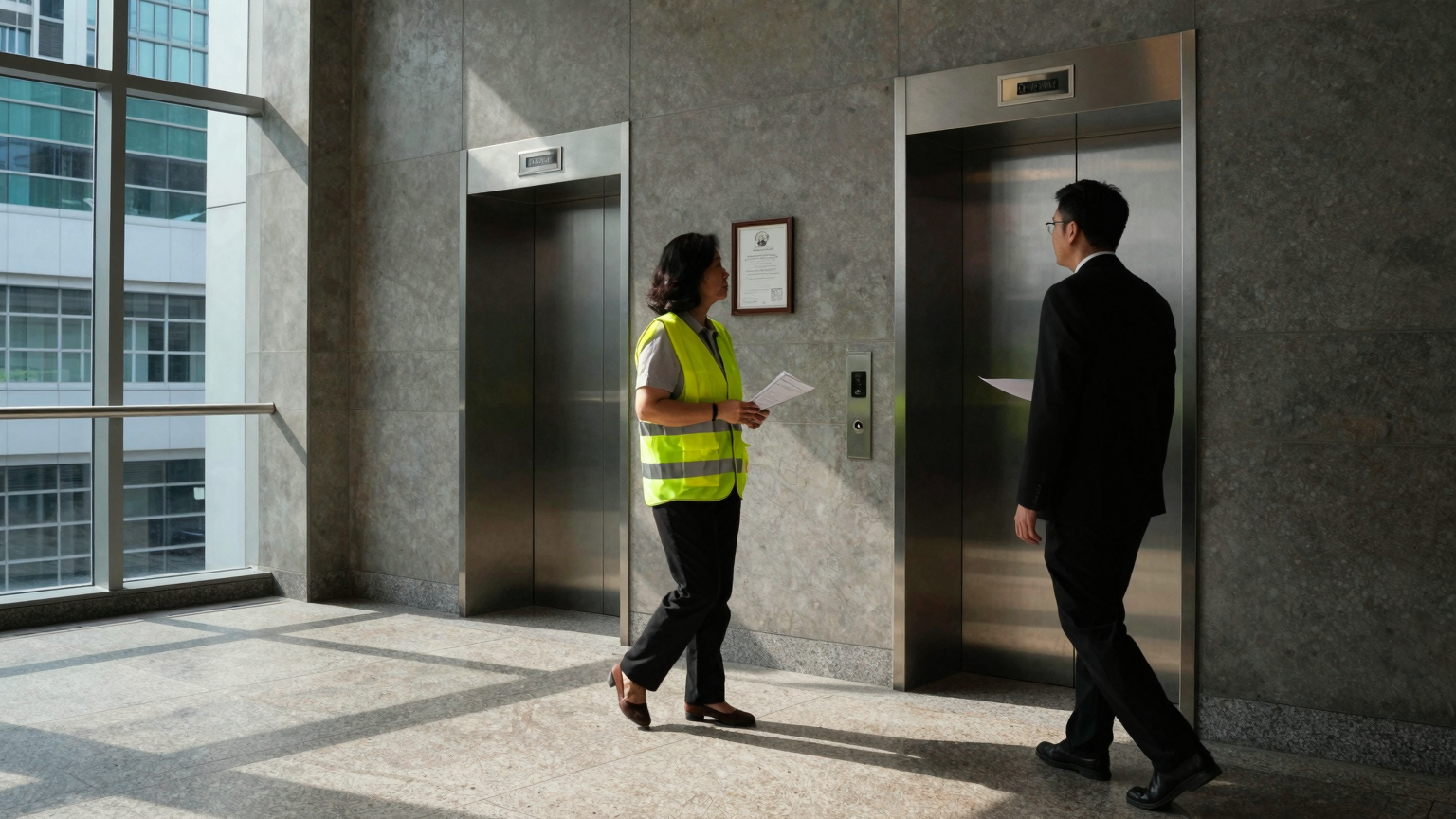

An inspector arrives at a CBD office tower and asks the building manager for the lift Permit to Operate. The manager has a certificate on the wall, a maintenance contract in a drawer, and a nagging feeling that the renewal was someone else's job. The inspector waits. The lift keeps running. Nobody in the lobby knows whether the paperwork is current.
That moment is where the director's name enters the room, because responsibility rests with the owner, not the contractor and not the building manager.
The stakes: the owner holds the permit, not the lift company
In Singapore, a valid Permit to Operate (PTO) is required before owners can operate their lifts, escalators and mechanised car parking systems, and operating a fixed installation without one is an offence under the Building Control (Fixed Installations) Regulations 2025. The duty is on the owner. The contractor maintains the equipment; the owner holds the permit and answers for it. When a PTO lapses, the lift is not just non-compliant on paper — it is being operated unlawfully, and the person who signs the duty-holder paperwork is the one who has to explain that to a board.
Singapore: the record lives in LEAP, and the clock starts three months out
Singapore has moved the PTO lifecycle onto a single platform. Applications, renewals and recommissioning for lifts, escalators and MCPS all run through the Lifts and Escalators Application Portal (LEAP), which automates the process from installation to termination. Owners or their representatives log in with Corppass (Singpass for individual homeowners), and the Supervisor QP or SPE must initiate a new PTO or recommissioning application before it routes to the owner.
For renewals, the owner can commence the application three months before the current expiry date. That window is the whole game. A portfolio manager who treats renewal as a task for the month of expiry has already lost the buffer that protects against a missing signature, a payment that fails, or a contractor who has changed.
Three things a director should be able to produce on request: the current PTO status for every installation, checked through BCA's Search PTO Enquiry portal or by scanning the QR code on the PTO certificate; the name of the BCA-registered FI service contractor currently engaged, updated via LEAP when the contract changes; and evidence that the annual inspection and testing was carried out by a registered contractor with an independent SPE or FI Inspector present. The BCA guidance on applying for a PTO sets out the LEAP process, the payment routes (GIRO and PaySG) and the user manuals, which is where a new building manager should start rather than guess.
Maintenance frequency is not uniform, and the record has to match the asset. Lifts generally need maintenance at the manufacturer's recommended frequency or at least monthly, whichever is more frequent, unless the Commissioner of Building Control has approved a remote monitoring and diagnostics schedule in writing. Escalators need maintenance every month. All lifts, escalators and MCPS need annual inspection and testing by a BCA-registered FI service contractor with an independent SPE or FI Inspector present. The Fixed Installations legislations page is the reference for the regulations behind those frequencies, including Regulation 39 of the Building Control (Fixed Installations) Regulations 2025.
Two further records catch portfolios out. First, a PTO ceases when a lift, escalator or MCPS undergoes major alteration or replacement works; the owner must notify the Commissioner in writing, obtain approval where required, and apply for a new PTO after the Supervisor QP certifies the installation fit for operation. A refurbishment programme that runs without a PTO reapplication leaves the building operating without a valid permit. Second, reportable safety incidents involving a lift, escalator or MCPS must be reported to BCA within six hours by phone, and reportable safety risks related to building products within 72 hours via FormSG. Those are records with a clock attached, and the clock starts when the reporter first becomes aware.
One more check worth building into onboarding: verify contractor registration through the BCA Directory of Registered Contractors. An entity registered with ACRA and holding a UEN is not thereby qualified to install or maintain fixed installations, and the BCA reminder to owners of stairlifts and vertical platform lifts makes that point directly. The same discipline applies to office buildings with platform lifts tucked away near a goods entrance.
UK: the same duty, a different paper trail
The UK does not use a PTO in the Singapore sense. The equivalent obligation is the thorough examination of lifting equipment under the Lifting Operations and Lifting Equipment Regulations 1998 (LOLER), which requires examination at least every six months for equipment carrying people, and every twelve months for equipment not carrying people, by a competent person. The record is the examination report, and responsibility rests with the employer or the person in control of the premises. In a multi-let office, that is usually the landlord or the managing agent, and the report has to be available for inspection by the enforcing authority, which is the Health and Safety Executive or the local authority.
The practical difference is where the evidence lives. In Singapore, the regulator holds the status and the owner can check it in a portal. In the UK, the owner holds the report and the regulator asks for it. That inverts the failure mode: a Singapore portfolio fails when a renewal is not started in time, and a UK portfolio fails when a report exists but cannot be produced. Both failures land on the same desk.
What a portfolio spanning both markets should standardise
Standardise the register, not the regulation. One line per installation, with the asset identifier, the building, the current permit or examination status, the expiry or next-due date, the contractor and their registration or accreditation, and the location of the underlying certificate or report. Then standardise the trigger: a renewal task that opens three months before expiry in Singapore, and an examination booking that opens at least a month before the UK due date, so the competent person has room to attend.
Standardise the escalation too. A PTO that has not been renewed inside the three-month window is a director-level item, not a building-manager item, because the offence sits with the owner. A UK examination report that is overdue is the same. The piece on the 14-day window makes the wider point about how a small administrative gap becomes a personal breach, and it reads across to lift records more easily than most compliance writing.
Finally, standardise the incident route. In Singapore, the six-hour phone call to BCA and the 72-hour FormSG notification are separate records with separate clocks, and neither is satisfied by a WhatsApp message. In the UK, the RIDDOR reporting route applies where a lift incident is reportable. A portfolio that has one incident protocol covering both markets will get the first hour right, which is the hour that matters.
Your 60-second self-check
- Could you produce the current PTO status for every lift, escalator and MCPS in your Singapore portfolio today, without asking the contractor?
- Is there a renewal task open for every installation whose PTO expires within the next three months, with a named owner?
- For your UK buildings, could you produce the most recent thorough examination report for each lift within the hour?
The free five-minute Director's Risk Check maps which statutory deadlines and penalties bear on your portfolio, with a citation for each, so the gaps are visible before a board meeting rather than after an inspector's visit. Run it at the Director's Risk Check and pass it to the person who keeps the files.
Herman's verdict
A lift certificate is not a document you keep. It is a date you manage, and the only question that matters is whether your register knows the date before the regulator does.
— Herman
Until next time — keep the evidence closer than the deadline.
Walk into your next senior management meeting with the answers
The free Director's Risk Check for Singapore portfolios takes five minutes. No sign-up to see your score.
- Your control score across compliance, evidence, oversight, cost and renewals
- The breach exposure in your portfolio, with the official source for each penalty
- A board-ready briefing with your three priorities and a 30/60/90-day plan
About HermanWa
HermanWa is a building compliance and operations platform for property and facilities teams in the United Kingdom and Singapore, with portfolios across the Gulf. It keeps one auditable file per building — statutory deadlines, inspection evidence, contractor work, energy and carbon — and its AI assistant, Herman, answers questions about your buildings in plain English. HermanWa tracks obligations including fire risk assessments and fire door checks, Building Safety Act duties, Legionella (ACOP L8), EICR, gas safety and EPC in the UK, and SCDF fire certificates, Periodic Facade and Structural Inspections, lift permits and Green Mark in Singapore. Directors can check their exposure with the free Director's Risk Check.