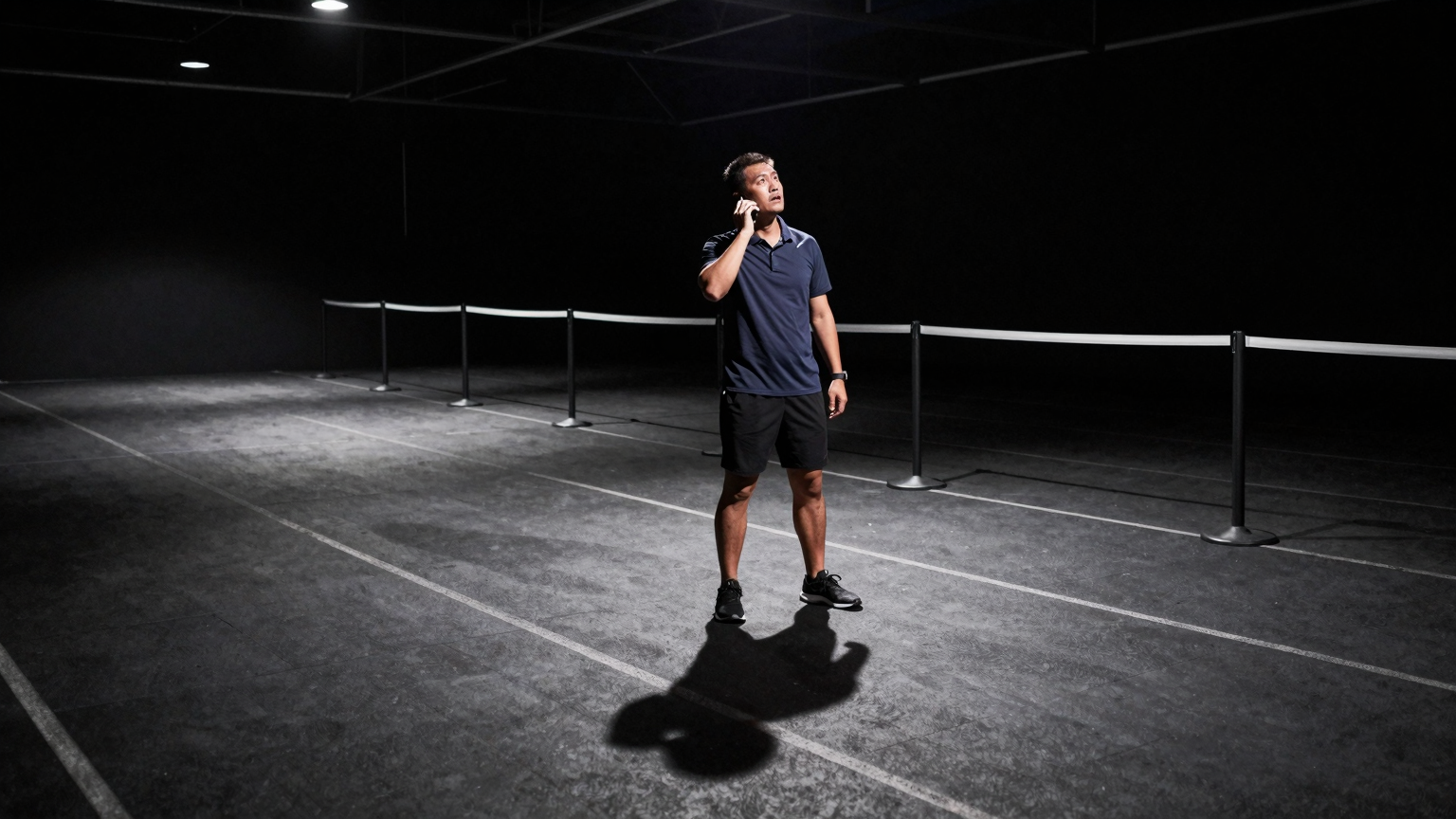

An event organiser emails you three days before a mass participation race and asks to add a second wave. You approve it, because the calendar says the mall is quiet that morning. Then the race director calls from the floor to say a competitor has collapsed at a shared station and the medical team wants the lane closed. Nobody in the room can say who has the authority to stop the race, or who signs the incident log, or who tells the next wave to wait.
That gap is not a medical problem. It is a governance problem, and it sits with the venue operator as much as the organiser.
The stakes: the organiser's rulebook is now your evidence
In September 2026, Hyrox allowed an elite competitor to finish and win a race in Beijing after a hygiene incident mid-course, and the fallout ran for days. Co-founder Moritz Fürste apologised to everyone affected "directly or indirectly" and accepted that he should have foreseen the situation, saying it was his job to foresee potential incidents and he did not. Hyrox then changed its rulebook immediately, giving a race director the power to withdraw a racer on medical grounds where blood, vomit, urine or contamination poses a welfare or contamination risk, recorded as Did Not Finish. Hyrox China refunded entry costs to affected participants and replaced contaminated equipment and venue carpet overnight. The BBC's report on the apology and rule change sets out the sequence.
Read that again as a venue operator. The organiser's written procedures, the named decision-maker and the incident record are what the public, the insurer and the regulator will ask to see. If your building hosted the event, your name is on the tenancy agreement and your name is in the sentence.
Who the Singapore rules apply to when you host a mass event
Singapore does not have a single "mass participation event licence". It has a stack of permits, and which ones bite depends on what is actually happening inside your building. The National Arts Council's event licensing guide is a useful map of the stack, even for non-arts events, because it shows how the pieces fit together.
The ceiling is worth knowing before you sign the hire agreement. Under the Fire Safety Act 1993, using or occupying premises without a valid fire safety certificate is an offence carrying a fine of up to S$200,000, imprisonment of up to 12 months, or both. A mass participation event changes the occupancy load, the escape routes in use and often the layout of the space it runs in, and the certificate you hold describes the building you normally operate — not the one you hand over for a weekend.
The fine is not the number that should worry you. MOM can issue a stop-work order that halts operations in the affected workplace until it is satisfied the risk has been dealt with, and it publishes the register of orders and their status; under section 50 of the WSH Act the fine for a body corporate tops out at S$500,000. For a mall, a hotel or an office tower, a fine is a line in next quarter's accounts. A floor that cannot trade, in a building whose tenants have turnover rent and break clauses, is a different order of number entirely — and it is the one your occupiers will hear about first.
An Arts Entertainment Licence from IMDA applies to public arts entertainment, and applications need to be made at least two months before the event start date. A Police Permit for Public Talk applies to each public lecture or talk. Film screenings need classification, and a film exhibition licence for NC16, M18 or R21 titles. For assemblies and processions, the Ministry of Home Affairs guidance on public order sets out when a police permit is required, and when an indoor public assembly held wholly inside a building or enclosed premises is exempt.
For a shopping centre, the practical question is not "do we need a licence". It is "which of these permits does the organiser hold, and can I produce a copy today". If the answer is a shrug, you are carrying the exposure without the paperwork.
What the venue operator actually has to control
The organiser runs the race. You run the building. That split sounds clean until something goes wrong at a shared station, and then it is not clean at all.
Three things sit with you, and none of them are the organiser's to sign off:
- Access and egress. A mass event changes how people move through a retail centre. Escape routes, fire doors and assembly points have to stay usable while a course is laid out across them. If the course blocks a means of escape, that is your problem, not the organiser's.
- Shared equipment and surfaces. In a Hyrox-style format, competitors alternate between running a kilometre and doing exercises at shared high-intensity stations, including rowing machines, sled pushes, burpee jumps, medicine ball throws and lunges with a sandbag. In a retail setting the equivalent is any surface or equipment that hundreds of people touch in sequence. Who cleans it, how often, and where is that written down.
- The incident record. When something unforeseen happens, the question is who decided what, when, and on what authority. Hyrox's own statement described the Beijing situation as one where protocols designed for elite competition and mass participation became blurred, creating ambiguity in how they were applied and understood. That is the failure mode to design out before the event, not during it.
If you cannot name the person in your organisation who can stop an event mid-race, you have not finished the planning.
The refund clause is a venue cost, not just an organiser cost
Hyrox China refunded entry costs to participants who started before 2.40pm on Saturday but had not finished by that time, and to athletes who departed in heat batches between 2.40pm and 8.40pm. That is a commercial decision made by the organiser, and it is the right one. But look at what it implies for a venue.
If a race is stopped, the organiser faces refunds, lost sponsorship value and reputational damage. Their next move is to look at the venue's contribution. Did the building's cleaning regime meet the standard the organiser assumed? Was the isolation procedure agreed in writing? Was there a named venue contact on site with authority to act?
Your tenancy agreement and your event licence with the organiser should answer those questions before the first wave starts. If they do not, the refund conversation becomes a liability conversation, and it will not be settled by goodwill.
What an inspector or insurer will ask to see
When something goes wrong at a mass event in a retail centre, the requests come in a predictable order. The regulator wants the permit trail. The insurer wants the risk assessment and the incident log. The organiser's lawyers want the correspondence that shows what was agreed and when.
You should be able to produce, for every event hosted in the last twelve months:
- The permits the organiser held, with dates and conditions.
- The written allocation of duties between organiser and venue, signed by both.
- The name of the venue-side decision-maker on site during the event.
- The cleaning and isolation procedure for shared surfaces and equipment.
- The incident log, including any decision to stop, pause or modify the event.
None of that is exotic. All of it is the difference between a controlled response and a board-level problem.
Your 60-second self-check
- Could you produce the signed duty allocation for the last mass event held in your building, today?
- Can you name the person on your side who had authority to stop that event mid-race?
- Does your event file contain the organiser's permit copies and the cleaning procedure for shared equipment?
When the answer to any of those is no, the fastest way to close the gap is to send the free 5-minute Director's Risk Check to the colleague who holds the event records, and ask them to run it. The briefing comes back to you, with the portfolio's breach exposure and the official sources attached, so you can take it into the next board meeting rather than chase it afterwards.
Herman's verdict
A rulebook that only exists in the organiser's head is not a control, it is a story you tell after the event. The venue operator who can produce the signed duty allocation, the permit copies and the incident log is the one who stays out of the headline.
— Herman
Until next time — keep the evidence closer than the deadline.
Walk into your next senior management meeting with the answers
The free Director's Risk Check for Singapore portfolios takes five minutes. No sign-up to see your score.
- Your control score across compliance, evidence, oversight, cost and renewals
- The breach exposure in your portfolio, with the official source for each penalty
- A board-ready briefing with your three priorities and a 30/60/90-day plan
About HermanWa
HermanWa is a building compliance and operations platform for property and facilities teams in the United Kingdom and Singapore, with portfolios across the Gulf. It keeps one auditable file per building — statutory deadlines, inspection evidence, contractor work, energy and carbon — and its AI assistant, Herman, answers questions about your buildings in plain English. HermanWa tracks obligations including fire risk assessments and fire door checks, Building Safety Act duties, Legionella (ACOP L8), EICR, gas safety and EPC in the UK, and SCDF fire certificates, Periodic Facade and Structural Inspections, lift permits and Green Mark in Singapore. Directors can check their exposure with the free Director's Risk Check.