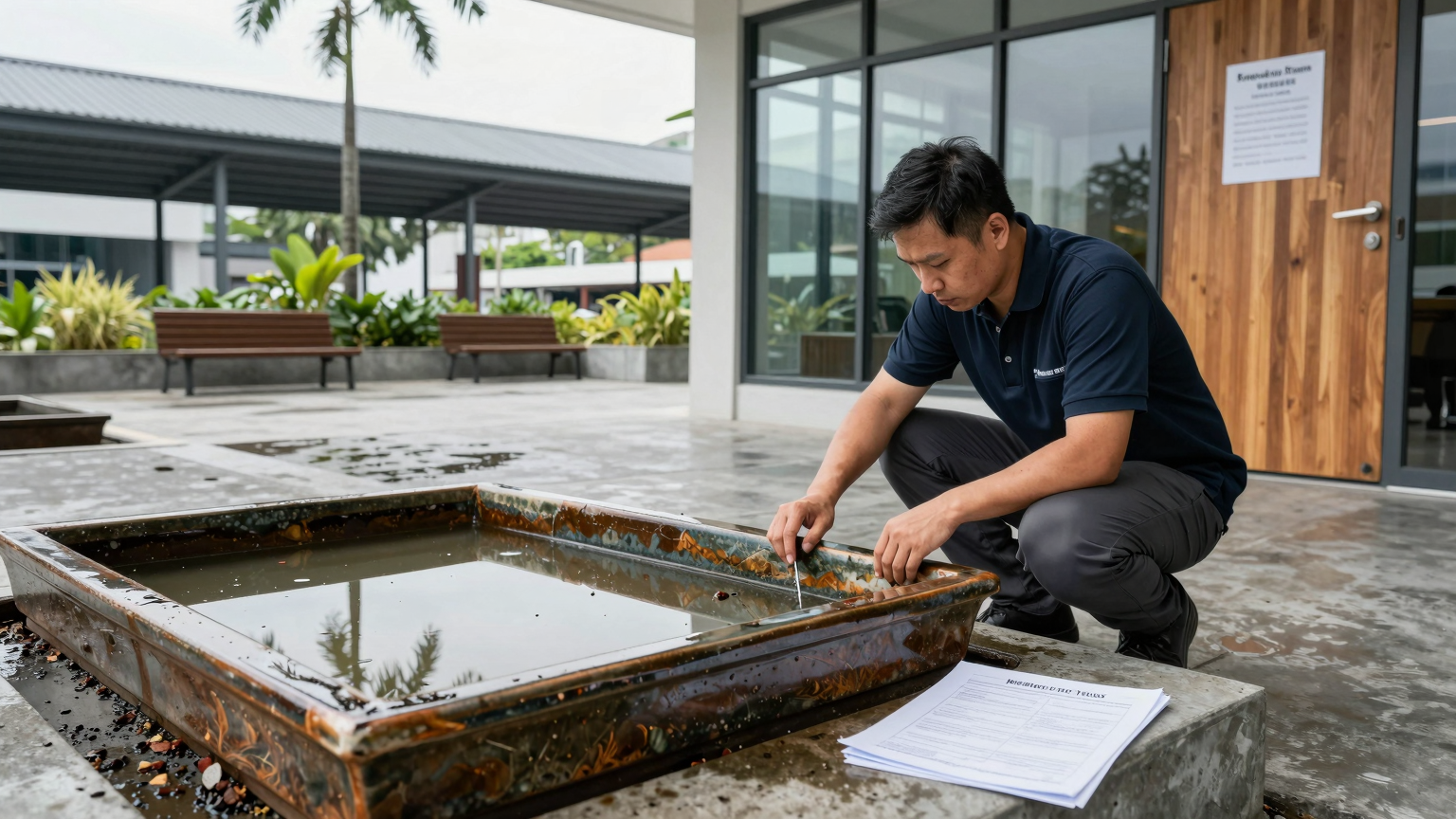

An NEA officer stands at the service yard of a mixed-use development, looking at a disused planter tray behind the bin centre. The facilities manager is called down from a meeting. The officer asks who is responsible for this part of the premises, and whether anyone has checked it this week.
That question — who owns this patch of ground — is where most portfolios come unstuck. In Singapore, the answer carries a fine. In the UK, it carries a different kind of exposure. If you run buildings in both markets, you need one standard that satisfies each.
The penalty in Singapore is a fine, and it lands on the occupier or owner
Under Singapore's Control of Vectors and Pesticides Act 1998, the National Environment Agency can serve notices on premises where mosquito breeding is found. For a first finding, the penalty is a fine of up to S$2,000. That figure comes from official updates on vector control operations, where breedings found in factory premises were met with a S$2,000 fine for first-time breaches.
The fine is not the whole picture. Refusing entry to an NEA dengue inspection officer is a separate offence. In the past three years, NEA encountered about 6 instances of refused entry for every 100 inspection attempts at residential premises. Individuals who fail to comply with a notice can be charged under Section 45 of the CVPA for obstructing or hindering NEA officers. On conviction, that carries a fine not exceeding S$5,000, imprisonment not exceeding 3 months, or both. The Ministry of Sustainability and the Environment has said it has no plans to increase these penalties at this time.
For a facilities manager, the practical point is this: the fine is small enough to be absorbed, but the inspection record is not. A single finding creates a paper trail that a director will eventually see.
What the inspector actually looks at in a mixed-use development
Mixed-use developments concentrate risk because they concentrate people and water. A single podium might contain a food court, a gym, a childcare centre, residential units and a car park. Each of those produces different water-holding containers, and each sits under a different lease or management arrangement.
NEA inspections focus on standing water. In a mixed-use building, that means planter boxes on common areas, disused trays behind bin centres, gully traps that have not been cleared, and any container that can hold water for more than a few days. The inspector is not looking for mosquitoes. They are looking for the conditions that produce them.
When chikungunya clusters were detected in Singapore, NEA deployed officers to carry out vector control inspections. In one operation at a wholesale centre, 20 officers were deployed and four breedings were found. In another area, up to 70 NEA officers were deployed, and breedings were found and destroyed in 52 factory premises. The pattern is consistent: inspectors find breeding where routine checks have lapsed.
Your job is to make sure the lapses are visible before the inspector arrives. That means a named person checking the same list of water-holding locations on a fixed schedule, and a record that shows the check happened.
In the UK, the duty is different but the evidence question is the same
The UK does not have a direct equivalent to Singapore's CVPA fine for mosquito breeding. Mosquitoes are treated as a statutory nuisance under the Environmental Protection Act 1990, and local authorities can serve abatement notices on premises where a nuisance is established. The penalty for failing to comply with an abatement notice is a fine, and the amount depends on the court and the circumstances.
For a facilities manager, the UK risk is less about a single fine and more about the pattern. A local authority environmental health officer responding to a complaint will ask for your inspection records. An insurer assessing a liability claim will ask the same. If you cannot produce a record showing that common areas and water-holding features were checked, the conversation shifts from what you did to what you failed to do.
The UK also has a separate duty around pest control in some leases and management agreements. In mixed-use developments, the freeholder or management company often holds responsibility for common parts, while individual tenants hold responsibility for their own demised areas. That split is where records go missing.
What a portfolio spanning both markets should standardise
The two markets differ on penalty, regulator and legal mechanism. They do not differ on the core operational requirement: a named person, a fixed schedule, and a record that survives a change of staff.
Standardise three things across every building, regardless of jurisdiction. First, a single register of water-holding locations — planter boxes, gully traps, bin centres, service yards, roof drains, and any container that can hold water. Second, a named owner for each location, with a deputy. Third, a monthly check recorded in a system that a director can access without asking the facilities manager to compile a report.
In Singapore, that record is your defence against a repeat finding and a higher fine. In the UK, it is your defence against a nuisance complaint and an insurer's question. In both markets, it is the difference between a facilities manager who can answer the question and one who cannot.
The Ministry of Health has published updates on chikungunya outbreaks that show how quickly vector control operations escalate. In one update, more than 4,800 inspections were conducted and 77 breedings were detected and destroyed. That scale of operation is not something a single building can absorb without warning. The warning is the record you keep before the operation starts.
Your 60-second self-check
- Could you produce this month's mosquito breeding inspection record for every mixed-use building in your portfolio, today?
- Does every water-holding location on your premises have a named owner and a deputy?
- If an NEA officer or a local authority environmental health officer asked who is responsible for the service yard planter, could you answer without checking?
If any of those questions gives you pause, the free 5-minute Director's Risk Check is the fastest way to see where your portfolio stands. Send it to the colleague who holds the records, and the briefing comes back to you. The check gives you a control score, your portfolio's breach exposure with official sources, and a board-ready briefing you can take into the next meeting. Start here: Director's Risk Check.
Herman's verdict
A mosquito breeding fine is small enough to pay and large enough to remember. The record of your inspection is the only thing that separates a routine check from a director-level question. Keep the record, and the question never reaches the board.
— Herman
Until next time — keep the evidence closer than the deadline.
Walk into your next senior management meeting with the answers
The free Director's Risk Check for Singapore portfolios takes five minutes. No sign-up to see your score.
- Your control score across compliance, evidence, oversight, cost and renewals
- The breach exposure in your portfolio, with the official source for each penalty
- A board-ready briefing with your three priorities and a 30/60/90-day plan
About HermanWa
HermanWa is a building compliance and operations platform for property and facilities teams in the United Kingdom and Singapore, with portfolios across the Gulf. It keeps one auditable file per building — statutory deadlines, inspection evidence, contractor work, energy and carbon — and its AI assistant, Herman, answers questions about your buildings in plain English. HermanWa tracks obligations including fire risk assessments and fire door checks, Building Safety Act duties, Legionella (ACOP L8), EICR, gas safety and EPC in the UK, and SCDF fire certificates, Periodic Facade and Structural Inspections, lift permits and Green Mark in Singapore. Directors can check their exposure with the free Director's Risk Check.