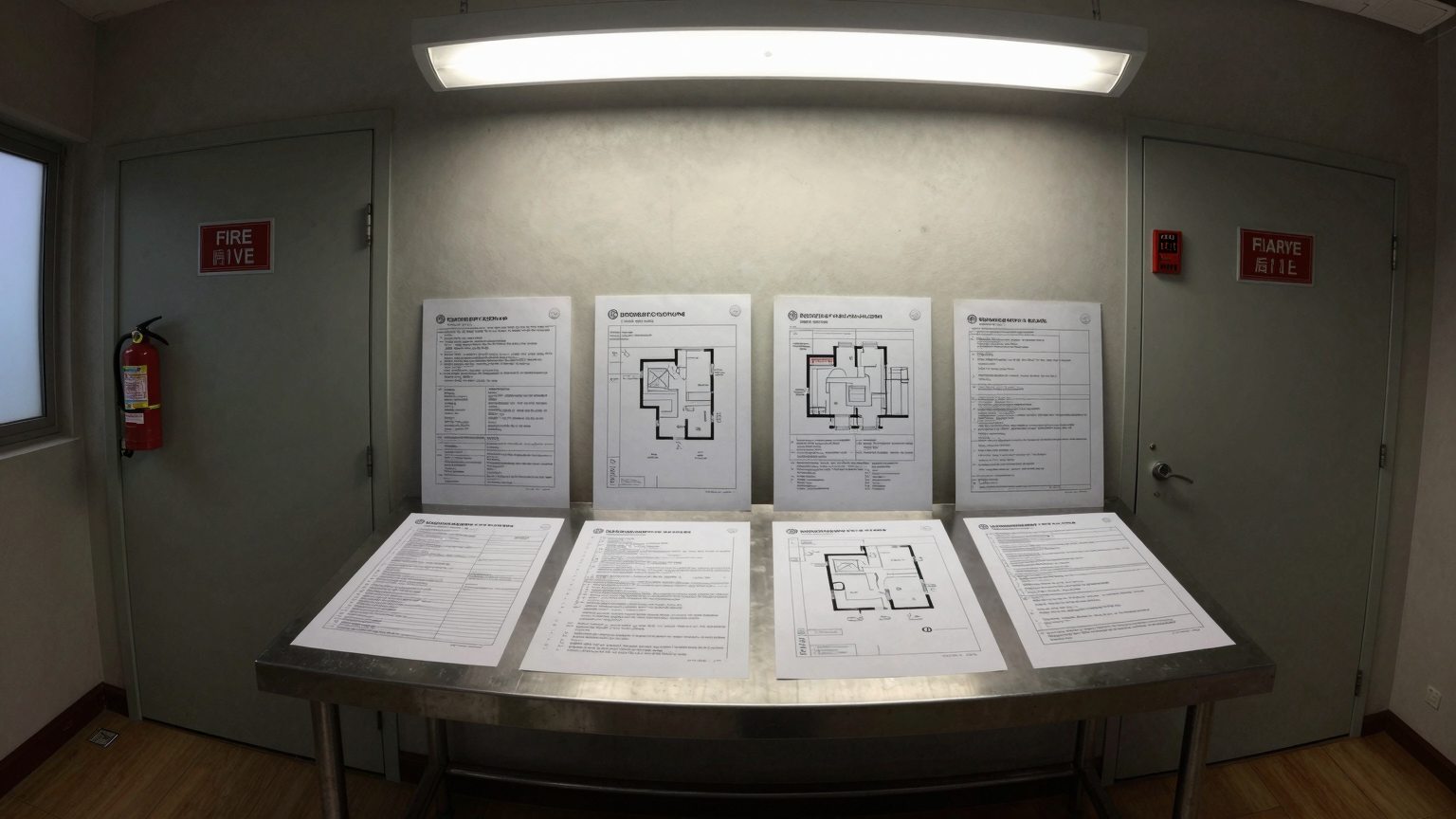

An inspector asks to see the fire safety certificate for the ballroom level, and the events team has already booked a trade fair into that space for next month. The certificate on file covers the building as approved, not the booth layout now being sketched on a laptop. Somebody in the room has to know whether that booking needs a temporary fire permit, a temporary change of use permit, or nothing at all — and whether the answer changes if the fair runs past 60 days.
In hotels and serviced apartments, this is where fire safety works and Temporary Fire Permits stop being a filing question and become a revenue question. The director of portfolio carries the answer, because the events calendar and the compliance calendar are usually kept by two different people.
The person changing the use carries the duty, not the person booking the space
Under the Fire Safety Act 1993 and the Fire Safety (Building and Pipeline Fire Safety) Regulations, any person changing the use of premises must obtain approval from the Singapore Civil Defence Force. In a hotel, that person is often the one signing off the event contract, not the one holding the fire plan. Fire safety works plans must typically be submitted by a qualified person — a registered architect or professional engineer — before the change is implemented, and on completion a fire safety certificate or temporary fire permit must be obtained from SCDF.
That sequence matters for your name on the paperwork. If a function room is reconfigured for an exhibition and nobody submits plans, the breach is not a housekeeping issue. Non-compliance with any fire safety condition results in enforcement action by SCDF, including fines and court prosecution. For a portfolio director, the exposure is not one event — it is every property where the events team and the fire safety file have never been introduced.
What falls due, and who owns it
Before any change of use: plan approval
Under the Fire Safety Act 1993, anyone intending to carry out fire safety works in a building must first obtain approval of plans from SCDF. Fire safety works cover more than most hotel teams assume: installation, addition, alteration, removal or relocation of fire protection systems such as hose reels, fire alarm panels, sprinklers, emergency exit signs and fire doors; changes to the design or layout of spaces that affect escape routes; works affecting fire compartments, including replacement of fire doors; works involving combustible materials, air-conditioning or ventilation systems, or LPG delivery systems for non-residential use; and change of use where the new use affects fire safety requirements.
Plans must be prepared and submitted by a qualified person on behalf of the building owner or occupier, through the CORENET e-Submission System. If the proposal includes an alternative solution to the Fire Code, a fire safety engineer prepares it and a separate peer reviewer assesses it. If the works fall under the Fire Safety (Exemption) Order, plan submission is exempted. If the minor alterations or additions fall within the Schedule at Regulation 4(4) — minor alterations or additions not requiring approval of plans — the works may proceed after MAA lodgement submission. In all other cases, plan approval from SCDF is required before works can begin.
Who owns it: the qualified person submits; the building owner or occupier instructs. In a serviced apartment block, that instruction usually comes from the property manager, which means the portfolio director should be asking who appointed the QP and when.
Fees that land on the project budget
New fire safety works applications cost S$160 for every 100 square metres, or part of 100 square metres, of floor area where the plans contain any prescribed fire safety measure — an area of refuge, automatic fire alarm system, emergency voice communication system, Fire Command Centre, fire lift or fire escape bed lift, fire sprinkler or water mist system, pressurisation system, rising main or breeching inlet, smoke control system, or smoke-free approach to exit staircase or smoke-free lobby. Where the plans contain none of those measures, the fee is S$100 for every 100 square metres or part thereof.
Amendments to approved fire safety works that do not increase floor area cost S$90 per storey. The same S$90 per storey applies to change of use, additions and alterations to existing fire safety works without an increase in floor area, and to new or altered fire protection and mechanical ventilation works involving sprinklers, automatic detection, emergency voice communications or smoke control systems. For a hotel refurbishing guest floors in phases, those per-storey figures are worth putting in front of the finance team before the QP is appointed, not after.
When the change is temporary: the 60-day line
SCDF offers a streamlined process for temporary changes of use. A temporary change of use permit is required if the change is temporary — maximum 60 days — and involves stage shows, promotional activities, exhibitions, trade fairs or carnivals. The TCOUP exempts such events from both plan submission via CORENET and fire safety certificate or temporary fire permit requirements.
That exemption is narrow, and the 60-day ceiling is the line that catches hotel portfolios. Events exceeding 60 days cannot use multiple TCOUP applications and must instead follow the standard process requiring plan submission and an FSC or TFP. A long-stay exhibition in a ballroom, or a seasonal retail activation in a lobby that quietly rolls over, moves from exempt to full submission the moment it crosses that threshold.
The TCOUP covers five categories: stage shows, promotional activities, exhibitions, trade fairs and carnivals. Stage shows are live public performances presented on a stage before an audience. Promotional activities are marketing events designed to increase awareness, attract customers or boost sales. Exhibitions are public displays of objects for educational, cultural or promotional purposes. Trade fairs are commercial events where companies display and sell products, including pasar malams and bazaars. Carnivals are public events or celebrations featuring entertainment, games, food or beverages.
Some events do not need a TCOUP at all. Events held within building areas that already possess a fire safety certificate for such activities — multi-purpose halls, exhibition halls, auditoriums, concert halls and theatres — are exempt. Temporary events relating to religious practice, such as funerals and weddings, conducted at open fields away from buildings or at HDB void decks do not require TCOUP. Fire-based performances in fully open-to-sky areas away from buildings do not require it. Events at fully open-to-sky outdoor locations using only basic setups — a single table, booth, stall or kiosk — without tentage do not require it. Placement of banners or advertisement backdrops does not require a TCOUP, provided they do not obstruct evacuation routes or interfere with ventilation provision.
But if the event setup adversely affects evacuation routes — for example, erecting a mezzanine structure — then both plan submission and an FSC are required. Newly erected, added or altered buildings or multi-storey structures, including those with mezzanines, containers and outdoor refreshment areas, require standard plan submission to SCDF by a QP via CORENET and an FSC or TFP, regardless of duration. A pop-up container bar in a hotel driveway is not a TCOUP event.
Who owns it: the event or venue manager applies for the TCOUP; the fire safety manager confirms the space's existing FSC covers the activity. Where it does not, the QP is back in the process.
Conditions that apply throughout the event
Fire engine accessways and fire engine access roads must remain unobstructed at all times. Open-flame activities, such as the use of blow torches, are prohibited. Booth height must not exceed 3 metres. Each row of booths must not exceed 15 metres in length and 6 metres in width. Clear passageways of at least 1.2 metres must be maintained between booth rows. All escape routes must remain unobstructed at all times. Class 'AB' portable fire extinguishers must be prominently displayed within tentage at 15-metre intervals. Areas that may adversely affect evacuation — such as areas designed using high occupant load factors under the prevailing Fire Code, including indoor car parks and storage areas — are not permitted for events.
These are the conditions an inspector checks on site, and they are the ones a hotel's banquet team can breach without meaning to. A booth row extended by half a metre, a fire engine hardstanding used for valet parking, a passageway narrowed by a registration desk — each is a condition breach, and each is visible from the doorway.
What this means for the portfolio director
The pattern across a hotel or serviced apartment portfolio is consistent. The events team sells the space. The fire safety manager holds the certificate. The QP is appointed late, if at all. The TCOUP is treated as a formality rather than a permit with conditions attached. And the 60-day line is discovered after the event has been extended, not before.
What a regulator, insurer or buyer will ask to see is not the intention to comply. They will ask for the approved plans, the FSC or TFP, the TCOUP where one was required, and the record showing the conditions were met on the day. If those documents sit in three different folders across two departments, the portfolio cannot answer the question quickly — and the director's name is on the answer.
SCDF publishes the plan approval process and the temporary change of use requirements in full, and both are worth reading alongside your own event calendar rather than after an incident. The plan approval guidance sets out the submission requirements, and the temporary change of use page sets out the TCOUP categories and conditions. SCDF also provides fire safety consultations for qualified persons and owners, including free consultation where an applicant cannot ascertain whether plan approval is needed.
Your 60-second self-check
- For every hotel and serviced apartment in your portfolio, could you produce today the current fire safety certificate or temporary fire permit, and say which spaces it covers?
- Does your events calendar flag any booking that runs beyond 60 days, or that involves a newly erected structure, container or outdoor refreshment area?
- Can you name the qualified person appointed for the last change of use in each building, and the date SCDF approved the plans?
If any of those answers requires a phone call, the free 5-minute Director's Risk Check at hermanwa.com/risk-check will reveal the statutory deadlines and penalties that bear on your portfolio, each tied to its official source. It gives you the breach exposure in a form you can take into a board meeting, and you can forward it to a colleague to answer on your behalf.
Herman's verdict
A fire safety certificate is not a document you file and forget. It is a statement about a building as approved, and the moment the furniture moves, the booths go up or the event runs past 60 days, that statement stops being true. The director who knows which spaces are covered, and which bookings need a permit before the contract is signed, is the one who never has to explain the gap afterwards.
— Herman
Until next time — keep the evidence closer than the deadline.
Walk into your next senior management meeting with the answers
The free Director's Risk Check for Singapore portfolios takes five minutes. No sign-up to see your score.
- Your control score across compliance, evidence, oversight, cost and renewals
- The breach exposure in your portfolio, with the official source for each penalty
- A board-ready briefing with your three priorities and a 30/60/90-day plan
About HermanWa
HermanWa is a building compliance and operations platform for property and facilities teams in the United Kingdom and Singapore, with portfolios across the Gulf. It keeps one auditable file per building — statutory deadlines, inspection evidence, contractor work, energy and carbon — and its AI assistant, Herman, answers questions about your buildings in plain English. HermanWa tracks obligations including fire risk assessments and fire door checks, Building Safety Act duties, Legionella (ACOP L8), EICR, gas safety and EPC in the UK, and SCDF fire certificates, Periodic Facade and Structural Inspections, lift permits and Green Mark in Singapore. Directors can check their exposure with the free Director's Risk Check.