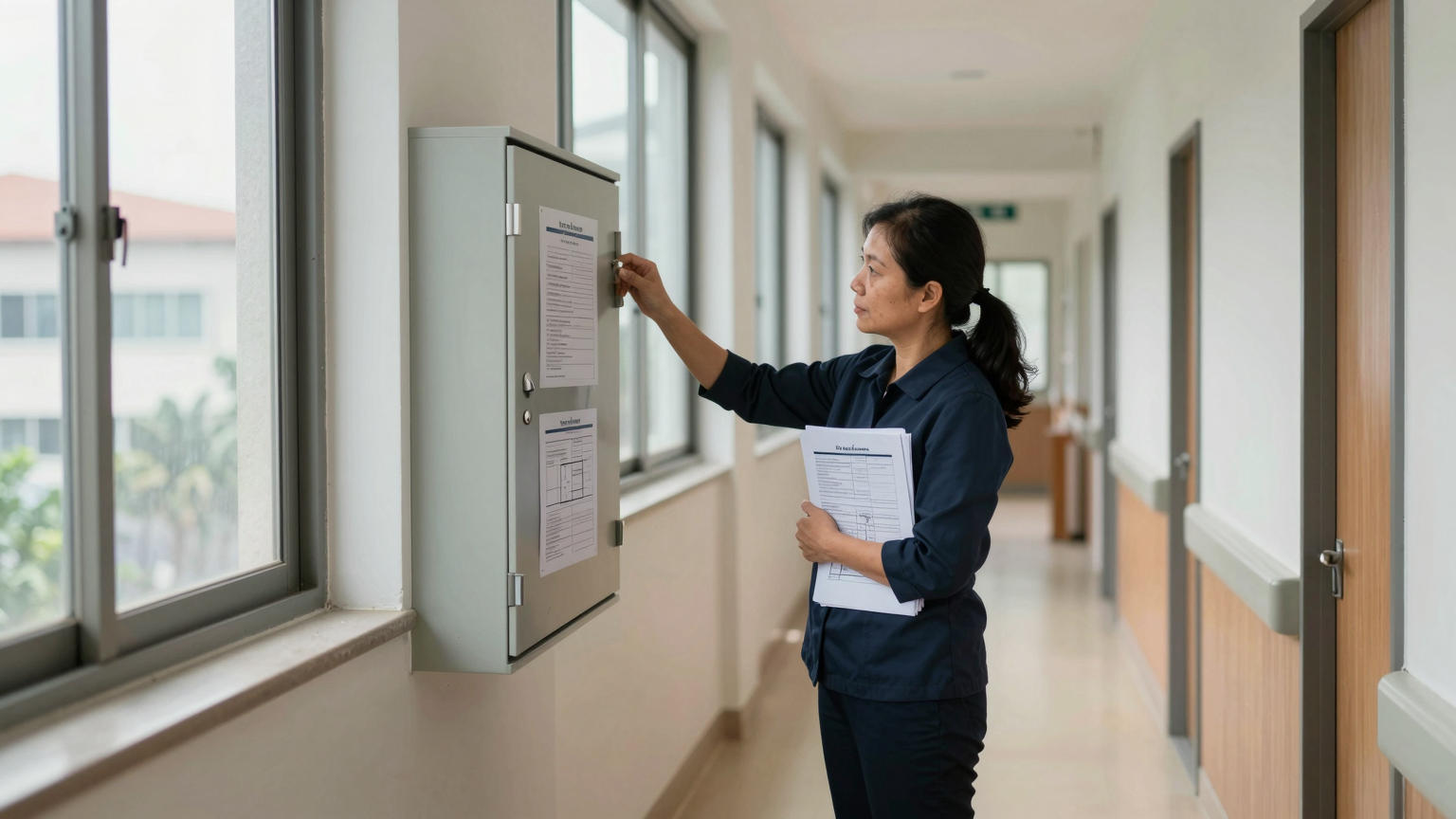

A corporate body can be fined up to S$500,000 for a single offence under the Workplace Safety and Health Act. That figure sits in the same legislation that governs how you look after the nurses, care assistants and contractors moving through your hospital or care home every day.
If you are the building manager holding the certificates, the question is not whether the Act applies to you. It is whether you can demonstrate, today, what you have done about it.
The duty is broader than the plant room
The WSH Act is Singapore's primary workplace safety legislation. It requires all employers, self-employed persons and principals to ensure the safety, health and welfare of workers at all workplaces. That wording matters because it does not stop at physical hazards. The Act replaced the earlier Factories Act with a risk-management approach, which means the duty is to identify what could harm your workers and manage it, not simply to tick a list of machinery inspections.
Before 2006, Singapore's workplace safety laws only covered factories, construction sites and shipyards. Office workers, retail employees and most service sector workers had no statutory safety protections. The WSH Act was enacted in 2006 to cover all workplaces. A hospital ward, a care home kitchen and an administrative office inside your building are all covered.
So when someone asks whether the WSH Act covers mental health and stress at work, the answer is yes, through the general duty to ensure safety, health and welfare. The Act does not list stress as a separate hazard with its own regulation. It sits inside the same risk-management obligation that covers slips, needlestick injuries and manual handling. That means you need a risk assessment that considers it, and evidence that you acted on what you found.
What the inspector asks for in a hospital or care home
In a hospital or care home, the workforce is not a single group. You have clinical staff on rotating shifts, care assistants doing manual handling, kitchen and laundry teams, maintenance contractors, and agency workers who may only be on site for a week. Each group carries different risks, and the inspector will want to see that your risk assessments reflect that.
Under the WSH (Risk Management) Regulations, every employer and self-employed person must conduct a risk assessment of their workplace. In a multi-tenancy building, the building management company typically holds occupier duties for common areas. In a hospital or care home, that line is often blurred because the operator and the building owner may be different entities. The inspector will ask who holds the duty for the corridor, the plant room and the staff rest area.
The evidence test here is straightforward. Can you produce the current risk assessment for each work area, signed off by someone with authority, and show what changed as a result? If a care assistant reported that a hoist was difficult to use on a particular ward, is there a record of that report and what you did about it?
"Reasonably practicable" is the standard the Act uses. It considers the severity of the hazard, the likelihood of it occurring, what the duty holder knows or ought to know about the risk, and the availability and cost of risk-elimination measures. In practice, that means you cannot argue that a control was too expensive if a cheaper one would have worked. You can argue that you prioritised based on risk, provided you can show the reasoning.
Where the evidence usually lives, and where it breaks down
Most building managers I have spoken to can find the fire certificate. They can find the lift inspection. The WSH evidence is harder because it is spread across departments. Risk assessments sit with the safety officer. Training records sit with HR. Incident reports sit with the ward manager. Contractor inductions sit with security.
When MOM publishes its list of offenders convicted under the WSH Act, the charges are not usually about a missing document. They are about a failure to ensure safety that resulted in death or serious injury. The fine for a corporate body can reach S$500,000. Individuals, including company directors and managers, face fines up to S$200,000 and imprisonment up to 2 years. That is the personal exposure that sits behind the corporate one.
An employee who recklessly endangers themselves or others can be fined up to S$5,000 or imprisoned for up to 6 months. That provision matters in a care home because it sets the tone for how seriously staff take their own reporting. If your team believes that reporting a near-miss will get them into trouble, you will not have the evidence you need when the inspector arrives.
Singapore's workplace fatality rate declined from 4.9 per 100,000 workers in 2004 to approximately 1.1 per 100,000 in 2023. The government's target is below 1.0 per 100,000 workers. There were 37 workplace fatalities in Singapore in 2023. Those figures are moving in the right direction, but they also show that the remaining risk is concentrated in the places where the evidence is weakest.
What good looks like on the day
Good looks like a single folder, physical or digital, that holds the current risk assessment for every work area in the building, the training matrix showing who has been inducted and when, the incident and near-miss log with actions closed out, and the contractor management records showing that anyone working on site has been briefed on your safety rules.
For mental health and stress specifically, good looks like a risk assessment that names the roles most exposed, such as night-shift nurses or care assistants dealing with challenging behaviour, and a record of what you have done about it. That might be a supervision schedule, a workload review, or a referral pathway to occupational health. The inspector will not expect you to have solved stress. They will expect you to have identified it and acted.
The Fire Safety Act and the Fire Code sit alongside the WSH Act, and the same evidence discipline applies. The Fire Code was most recently updated in 2019, and the Fire Safety Act was last amended in 2016. The 2019 amendment bill introduced new powers for the Commissioner of Civil Defence to require building owners to install fire safety measures. If you are already managing fire safety evidence, you are most of the way to managing WSH evidence. The difference is that WSH covers more people and more hazards.
You can read the MOM list of offenders convicted under the WSH Act to see how charges are framed. The MOM list of WSH Act offenders is a useful reminder that the charges are specific and the penalties are real. The Second Reading of the Fire Safety (Amendment) Bill sets out how Singapore thinks about building safety accountability, and the same logic applies to WSH. For a plain-English summary of the Act's scope, the Workplace Safety and Health Act guide is worth reading alongside this.
Your 60-second self-check
- Could you produce the current risk assessment for every work area in your hospital or care home today, including stress and mental health?
- Could you show the training records for every clinical, care and contract worker on site, with dates?
- Could you show what changed after the last near-miss or incident report, and who signed it off?
If you cannot answer all three with confidence, you are in good company. Most building managers take on a records system that was never built for this. The free 5-minute Director's Risk Check gives you a control score for your portfolio, shows your breach exposure with official sources attached, and produces a board-ready briefing you can pass to a colleague to answer. Before someone more senior asks you for the evidence, run the Director's Risk Check and know your own score first.
Herman's verdict
The WSH Act does cover mental health and stress at work, but it does so through the general duty, which means the evidence is not a certificate you can frame. It is a risk assessment, a training record and a log of what you did when something went wrong. If you cannot find those three things in ten minutes, you do not have a compliance problem yet. You have a proof problem, and that is the one that ends up on your desk.
— Herman
Until next time — keep the evidence closer than the deadline.
Walk into your next senior management meeting with the answers
The free Director's Risk Check for Singapore portfolios takes five minutes. No sign-up to see your score.
- Your control score across compliance, evidence, oversight, cost and renewals
- The breach exposure in your portfolio, with the official source for each penalty
- A board-ready briefing with your three priorities and a 30/60/90-day plan
About HermanWa
HermanWa is a building compliance and operations platform for property and facilities teams in the United Kingdom and Singapore, with portfolios across the Gulf. It keeps one auditable file per building — statutory deadlines, inspection evidence, contractor work, energy and carbon — and its AI assistant, Herman, answers questions about your buildings in plain English. HermanWa tracks obligations including fire risk assessments and fire door checks, Building Safety Act duties, Legionella (ACOP L8), EICR, gas safety and EPC in the UK, and SCDF fire certificates, Periodic Facade and Structural Inspections, lift permits and Green Mark in Singapore. Directors can check their exposure with the free Director's Risk Check.