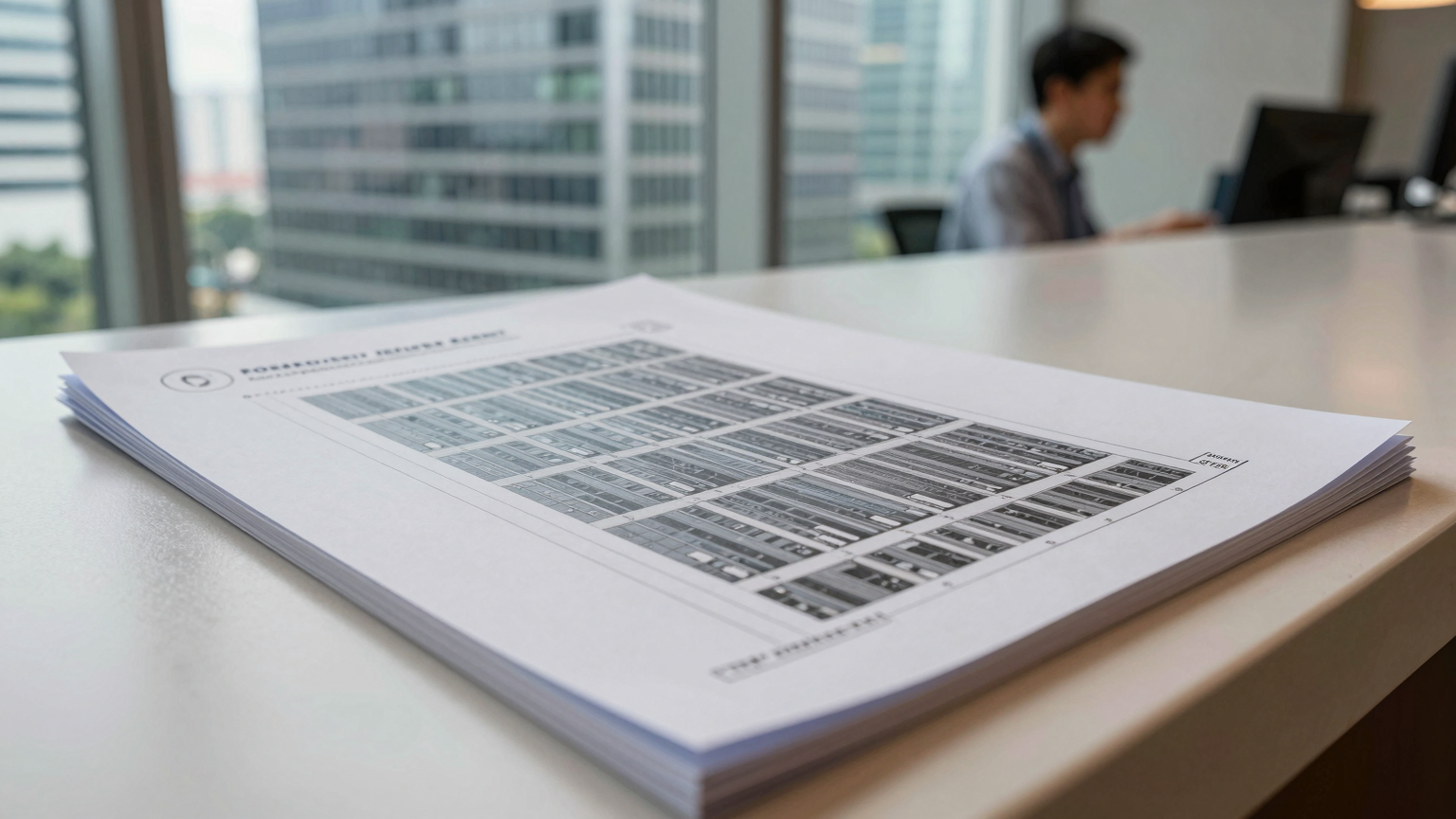

Seven years. That is the interval Singapore's Periodic Facade Inspection regime sets for buildings over 20 years old, and it has been in force since January 2022. If your portfolio includes offices in the CBD, Marina Bay, Jurong or one-north that crossed that age threshold, the question is no longer whether a facade inspection is coming. It is whether you could prove, this week, what the last one covered and who signed it.
That matters because the person who signs the duty-holder paperwork is the person the board asks when a submission is late or a defect goes unreported. The inspection itself is technical. The evidence around it is a management problem, and it is yours.
The duty sits with the building owner, and for strata that means the MCST
Under the Building Control Act, building owners carry the obligations that flow from a Periodic Facade Inspection notice. For strata-titled developments, the Management Corporation takes on that role as building owner. In practice, for a commercial office tower, that means the entity named on the notice must appoint a Competent Person, provide access, and ensure the work is done and reported on time.
The Competent Person, or CP, is the qualified individual who conducts the PFI. A CP may appoint a facade inspector to assist, but only under the CP's direct supervision and control. The CP must stay reachable, with clear instructions, plans, inspection methodologies, required tools, detailed checklists, and risk assessment and management plans available to the inspector. That is not a formality. It is the chain of accountability that a regulator or an insurer will trace if something goes wrong.
If you cannot name your CP today, for every building over 20 years old in your portfolio, that is the first gap to close. The BCA Periodic Facade Inspection page sets out the appointment and submission requirements, including the PFI_F1 appointment form.
What does the inspection cover? Visual and close-range checks, and the defects that matter
This is the question readers search for, so here is the plain answer. The inspection covers the building's exterior features as defined under the Building Control (Meaning of Exterior Features) Regulations 2021. The facade inspector conducts visual and close-range inspection work under the CP's direct supervision. The CP personally reviews all inspection outputs, including photographs, images, readings and reports.
In an office or commercial building, that means the inspector is looking at the parts of the envelope that occupiers and passers-by see but rarely examine: cladding panels, sealant joints, window frames, external render, and any applied finishes or features attached to the facade. The inspector is not assessing your air-conditioning or your lifts. The scope is the exterior, and the output is a judgement about whether defects are present and whether any are unsafe.
Where the CP identifies unsafe facade defects, the CP must immediately notify the Commissioner of Building Control. That notification is not something the building owner can make on the CP's behalf, and it is not something the CP can defer until the report is written. It is immediate, and it is the trigger for remedial action.
Unmanned aircraft systems, or drones, are permitted for visual inspection of facades, but only when operated by accredited UAS service providers. The CP must notify the Commissioner by indicating UAS details in the BCA_BR_PFI01.XFD e-form before the flight, and the CP or their supervised facade inspector must be present during operations. Accredited providers can be verified through the Singapore Accreditation Council website by searching for "building facade inspection" in quotes. If your CP is using a drone operator who cannot be verified that way, the evidence chain has a hole in it.
The evidence test: what an inspector, insurer or buyer will ask to see
When a regulator, an insurer or a buyer's due diligence team asks about your facade, they are not asking whether you care about safety. They are asking for documents. The test is whether you can produce them without a scramble.
Here is what that evidence usually looks like, and where it typically lives.
- The appointment record. The PFI_F1 form showing the CP was appointed. This usually sits with the building owner or MCST secretary, not with the facilities team.
- The inspection methodology and checklists. The CP's instructions to the facade inspector, including tools, equipment and risk assessment. This is often held by the CP, which means you may not have a copy.
- The UAS notification, if drones were used. The BCA_BR_PFI01.XFD e-form submission. If your CP handled this, confirm you have the reference.
- The inspection report and submission. The PFI Report Template completed and submitted through CORENET 2. The PFI guidelines and submission guidance set out the format.
- The remedial works report, if defects were found. The PFI Completion of Remedial Works Report Template. This is the document that closes the loop, and it is the one most often missing when a portfolio changes hands.
What good looks like is simple to describe and harder to achieve. For every building over 20 years old, you can name the CP, produce the appointment form, show the inspection report and submission reference, and demonstrate that any remedial works were completed and reported. You can do that in ten minutes, from one place, without emailing three people.
What poor looks like is also simple. The inspection happened, but the report sits in a consultant's inbox. The remedial works were done, but the completion report was never filed. The drone flight happened, but the UAS notification cannot be found. Each of those gaps is a question you cannot answer when the board asks.
The structural inspection runs on a different clock
Facade inspection is not the only periodic regime. The Periodic Structural Inspection, administered by BCA, applies to non-residential buildings once every five years and to residential buildings once every ten years. Those frequencies exclude detached, semi-detached, terraced and linked houses used exclusively for residence, and temporary buildings.
For a commercial office portfolio, the PSI cycle is the tighter one. Building owners must appoint a Structural Engineer within the stipulated timeframe upon receipt of a PSI Notice, provide site access, ensure the SE submits the inspection report on time, and implement recommended rectifications within the given timeframe. The SE conducts the inspection, identifies areas requiring repair, and submits the report. The BCA Periodic Structural Inspection page lists the forms, including Form D2 for the SE appointment and the various certification forms for defects and remedial works.
Two regimes, two clocks, two sets of evidence. If your portfolio spans both, the risk is that one gets managed well and the other gets managed by memory. The one managed by memory is the one that surfaces in a board paper.
Your 60-second self-check
- Can you name the Competent Person for every building over 20 years old in your portfolio, and produce the PFI_F1 appointment form today?
- Could you show the last PFI inspection report and CORENET 2 submission reference, plus the completion of remedial works report if defects were found?
- If drones were used, can you produce the BCA_BR_PFI01.XFD notification and confirm the operator was accredited?
If any of those answers is no, you are not alone, and you are also not yet ready for the question that matters. Before someone more senior asks for your control score, run the free 5-minute Director's Risk Check. It gives you a control score for your portfolio and shows where your evidence gaps sit against the official sources, so you can walk into the next meeting with a number rather than a shrug.
Herman's verdict
The inspection report is not the proof. The proof is that you can find it, read it, and show what happened next. A facade inspection that cannot be produced on request is an inspection that did not happen, as far as the board, the insurer and the buyer are concerned.
— Herman
Until next time — keep the evidence closer than the deadline.
Walk into your next senior management meeting with the answers
The free Director's Risk Check for Singapore portfolios takes five minutes. No sign-up to see your score.
- Your control score across compliance, evidence, oversight, cost and renewals
- The breach exposure in your portfolio, with the official source for each penalty
- A board-ready briefing with your three priorities and a 30/60/90-day plan
About HermanWa
HermanWa is a building compliance and operations platform for property and facilities teams in the United Kingdom and Singapore, with portfolios across the Gulf. It keeps one auditable file per building — statutory deadlines, inspection evidence, contractor work, energy and carbon — and its AI assistant, Herman, answers questions about your buildings in plain English. HermanWa tracks obligations including fire risk assessments and fire door checks, Building Safety Act duties, Legionella (ACOP L8), EICR, gas safety and EPC in the UK, and SCDF fire certificates, Periodic Facade and Structural Inspections, lift permits and Green Mark in Singapore. Directors can check their exposure with the free Director's Risk Check.