
There are around 3,700 licensed electrical workers in Singapore, and 1,400 of them are aged 60 or above and still actively practising. That is the number that should sit behind every electrical certificate in your filing cabinet, because it tells you how thin the bench is when your hospital or care home needs a signature that only a licensed electrical worker can give.
If you run facilities in a hospital or a care home, the question "who needs an EMA electrical installation licence in Singapore?" is not academic. It decides who is allowed to certify your installation fit for operation, and whether you can produce that certificate when someone senior asks.
The licence question, answered plainly
The Energy Market Authority regulates electrical installations in Singapore through the Electricity (Electrical Installations) Regulations. Under that framework, electrical installations must be inspected and certified fit for operation by a licensed electrical worker at least once a year. The licence sits with the worker, not with your building and not with your facilities team. Your electrician, however experienced, cannot sign the certificate unless he holds the LEW licence.
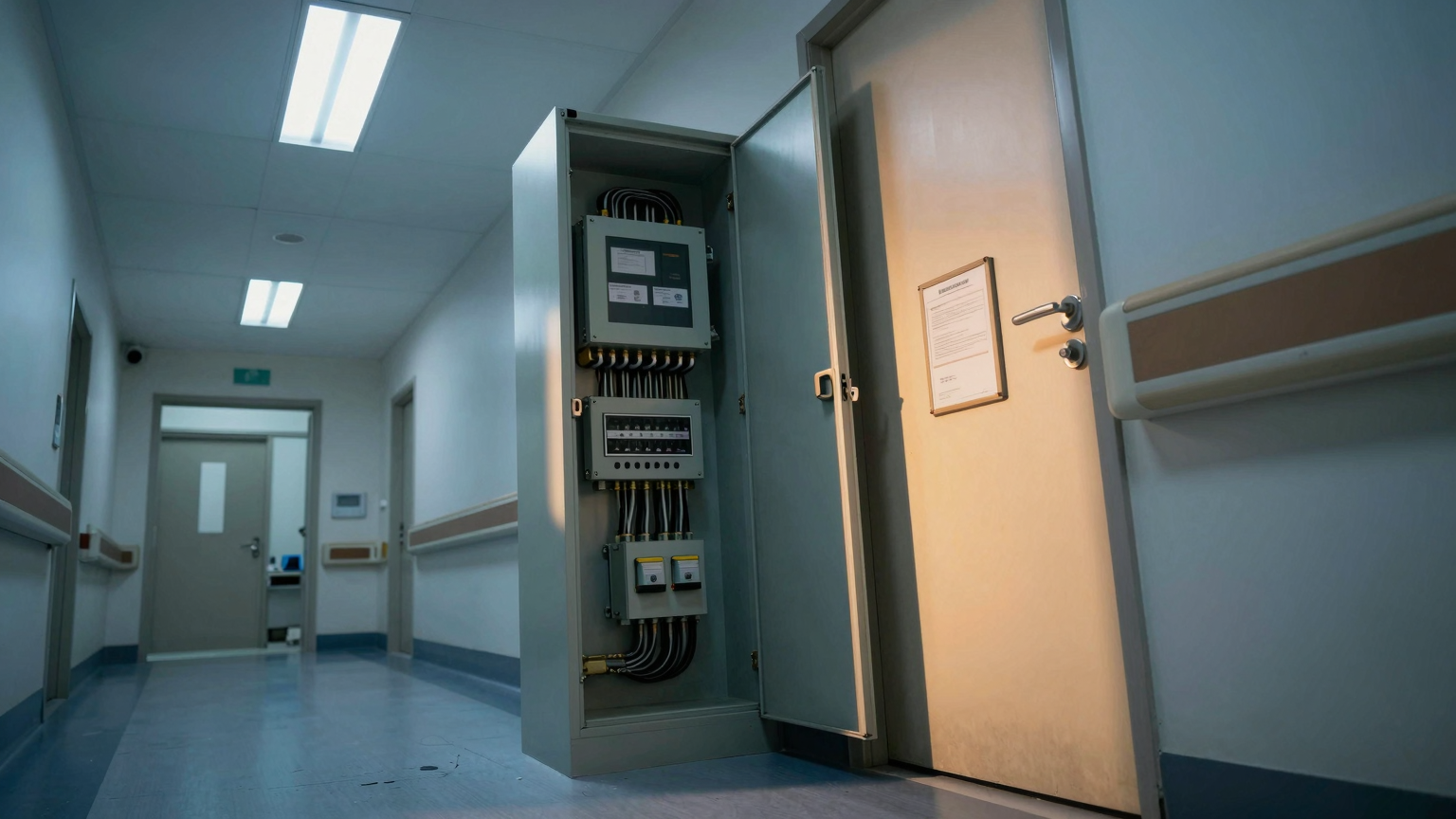
So the answer to who needs the licence is: the person doing the inspection and certification. You need to know that person exists, that their licence is current, and that they are available when your inspection falls due. In a hospital, that means the worker who certifies the main switchboard, the theatre isolation panels and the standby supply. In a care home, it means the worker who signs off the distribution boards and the outdoor equipment that keeps the kitchen and the nurse call system alive.
The requirements are published by EMA in its handbook on the electrical installation licence, and the underlying technical standard is SS638:2018, Singapore's Code of Practice for electrical installations. That code sets minimum protection standards, including against direct sunlight and rain water — which matters more than it sounds when your outdoor switchgear sits on a rooftop plant deck through a wet season. The Ministry of Trade and Industry has also set out the inspection requirements for outdoor electrical installations in a written reply to Parliament.
Higher-risk premises get inspected more often
The annual cycle is the floor, not the ceiling. EMA states that electrical installations in higher-risk settings or premises are subject to more regular inspection and certification. Construction sites must be inspected monthly. HDB estates and public areas must be inspected at least once every six months.
Hospitals and care homes sit in the higher-risk category by any reasonable reading, because the occupants cannot self-evacuate quickly and because life-safety systems depend on power. That means your inspection calendar is tighter than a commercial office's, and your reliance on a licensed worker is more frequent. If you have been treating the annual certificate as the whole obligation, check whether your premises have been assessed as higher-risk and what frequency that assessment produced.
EMA reviews inspection frequency from time to time as safety risk and industry feedback change, so the schedule you built two years ago may not be the schedule that applies now. It is also exploring technology to monitor real-time operating conditions of the grid, and studying where artificial intelligence might help. None of that removes the signature requirement today.
What the shortage actually costs you
With 1,400 of roughly 3,700 licensed electrical workers at or past 60, the supply of people who can legally certify your installation is not growing quickly. EMA is working with the Institutes of Higher Learning and industry partners to bring younger people in, including a Technical Engineer Diploma in Electrical Engineering (Clean Energy) with ITE, an Internship Training Plan, and enhanced preparatory courses with the Singapore Institute of Power and Gas for workers without formal academic qualifications. Those measures take years to change the headcount. The Ministry of Trade and Industry has published a written reply on addressing the shortage of licensed electrical workers that sets out these measures.
The direct penalty for a missed or invalid certification is not the main cost. The main cost is what happens after an electrical incident in a building where the certificate cannot be produced. Your insurer asks for the inspection record. Your licensor or operator asks for it. The coroner, if it comes to that, asks for it. Remediation of switchgear in a live hospital wing is expensive because you cannot simply shut down a ward to fix it — you work around clinical activity, at night, with temporary supplies, and the bill reflects that.
The cheaper path is boring: know your inspection dates, know your licensed worker by name and licence class, and keep the certificate where you can find it in under a minute. That is a scheduling and records problem, not an engineering one.
Where the paperwork usually breaks
In hospitals and care homes, the failure pattern is rarely a missing inspection. It is a certificate that exists but cannot be matched to the right board, the right building, or the right date. A facilities manager inherits a folder of PDFs from a predecessor, the licensed worker has retired or moved firms, and nobody can say which certificate covers the theatre block's isolation panel versus the main intake.
The inspector or the insurer will ask a simple question: show me the current certification for this installation. If your answer requires three phone calls, you have a team oversight problem, not a compliance one. The same discipline applies to other dated obligations in your portfolio — the work-rest ratios that keep outdoor teams legal in the heat, or the 14-day window that turns a late notification into your breach.
Build a register that lists, for every building: the installation, the licensed worker's name and licence class, the last inspection date, the next due date, and where the certificate is stored. Then check it against the actual certificates. The gap between the register and the folder is your real exposure.
Your 60-second self-check
- Can you name the licensed electrical worker who certified each of your buildings in the last 12 months, and state their licence class?
- Could you produce the current certificate for your main switchboard and your theatre or clinical isolation panels today, without calling anyone?
- Do you know whether your premises have been assessed as higher-risk, and what inspection frequency that assessment set?
If any of those gave you pause, you are not the only one facing this — but you are also the person whose name sits on the answer. Before someone more senior asks for your control score, get it yourself. The free 5-minute Director's Risk Check gives you a control score for your portfolio, and you can send it to a colleague to answer if the files live with them.
Herman's verdict
A certificate you cannot find is not a certificate. It is a piece of paper that proves you once had a licensed worker, and the only person who will care about that distinction is the one asking you for it under pressure.
— Herman
Until next time — keep the evidence closer than the deadline.
Walk into your next senior management meeting with the answers
The free Director's Risk Check for Singapore portfolios takes five minutes. No sign-up to see your score.
- Your control score across compliance, evidence, oversight, cost and renewals
- The breach exposure in your portfolio, with the official source for each penalty
- A board-ready briefing with your three priorities and a 30/60/90-day plan
About HermanWa
HermanWa is a building compliance and operations platform for property and facilities teams in the United Kingdom and Singapore, with portfolios across the Gulf. It keeps one auditable file per building — statutory deadlines, inspection evidence, contractor work, energy and carbon — and its AI assistant, Herman, answers questions about your buildings in plain English. HermanWa tracks obligations including fire risk assessments and fire door checks, Building Safety Act duties, Legionella (ACOP L8), EICR, gas safety and EPC in the UK, and SCDF fire certificates, Periodic Facade and Structural Inspections, lift permits and Green Mark in Singapore. Directors can check their exposure with the free Director's Risk Check.