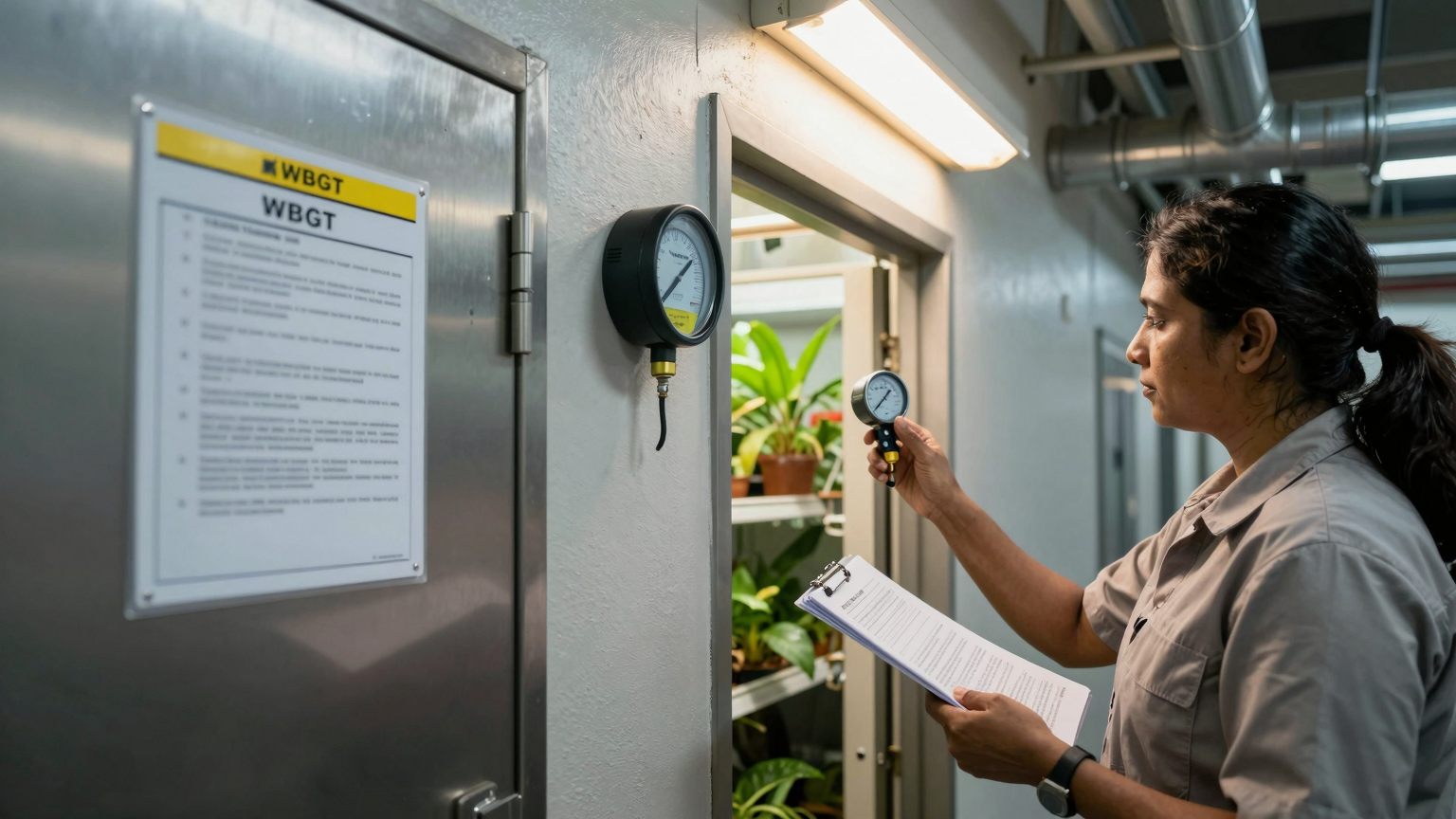

From 1 December 2026, if your maintenance team is on the roof at Marina Bay or in the car park at Jurong, you must monitor Wet Bulb Globe Temperature hourly during work hours. When WBGT reaches 33°C or higher, MOM encourages at least 15 minutes of rest every hour under shade. The director's name sits on the breach when a worker collapses and the logbook is blank.
That is the deadline that bites. Not a fine you can absorb, but a duty you now hold in writing.
The stakes: who owns the work-rest ratio
Under the Workplace Safety and Health Act and its regulations, employers must minimise the risk of heat stress. The WSH Council's guidelines include a 14-day heat acclimatisation programme in the first two weeks of employment and adequate work-rest cycles. In a hotel or serviced apartment, the people most exposed are not your front desk. They are the technicians on the cooling tower, the pool plant room, the bin centre, and the loading bay. They work alone or in pairs, on shifts that start before the heat builds.
When a heat injury happens, the inspector asks for the WBGT log, the rest schedule, and the acclimatisation record. If you cannot produce them, the question moves from the worker's health to your oversight.
How do I calculate the work-rest ratio for heat stress management?
The calculation starts with measurement, not arithmetic. You cannot set a ratio from a weather app. You need the WBGT at the work site, taken hourly during work hours. MOM's enhanced requirements, effective 1 December 2026, make that monitoring mandatory for outdoor work.
Once you have the reading, the ratio follows a simple rule from the Source Facts: when WBGT reaches 33°C or higher, provide at least 15 minutes of rest every hour under shade. That is the floor, not the ceiling. For heavier work, or for workers still inside their first two weeks, the rest period should be longer. The WSH Council guidelines call for adequate work-rest cycles, which means you set them by task intensity and by the individual's acclimatisation status.
So the practical calculation is this: measure WBGT hourly, compare it to 33°C, and if it meets or exceeds that threshold, schedule 15 minutes of shaded rest per hour. Then adjust upward for strenuous tasks and for new workers. Document the reading, the rest taken, and who supervised it.
If you want to see how your current records would stand up to that test, the Director's Risk Check takes five minutes and gives you a control score for your portfolio.
What falls due, and when
Heat stress obligations do not arrive all at once. They cluster around the hot season and around the employment cycle. Here is the run-down by frequency, with who owns each one.
Daily, during outdoor work
- Hourly WBGT monitoring. The facilities manager or the shift supervisor owns this. The reading goes in the log, not in a WhatsApp message that disappears.
- Shaded rest at 33°C or above. At least 15 minutes per hour. The team leader on site owns this, but the facilities manager owns the schedule that makes it possible.
- Drinking water access. The WSH Council guidelines require access to drinking facilities throughout the day. The facilities manager checks that the water point on the roof is working before the shift starts.
First two weeks of employment
- 14-day heat acclimatisation programme. New maintenance hires, including contract staff, need this. The HR lead and the facilities manager share ownership. If a new technician is on the roof in week one without it, that is a gap the inspector will find.
Before the hot season, March to May
- Refresh the heat plan. The Mercury Task Force agencies refresh their plans ahead of every hot season, as set out in the Written Reply to Parliamentary Question on Mercury Task Force to Tackle Heatwave. Your site should do the same. The facilities manager reviews the rest schedule, checks the shade structures, and confirms the WBGT device is calibrated.
- Check the haze supply. Businesses with outdoor operations should maintain at least a one-week supply of N95 masks, per MTI's FAQ. The facilities manager owns this, and it sits alongside the heat plan because both affect the same people.
When the haze arrives
- Monitor 24-hour PSI. If it reaches the unhealthy range (PSI above 100), employers are encouraged to reduce prolonged or strenuous work for healthy employees. The facilities manager checks NEA's Haze Microsite or NEA's corporate website for the readings.
- Apply the tripartite advisory. The guidelines for employers on protecting employees from the effect of haze set out what to do. The director owns the decision to reduce outdoor work, but the facilities manager supplies the PSI reading that triggers it.
When a heatwave is declared
- Activate the response plan. A heatwave is declared when the daily maximum temperature averaged across all weather stations is at least 35°C for three consecutive days, and the average daily mean temperature throughout the period is at least 29°C. The Mercury Task Force coordinates the national plan, which includes cooling centres islandwide. Your site plan should mirror that: identify the nearest cooling room, and make sure the team knows where it is.
The paperwork that proves you did it
An inspector or an insurer will not ask whether you care about your team. They will ask for the WBGT log, the rest schedule, the acclimatisation record, and the N95 stock count. If those documents live in different places, or if the log has gaps on the hottest days, the oversight question answers itself.
I have seen maintenance teams do the right thing on the roof and fail the paper test in the office. The work-rest ratio is only as good as the record that shows you applied it. If your predictive maintenance software is already promising more than it delivers, the same discipline applies here: the tool does not replace the log. For more on that pattern, see why most facilities teams see 8% rather than 40%.
Your 60-second self-check
- Could you produce today's WBGT readings for every outdoor work site in your portfolio?
- Does every new maintenance hire have a completed 14-day acclimatisation record?
- Is there at least a one-week supply of N95 masks on site, and does the team know where they are kept?
If those three questions leave you hesitating, plenty of facilities leaders are in the same position. The free 5-minute Director's Risk Check gives you a control score for your portfolio and a board-ready briefing you can hand to a colleague to answer. Walk into your next senior management meeting with answers rather than follow-ups. Start here: Director's Risk Check for Singapore portfolios.
Herman's verdict
The work-rest ratio is not a formula you keep in your head. It is a logbook you can hand to an inspector on the worst day of the year. If the log is blank, the ratio never existed.
— Herman
Until next time — keep the evidence closer than the deadline.
Walk into your next senior management meeting with the answers
The free Director's Risk Check for Singapore portfolios takes five minutes. No sign-up to see your score.
- Your control score across compliance, evidence, oversight, cost and renewals
- The breach exposure in your portfolio, with the official source for each penalty
- A board-ready briefing with your three priorities and a 30/60/90-day plan
About HermanWa
HermanWa is a building compliance and operations platform for property and facilities teams in the United Kingdom and Singapore, with portfolios across the Gulf. It keeps one auditable file per building — statutory deadlines, inspection evidence, contractor work, energy and carbon — and its AI assistant, Herman, answers questions about your buildings in plain English. HermanWa tracks obligations including fire risk assessments and fire door checks, Building Safety Act duties, Legionella (ACOP L8), EICR, gas safety and EPC in the UK, and SCDF fire certificates, Periodic Facade and Structural Inspections, lift permits and Green Mark in Singapore. Directors can check their exposure with the free Director's Risk Check.