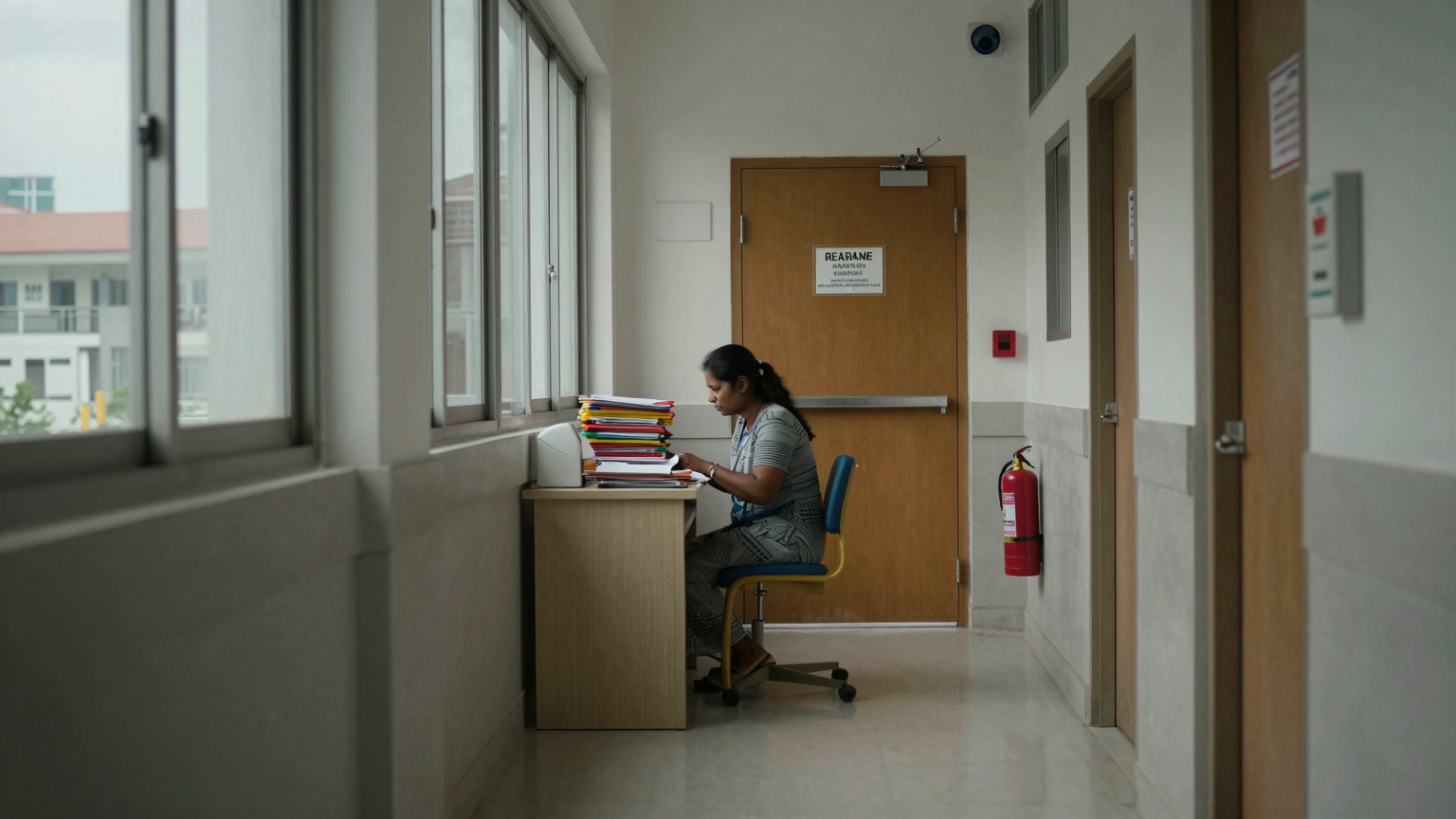

An SCDF officer asks for the Fire Safety Manager's appointment record for a hospital in your portfolio. Not the fire certificate. Not the last drill report. The eFSM portal entry that proves a certified FSM was appointed, and that the appointment is still live. You know the building has a fire safety manager. You are less sure who signed the termination when the last one left, or whether the replacement went in within the window SCDF allows.
That gap is where the enforcement sits. The owner or occupier of specified premises is liable, on conviction for failing to appoint an FSM through the eFSM portal, to a fine not exceeding S$10,000, imprisonment for a term not exceeding six months, or both. For a portfolio manager answering across many buildings, the question is not whether your hospitals have an FSM. It is whether you can prove it, today, for every one of them.
The stakes: who holds the duty, and what it costs when it slips
The Fire Safety (Fire Safety Manager) Regulations 1994 made it mandatory for owners of designated buildings to appoint FSMs. The amended regulations were gazetted on 13 April 2007. The appointment obligation rests with the owner or occupier, not the FSM. The FSM carries out the duties under Regulation 7 of the Fire Safety (Fire Safety Managers) Regulations, but the appointment obligation, and the penalty for missing it, belongs to the party that answers for the building.
For a portfolio manager, that means the exposure is yours to report, even when the operational work sits with a site team. A missed appointment is not a site-level lapse. It is a compliance breach with a named liable party.
Do all businesses in Singapore need a Fire Safety Manager? No — but hospitals always do
The short answer is no. The FSM requirement applies to designated buildings, not to every business. A small office, a retail unit below the thresholds, a workshop that does not meet the criteria — none of these need an FSM under the scheme.
But the thresholds are where portfolios get caught. A public building requires an FSM if it has 9 storeys or more, including any basement. It also requires one if it has an occupant load of 1,000 persons or more, or a floor area of 5,000 square metres or more. An industrial building requires an FSM if it has an occupant load of 1,000 persons or more, or a floor area or site area of 5,000 square metres or more. A foreign employee dormitory follows the same occupant load and floor area thresholds.
And then there is the category that does not need a threshold at all. A hospital requires an FSM. Full stop. That is the line that matters for anyone running hospitals and care homes in Singapore. You do not get to argue that a facility is small, or that the occupant load is modest, or that the floor area sits under 5,000 square metres. If it is a hospital, the appointment is mandatory.
Care homes sit in a different position. The Source Facts do not list care homes as a standalone category, so the test for a care home is whether it meets the public building thresholds or falls under another designated category. That is a question to settle building by building, not to assume. The SCDF Fire Safety Manager page sets out the categories and thresholds in full.
What the inspector actually checks, and where portfolios fail
When SCDF looks at FSM compliance, it is not only asking whether a name is on a form. It is asking whether the appointment was made through the eFSM portal, whether the person is certified, and whether the certification is current.
Since 13 April 2007, all qualified FSMs holding the relevant qualification need to register with SCDF through the e-FSM Portal to be certified. FSMs that are not certified are not allowed to practise or be appointed as FSM by building owners or occupiers. So an appointment to an uncertified person is not a valid appointment, even if the person is competent and on site every day.
There are two timing rules that catch portfolio managers who inherit a building mid-cycle. Owners of new premises have to appoint an FSM within 90 days of obtaining a certificate of statutory completion or a temporary occupation permit. And a new FSM must be appointed within 14 days if an FSM's appointment is terminated. Fourteen days is not long. If a hospital FSM resigns and the replacement is identified but not yet registered on the portal, the clock is running.
Then there is continuing professional development. FSMs are to accumulate a minimum of 30 points within the 3-year cycle to remain a Certified FSM. Senior FSMs require 40 CPD points to be recertified as Senior FSM. The current CPD cycle runs from 1 January 2026 to 31 December 2028. FSMs that did not meet the requirement of accumulating at least 30 CPD points within the 3-year cycle will be suspended and not be re-certified. A suspended FSM cannot be appointed. If your hospital's FSM is suspended, your appointment is not valid, and the S$10,000 fine exposure sits with the owner or occupier.
For a portfolio manager, the practical check is not whether the FSM is doing the job. It is whether the certification, the portal entry, and the CPD points are all current, for every designated building, at the same time. That is a records question, and it is the one that tends to be answered differently across buildings.
Senior FSM: the threshold that catches large hospitals
A hospital requires an FSM. A large hospital may require a Senior Fire Safety Manager. A Senior FSM is required for a building that has an occupant load of 5,000 persons or more, or that is 31 storeys or more in height including any basement, or that has a gross floor area of 50,000 square metres or more, or that has a basement storey with a floor area of 10,000 square metres or more. A Senior FSM is also required where fire safety works are carried out according to a plan using an alternative solution the Commissioner may reasonably determine to be complex.
That last one is the quiet risk. A hospital with an alternative solution in its fire safety design may need a Senior FSM even if it sits under the occupant load and floor area thresholds. If your portfolio includes hospitals with complex fire engineering, the Senior FSM requirement is not a size question. It is a design question.
Senior FSMs who could meet only 30 CPD points may be re-certified as FSMs in the coming CPD cycle, but not as Senior FSMs. They will need to pass the Senior FSM examination to be re-certified as Senior FSM. So a Senior FSM who falls short on points does not simply drop to FSM and carry on. The building may still need a Senior FSM, and the person in post may no longer qualify.
What this looks like across a portfolio
The pattern I see is not a building with no FSM. It is a portfolio where the FSM records are held in different places. One hospital's appointment is on the eFSM portal and current. Another was appointed before a transfer and the portal entry was never updated. A third has an FSM whose CPD points are fine but whose certification lapsed because the re-validation course was not booked. A fourth is a care home that has never been tested against the public building thresholds because everyone assumed it was too small.
None of these are dramatic failures. They are records failures. But the penalty does not distinguish between a building with no FSM and a building with an FSM whose appointment cannot be evidenced. The owner or occupier is liable either way.
If you run hospitals and care homes across the CBD, Marina Bay, Jurong, one-north or the HDB estates, the check is the same. Can you produce, for every designated building, the current eFSM portal appointment, the FSM's certification status, and the CPD points position within the current cycle? If the answer is yes for some buildings and not others, you know where the exposure sits.
For a related look at how evacuation and fire safety rules shift when building use changes, the Dubai mixed-use tower evacuation changes are a useful comparison for how regulators tighten requirements around complex buildings.
Further reading: Contact Us, Fire Safety.
Your 60-second self-check
- Could you produce the current eFSM portal appointment record for every designated building in your portfolio today?
- For each FSM, can you confirm the certification is current and the CPD points sit within the 1 January 2026 to 31 December 2028 cycle?
- If an FSM left this week, do you know which buildings would need a replacement appointed within 14 days, and who owns that action?
Those three questions take a minute to ask and considerably longer to answer if the records are scattered. The free 5-minute Director's Risk Check gives you a control score and the portfolio's breach exposure with official sources attached, so you walk into the audit or the renewal with the position already mapped. You can run the check here, or pass it to the colleague who keeps the FSM records and let them answer it.
Herman's verdict
The FSM appointment is not a document you file once and forget. It is a live status that changes when a person leaves, when certification lapses, and when CPD points fall short. A portfolio manager who cannot see that status across every building is not managing compliance. They are waiting for the inspector's request to find out where they stand.
— Herman
Until next time — keep the evidence closer than the deadline.
Walk into your next senior management meeting with the answers
The free Director's Risk Check for Singapore portfolios takes five minutes. No sign-up to see your score.
- Your control score across compliance, evidence, oversight, cost and renewals
- The breach exposure in your portfolio, with the official source for each penalty
- A board-ready briefing with your three priorities and a 30/60/90-day plan
About HermanWa
HermanWa is a building compliance and operations platform for property and facilities teams in the United Kingdom and Singapore, with portfolios across the Gulf. It keeps one auditable file per building — statutory deadlines, inspection evidence, contractor work, energy and carbon — and its AI assistant, Herman, answers questions about your buildings in plain English. HermanWa tracks obligations including fire risk assessments and fire door checks, Building Safety Act duties, Legionella (ACOP L8), EICR, gas safety and EPC in the UK, and SCDF fire certificates, Periodic Facade and Structural Inspections, lift permits and Green Mark in Singapore. Directors can check their exposure with the free Director's Risk Check.