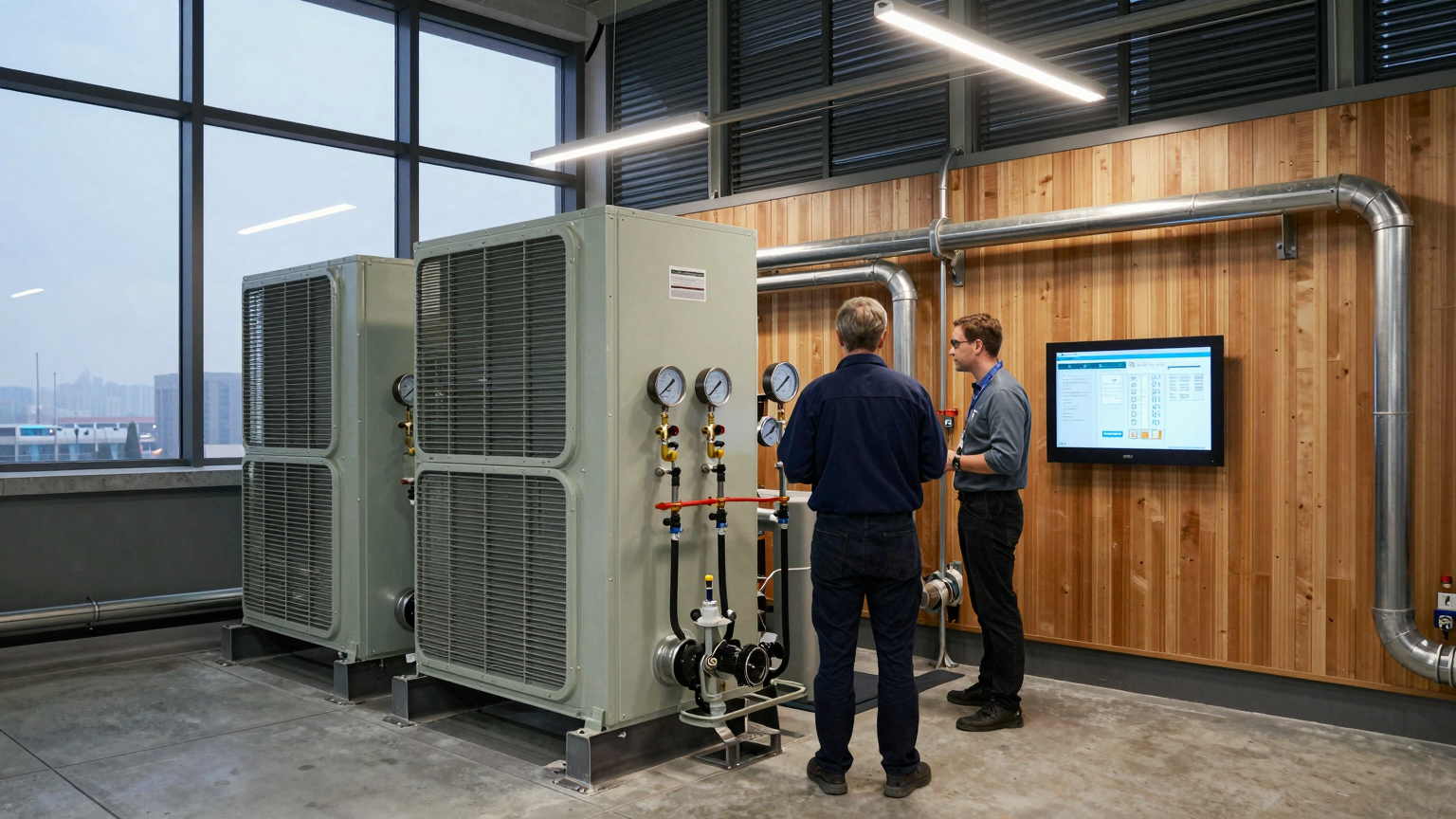

12kW. That is the threshold that decides whether the air conditioning in your building sits inside the energy performance regulations, and it is lower than most people assume. A modest split system serving one open-plan floor can cross it.
If you cannot say today which of your systems are over 12kW, when each was installed, and where the inspection report is filed, you are carrying a cost and enforcement exposure that will surface at the worst possible moment.
The rule is simpler than the paperwork around it
Under the energy performance regulations, an air-conditioning system means any system where refrigeration is used to cool for the comfort of occupants. That definition is deliberately wide, so it catches the split units above a comms room as well as the chiller on the roof.
The thresholds are set out in the official guidance on air-conditioning energy inspections. Systems with a rated output of 12kW or more installed before 30 December 2008 must be inspected now. Systems of 12kW or more installed after that date must be inspected within five years of installation. All systems over 12kW should then be inspected regularly, at intervals not exceeding five years.
So the answer to which buildings require TM44 inspections is not a building type. It is a plant schedule. If a building has cooling plant over 12kW, the duty attaches to that plant, whether the building is a Manchester office, a Birmingham retail unit or a Glasgow mixed-use block.
What the assessor actually looks at
The energy assessor inspects the system and gives you a report of their findings. That report includes recommendations to improve the system's performance, which is where the cost control angle sits. A chiller running outside its design parameters, a control strategy that fights itself, or a setpoint nobody has reviewed since commissioning all show up in the recommendations.
In an office, the assessor will want access to the plant room, the outdoor units, and the controls. They will ask for the maintenance records and the commissioning data. If the building manager cannot produce those on the day, the inspection still happens, but the report is thinner and the recommendations are less useful to you.
This is the same discipline that runs through asbestos inspections under HSE pressure. The regulator is not asking whether you care. They are asking whether the record exists.
By law you must have a copy of the report at all times
This is the part that catches people. The duty is not just to have the inspection done. By law you must have a copy of the report at all times, and it should be shown to an authorised officer of an enforcement authority if they visit your building to confirm compliance.
Failing to have a copy may mean enforcement action and a penalty charge notice, even if you have had the system inspected. That is the gap between doing the work and being able to prove it. The inspection happened, the report was emailed to someone who has since left, and the file is empty.
Not inspecting your system for energy efficiency could lead to enforcement action by district councils, and that action can include a penalty charge notice. The enforcement route runs through local authority building control, so the officer who turns up is not there to debate the merits of your maintenance regime. They are there to see the report.
You can find a qualified assessor via the GOV.UK website, and for advice on air-conditioning energy inspections you contact your local district council building control. The post-implementation review of the Energy Performance of Buildings Regulations 2012 notes that no cost figures are available for ACIRs, and that costs might only be incurred once every 10 years. That is a useful line for the budget conversation, because it frames the inspection as a periodic cost rather than an annual one.
Where the evidence usually lives, and what good looks like
In most portfolios, the ACIR report sits in one of four places: a shared drive nobody owns, an email inbox, a contractor's portal, or a filing cabinet in the building. None of those survive a change of facilities manager, and all of them fail the ten-minute test.
Good looks like a single register that lists every system over 12kW, the installation date, the inspection date, the next due date, and a link to the report. It should be readable by someone who has never set foot in the plant room. If the officer arrives on a Tuesday morning and the facilities manager is on leave, the person at the front desk should be able to produce the report without making a phone call.
The same logic applies to the wider energy certificate picture. If you are already tracking EPC deadlines, the 340,000 buildings needing EPC C by April 2027 is the larger version of the same problem. The technical notes on Energy Performance of Buildings Certificates set out how EPCs and DECs are lodged and how long they remain valid, which is useful context when you are building a single compliance calendar.
Your 60-second self-check
- Can you list every air-conditioning system in your portfolio with a rated output of 12kW or more, and the date each was installed?
- For each of those systems, can you produce the most recent inspection report today, without asking a contractor?
- Do you know which systems are already past their five-year inspection date, or will be within the next twelve months?
If any of those answers is no, the fastest way to see where you stand is the free 5-minute Director's Risk Check. Send it to the colleague who holds the records, and the briefing comes back to you. It gives you a control score for the portfolio, the breach exposure with official sources attached, and a board-ready briefing you can take into the next meeting. You can run it at hermanwa.com/risk-check.html?m=uk.
Herman's verdict
The inspection is the easy part. The report is the asset, and the register is the proof. If you cannot put your hand on the ACIR for every system over 12kW in under ten minutes, you have not got a compliance position. You have got a filing problem waiting to become a penalty charge notice.
— Herman
Until next time — keep the evidence closer than the deadline.
One auditable file per building, across your UAE portfolio
Every certificate, inspection and contractor job against the building it belongs to — dated, evidenced and ready when Civil Defence asks.
- Statutory deadlines tracked per building, with the evidence attached
- Digital records in the format the 2023 code expects, not paper logbooks
- One view of what is due, what is late and who is doing it
About HermanWa
HermanWa is a building compliance and operations platform for property and facilities teams in the United Kingdom and Singapore, with portfolios across the Gulf. It keeps one auditable file per building — statutory deadlines, inspection evidence, contractor work, energy and carbon — and its AI assistant, Herman, answers questions about your buildings in plain English. HermanWa tracks obligations including fire risk assessments and fire door checks, Building Safety Act duties, Legionella (ACOP L8), EICR, gas safety and EPC in the UK, and SCDF fire certificates, Periodic Facade and Structural Inspections, lift permits and Green Mark in Singapore. Directors can check their exposure with the free Director's Risk Check.