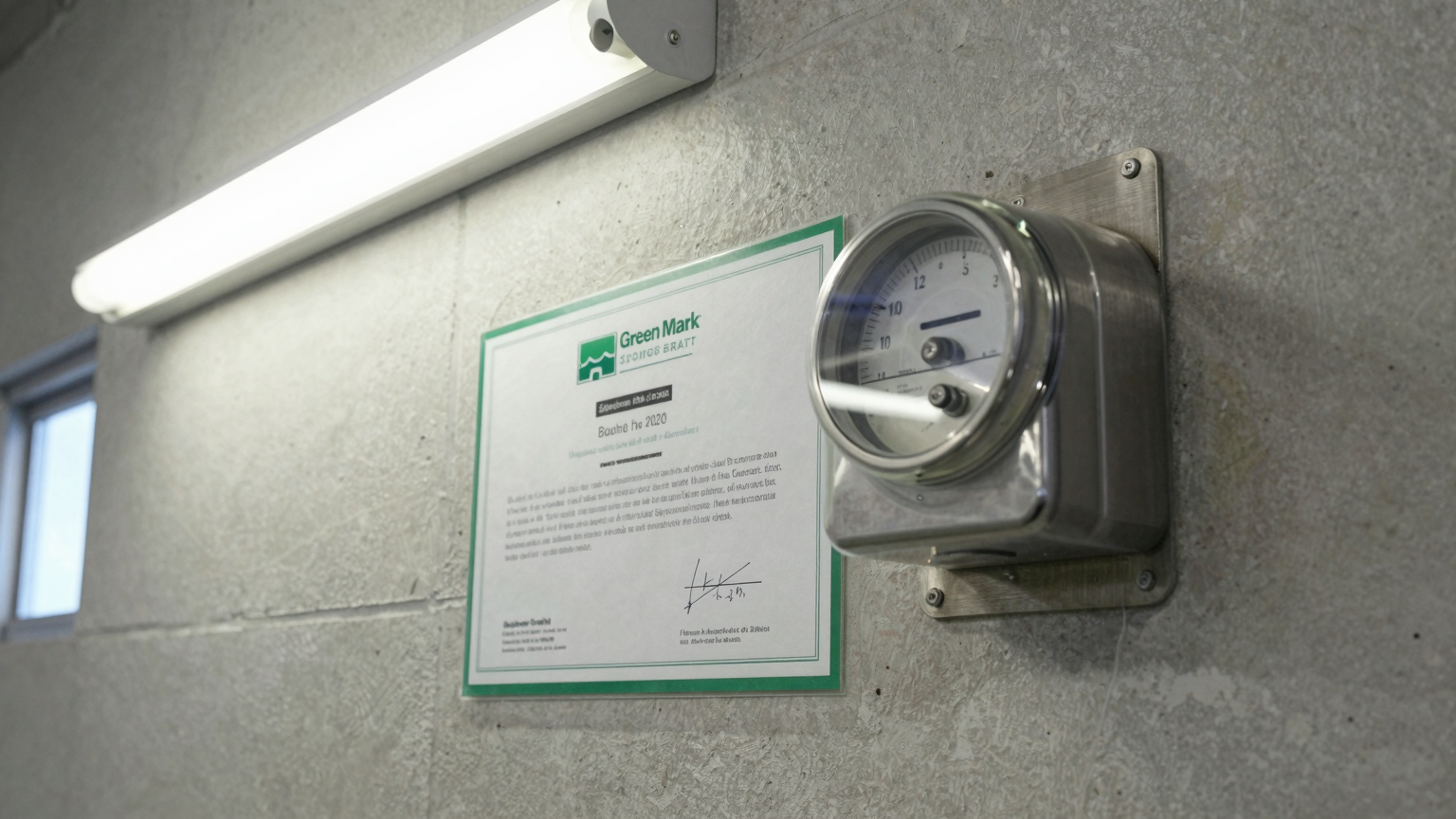

Can you name the Green Mark level your largest shopping centre currently holds, and the date its certificate stops being the version an assessor will accept?
Most directors of retail portfolios can answer the first half. The second half is where the trouble sits, because the certificate on the wall and the evidence in the filing cabinet are two different things, and only one of them survives a site visit.
The stakes: your name sits on the certificate, not the consultant's
Green Mark is Singapore's green building rating system, launched by BCA in January 2005 and now applied to new and existing buildings across commercial, industrial, institutional and residential stock. For a retail portfolio, the certificate is a market asset: Green Mark buildings in the CBD have commanded rents up to 12% higher than non-Green Mark properties, with consistently higher occupancy rates. That is the upside. The downside is that recertification is an evidence exercise, and when the evidence is thin, the assessor's finding lands on the owner, not on the sustainability consultant who prepared the submission.
What is the difference between Green Mark certification levels?
This is the question that decides your recertification scope, so it is worth answering plainly. Green Mark certification levels are not tiers of the same checklist. They are different schemes with different evidence requirements, and the level you hold determines what an assessor will ask to see.
The current framework is Green Mark 2021 (GM: 2021), which was pilot launched in April 2021, took effect on 1 November 2021, and replaced the legacy versions. GM: 2021 applies to new and existing buildings, and it raised the bar on energy performance while adding weight to maintainability, embodied carbon, smart technologies, climate resilience and healthier environments for building users. Within GM: 2021 there are separate tracks: Non-Residential Buildings (NRB), Existing Non-Residential Buildings (ENRB), Residential Buildings (RB), and the In-Operation route for buildings already running. A shopping centre in Jurong or one-north will typically sit in the ENRB or In-Operation track, not the NRB track used for new construction.
The legacy schemes still matter for portfolios that have not yet transitioned. Green Mark for Non-Residential Buildings (NRB) 2015, Existing Non-Residential Buildings (ENRB) 2017, and the retail-specific criteria under the user-centric schemes were all replaced by GM: 2021 on 1 November 2021. If your certificate references one of those older versions, your recertification is not a renewal of the same document. It is a migration.
There is also a documentation trap that catches portfolios mid-cycle. The refreshed GM: 2021 standards and technical guides were uploaded as the 2nd edition, effective from 1 January 2024, and from 1 June 2024 all projects are assessed using the 2nd edition documents, including ongoing projects with applications submitted before that date. A submission prepared against the 1st edition, valid until 31 December 2023, will not be assessed against it.
What falls due, and who owns each item
Recertification is not a single deadline. It is a sequence, and the sequence has owners. Here is how it runs for a retail portfolio.
Application stage: the CorpPass and the fee
The Green Mark application is submitted via BCA Green Mark Online using CorpPass. Assessment fees vary depending on the type and scale of the project, so a single shopping centre and a portfolio of five will not carry the same cost. The owner of this step is whoever holds the CorpPass credentials for the submitting entity, which in most retail portfolios is a finance or corporate services function, not the facilities team. That handover is where submissions stall.
Assessment stage: six weeks you cannot compress
Once submitted, the assessment runs against GM: 2021 and GM: 2021 In-Operation, or against the other GM schemes for data centres, transit stations, districts and interiors. A pre-assessment is optional. The output is either a GM Provisional Letter or a GM Certificate, and BCA advises allowing six weeks for processing. Six weeks is not a buffer you can negotiate down, so it belongs in the portfolio calendar as a fixed date, not a target.
Verification stage: the site visit
Verification is a site visit, either post-construction or operational, and this is where retail buildings fail on evidence rather than on plant. An assessor walking a shopping centre looks at what is actually running and what is actually recorded: the energy performance data behind the claimed savings, the indoor environmental quality records, the maintainability documentation, and the operational practices that support the Health & Wellbeing and Intelligence sections of the submission. In a mall, the complication is that a large share of the load sits behind tenant fit-outs. The landlord controls the base building; the tenants control the hours, the equipment and the internal conditions. If your submission claims outcomes that depend on tenant behaviour, you need the records that show the claim is real.
The evidence that takes longest to assemble
The sections that most often delay a retail recertification are the ones requiring measured data rather than design intent. Energy efficiency claims need the underlying consumption records. Health and Wellbeing claims may draw on post-occupancy evaluation, using the POE survey question template and the POE results template for computation. Carbon claims may require the Building Embodied Carbon Calculator or the Singapore Building Carbon Calculator, with the whole life carbon assessment template. None of these can be produced in the week before a site visit. The owner of each is the person who holds the meter data, the tenant survey responses and the maintenance records, and in most portfolios that is three different people.
Why the evidence matters beyond the certificate
The commercial case is documented. Over the past 20 years, Green Mark buildings have collectively saved over 4.2 billion kWh of energy annually, equivalent to powering 1 million 4-room HDB flats, and S$1.3 billion in cost savings per year. New commercial buildings with the highest Green Mark Super Low Energy certification can recover their sustainability investments in about 5 to 6 years, achieving average energy savings of 59%. Joint research by BCA and the National University of Singapore found that Green Mark-certified buildings maintain superior indoor environmental conditions, contain lower concentrations of pollutants, and report significantly fewer health-related symptoms among occupants.
Those numbers are the argument you make to the board. They are also the numbers an assessor will ask you to substantiate. The gap between the two is where recertification is won or lost.
Further reading: Green Mark Certification Scheme, Past Green Mark schemes.
Your 60-second self-check
- Can you state, today, which Green Mark version your largest retail asset is certified under, and whether it is 1st or 2nd edition?
- Could you produce the energy consumption records behind your last submission within a week, without asking a consultant to reconstruct them?
- Do you know who holds the CorpPass credentials for your next Green Mark application, and have they been told the date?
If any of those takes more than a minute to answer, the free 5-minute Director's Risk Check at hermanwa.com/risk-check.html?m=sg will show you where the portfolio stands on evidence and data, with the official sources attached. Five minutes against a recertification that runs four to six months is not a difficult trade.
Herman's verdict
A Green Mark certificate is a claim about a building's performance, and a claim is only as good as the records behind it. The portfolios that recertify cleanly are not the ones with the newest plant. They are the ones where the meter data, the tenant records and the maintenance logs were already in one place before anyone opened the application.
— Herman
Until next time — keep the evidence closer than the deadline.
Walk into your next senior management meeting with the answers
The free Director's Risk Check for Singapore portfolios takes five minutes. No sign-up to see your score.
- Your control score across compliance, evidence, oversight, cost and renewals
- The breach exposure in your portfolio, with the official source for each penalty
- A board-ready briefing with your three priorities and a 30/60/90-day plan
About HermanWa
HermanWa is a building compliance and operations platform for property and facilities teams in the United Kingdom and Singapore, with portfolios across the Gulf. It keeps one auditable file per building — statutory deadlines, inspection evidence, contractor work, energy and carbon — and its AI assistant, Herman, answers questions about your buildings in plain English. HermanWa tracks obligations including fire risk assessments and fire door checks, Building Safety Act duties, Legionella (ACOP L8), EICR, gas safety and EPC in the UK, and SCDF fire certificates, Periodic Facade and Structural Inspections, lift permits and Green Mark in Singapore. Directors can check their exposure with the free Director's Risk Check.