 Free checklist · UAEUAE green building checklist: Estidama & Al Sa'fatWhat keeps a green rating true after handover, with who enforces each duty, the published penalty and the steps to walk it.Get the free checklist →
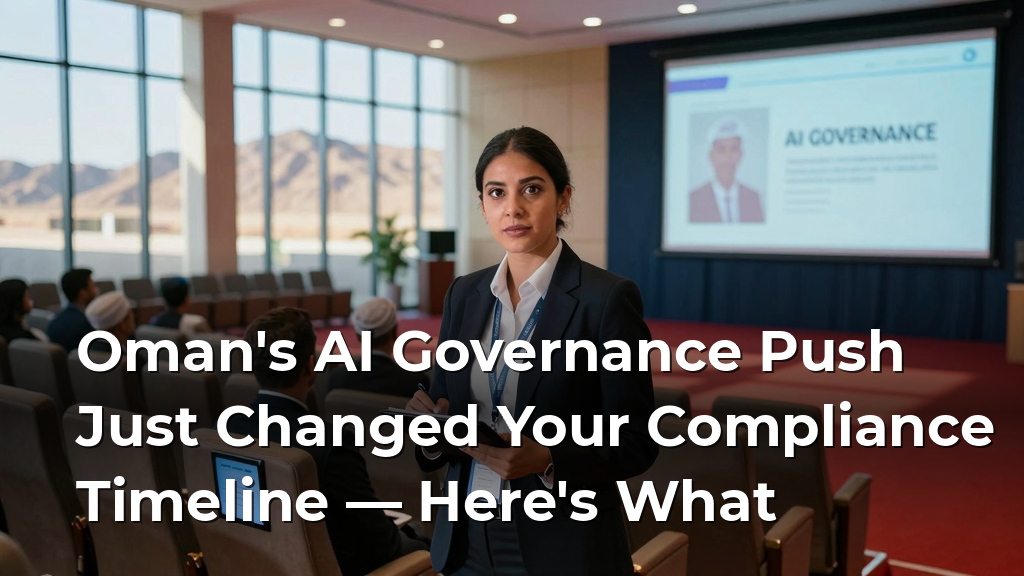
Oman's 25th Annual Government Conference wrapped up in Salalah last week. The agenda was heavy on AI, digital governance, and sustainability. CIBSE it was not. But for facilities managers watching the GCC, this event matters more than the technical sessions you might have skipped in London.
Governments in the Gulf do not hold conferences for the sake of it. They use them to align ministries, signal policy direction, and prepare the private sector for what comes next. If you run buildings in Oman, or anywhere in the GCC, the themes from Salalah are a preview of your compliance calendar.
AI is moving from pilot projects to regulatory backbone
The conference did not debate whether AI belongs in government. It assumed AI is the operating system. That is a shift from previous years where AI was a side panel. Now it is the main stage.
For building operators, this means the software you use to manage energy, maintenance, and tenant comfort will eventually need to talk to government systems. Not voluntarily. By mandate. The regulatory trajectory across the GCC is unmistakable: data standards are being set at the federal level, and private-sector platforms will be required to conform. This is not about optional interoperability or best-effort reporting. It is about structured, auditable data flows that regulators can ingest, validate, and act upon in near real time.
Look at what Dubai already did with its AI Rental Index, which went live in January 2025. Building condition data now directly sets rent. That system did not exist three years ago. It was built on the same logic Oman is now discussing: use data to make regulation smarter and more responsive. But the deeper implication is procedural. Once a government embeds AI into a pricing or compliance mechanism, it cannot revert to manual audits. The system becomes the referee. That means your building's digital twin—if you have one—is no longer a visualisation tool. It becomes the evidentiary record that a regulator can query on demand.
If Oman follows a similar path, your BMS data, your energy consumption records, and your maintenance logs become compliance evidence. Not just operational tools. The question is not whether this happens. It is whether you have the data collection in place before the deadline lands. And deadlines in this region have a habit of arriving faster than the pilot-phase timelines suggest. The operators who will struggle are not those without smart meters—they are those with fragmented data silos that cannot produce a coherent, timestamped narrative when the regulator asks for one.
Free checklist · UAEUAE green building checklist: Estidama & Al Sa'fatWhat keeps a green rating true after handover, with who enforces each duty, the published penalty and the steps to walk it.Get the free checklist →Sustainability is no longer a voluntary badge
The conference placed sustainability alongside AI as a core governance pillar. That pairing is deliberate. Governments in the GCC have realised that sustainability targets are unenforceable without digital tracking.
You cannot verify a carbon reduction claim from a PDF. You can verify it from a meter reading streamed to a central database. That is the direction of travel.
Abu Dhabi already tightened Estidama standards, with new design specs closing in 2026. DEWA made energy audits mandatory, with a Q4 2026 compliance deadline. Dubai Civil Defence extended its smart fire system mandate to 2027. The pattern is consistent: regulators are digitising compliance and shortening timelines.
Oman's conference suggests the Sultanate is preparing similar moves. The specific standards may differ, but the architecture will be the same. Expect mandatory energy reporting, digital audit trails, and penalties for operators who cannot produce clean data on demand.
What this means operationally is a shift from periodic certification to continuous verification. A building's sustainability performance will no longer be assessed at a single point in time—during an audit or a design review—but monitored as a live data stream. For facility managers, this changes the compliance burden fundamentally. You are no longer preparing a dossier for a consultant; you are maintaining a persistent, machine-readable record of every asset's consumption profile. The practical consequence is that legacy building management systems, which were never designed to export granular data in standardised formats, become liabilities. Operators who delay upgrading their metering infrastructure or centralising their data architecture will find themselves unable to respond to regulator requests within the new, compressed windows. The conference's emphasis on AI is not incidental here—it signals that regulators expect the data they receive to be not only accurate but also pre-analysed, with anomalies flagged and explained. In this environment, sustainability reporting becomes a core operational function, not an annual exercise in document assembly.
Digital governance means your paperwork becomes public record
One of the quieter threads at Salalah was digital governance. This is the unglamorous work of making government services work online. For building managers, it has a direct consequence: your compliance records become auditable in real time. The shift is not merely procedural; it fundamentally alters the burden of proof. Previously, compliance was reactive—you produced a certificate when asked. Now, it is proactive and continuous. Your building's data is a live feed, and the regulator's dashboard is the only version of the truth that matters. If your records are incomplete, inconsistent, or simply not uploaded in the correct schema, you are non-compliant by default. The onus is on you to prove your data is accurate before a query is raised, not after.
The UK already moved this way. CP12 gas safety records became digitally auditable in April 2025. Landlords who kept paper files in a drawer found themselves exposed. The same logic applies across the GCC, but with a steeper curve because the administrative culture is younger. The practical implication for operators is that your internal record-keeping must be engineered for external scrutiny, not for your own convenience. This means standardising how you log maintenance tasks, who signs off on them, and when timestamps are generated. A handwritten logbook entry is no longer evidence; a timestamped digital entry with a verified user ID is.
When a regulator can query your building's data remotely, they do not need to schedule an inspection. They can see your cooling tower registration status, your fire alarm test logs, and your energy audit results from a dashboard. If something is missing, the fine arrives by email. No warning visit. No chance to tidy up. This removes the informal grace period that many facilities managers relied upon. The regulatory relationship becomes transactional and immediate. For multi-site operators, this creates a new operational risk: a single missed upload at one property can trigger a penalty that affects the entire portfolio's compliance rating.
This is not speculation. It is how Dubai Municipality already operates for water tank compliance, where a six-month mandate carries AED 5,000 fines. It is how the UK handles MEES for commercial offices, where 78% of Westminster offices will fail by 2030 without retrofit work. The pattern is consistent: digital governance does not just digitise paper; it redefines what constitutes a compliant building. The question for operators is no longer whether you have the certificate, but whether your data infrastructure can produce the right evidence at the right time, every time.
What this means for your building budget
Every one of these regulatory shifts has a cost attached. The question is whether you pay now for data infrastructure or pay later in fines and emergency retrofits. The asymmetry is stark: proactive investment compounds, while reactive compliance compounds interest. Consider the numbers. A typical hotel in Dubai spends between AED 8 and AED 12 per square foot annually on energy. A mandatory energy audit, under DEWA rules, costs a fraction of that. But the audit is only useful if you can act on it. That requires submetering, a functioning BMS, and someone who can interpret the data. Without that chain, the audit is a paper exercise—a compliance checkbox that generates no operational return. The real cost is not the audit fee; it is the lost visibility into which zones, assets, or occupancy patterns are bleeding kilowatt-hours.
In the UK, the October 2030 EPC C deadline for rental properties carries an estimated £10,000 per property cost. The 2028 deadline for Band C is closer. Every year you delay data collection makes the retrofit more expensive because you cannot target the work. You end up replacing entire systems when a data-driven approach would have identified a failing chiller or a poorly insulated glazing line. The difference between a targeted retrofit and a blanket one is often 40–60% of the capital outlay. That is not a hypothetical; it is the arithmetic of building physics. The longer you operate without granular data, the more your capital expenditure becomes a guessing game—and the market prices that risk into your asset valuation.
Oman has not published specific building regulations from this conference. But the direction is clear. If you wait for the law to be written before you start collecting data, you will be behind. The conference is the signal. The regulation is the lagging indicator. What the Salalah agenda signals is that digital governance—AI-driven energy management, automated reporting, and predictive maintenance—will become the baseline for public-sector procurement and, by extension, private-sector tenancy agreements. The operators who treat this as a data infrastructure problem now will have the audit trails, the submetering granularity, and the AI models to negotiate from strength. Those who wait will face a compressed timeline, inflated retrofit costs, and the unglamorous scramble to meet deadlines with suboptimal solutions. The budget question is not whether you can afford the sensors. It is whether you can afford the opacity.
Where to start
You do not need to rip out your existing systems. You need to know what data you already have and whether it is trustworthy. Start with your energy meters. Check if they are calibrated and if the readings reconcile with your utility bills. Then look at your maintenance logs. Are they digital? Can you produce a complete history for any asset in under an hour?
If the answer is no, that is your first project. Not a new chiller. Not a solar array. Data hygiene. It is the cheapest insurance against a regulatory surprise. The conference’s emphasis on AI and digital governance is not a mandate to adopt speculative technology; it is a signal that regulators will increasingly expect auditable, machine-readable evidence of operational performance. When a government body asks for your sustainability metrics, they will not accept a PDF of handwritten logbooks. They will want structured data that can be verified against meter readings and maintenance timestamps. The gap between what you can prove and what you claim is where liability lives.
This is why the starting point is not procurement but reconciliation. If your energy data does not match your utility invoices, you have a metering problem, not a sustainability problem. If your maintenance history is scattered across spreadsheets and paper files, you have a traceability problem, not an AI problem. Fix those first. Once your baseline data is clean, you can begin to ask meaningful questions about performance — and that is where tools like natural-language querying become genuinely useful, not as a novelty but as a way to compress the time between asking a question and acting on it.
For a practical look at how building data can be monitored and queried in plain English, see how Herman handles this. The platform is built for operators who need answers from their building without a data science degree.
— The HermanWa Team
Until next time — keep the evidence closer than the deadline.
Keep the green rating true after handover
The free UAE green building checklist covers Estidama Pearl and Al Sa'fat: every duty with who enforces it, how often, the published penalty and the official source.
- Estidama Pearl in Abu Dhabi and Al Sa'fat in Dubai
- The waste permit and energy audit that evidence them
- The steps to walk each duty, ready to print or save as PDF
Prefer to talk it through? Book a 20-minute walkthrough
About HermanWa
HermanWa is a building compliance and operations platform for property and facilities teams in the United Kingdom and Singapore, with portfolios across the Gulf. It keeps one auditable file per building — statutory deadlines, inspection evidence, contractor work, energy and carbon — and its AI assistant, Herman, answers questions about your buildings in plain English. HermanWa tracks obligations including fire risk assessments and fire door checks, Building Safety Act duties, Legionella (ACOP L8), EICR, gas safety and EPC in the UK, and SCDF fire certificates, Periodic Facade and Structural Inspections, lift permits and Green Mark in Singapore. Directors can check their exposure with the free Director's Risk Check.