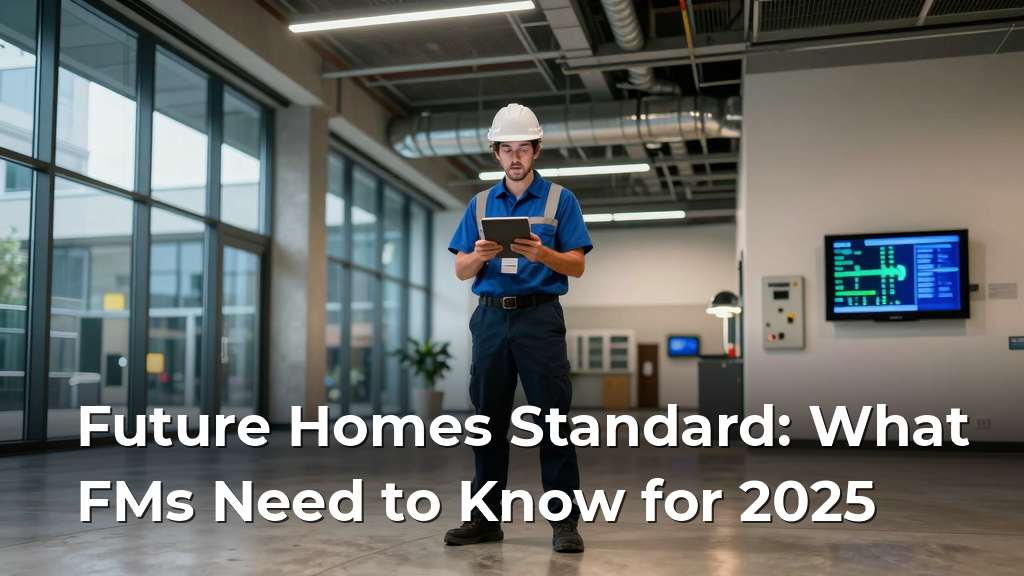

The UK government has confirmed the timeline. The Future Homes Standard and Future Buildings Standard will require all new buildings to be zero-carbon ready, with phased implementation starting in 2025. For facilities managers, this is not a policy document to file away. It is a direct instruction about how your next building will be built, what systems it will run, and what your operating costs will look like from day one.
Zero-carbon ready means something specific for your plant room
Zero-carbon ready does not mean the building produces zero carbon on opening day. It means the building is designed so that it can achieve zero carbon emissions once the grid decarbonises. Practically, this translates to three things for the people who will run these buildings:
- Fabric efficiency first. The building envelope must minimise heat loss. Better insulation, triple glazing, airtight construction. This changes how your HVAC loads behave. Smaller peaks. Slower temperature drift. Your BMS strategy needs to account for a building that holds temperature longer.
- Low-carbon heating. Gas boilers are effectively banned in new builds from 2025. Heat pumps become the default. If you have managed heat pumps before, you know they behave differently from gas-fired systems. Lower flow temperatures. Slower response. Different maintenance rhythms.
- On-site renewables or connection to district networks. Solar PV is expected on most new homes. Commercial buildings may connect to heat networks. Either way, your energy monitoring needs to handle generation as well as consumption.
A 180-room hotel in Manchester city centre built to the new standard will have a different chiller plant than one built in 2019. The load profile shifts. The control logic shifts. The maintenance schedule shifts.
The phased timeline matters for your portfolio planning
The implementation is not a single date. It is a sequence.
- 2025. The Future Homes Standard comes into force for new homes. The Future Buildings Standard for commercial buildings follows a similar trajectory, with consultation closing in 2024 and implementation expected in 2025 or early 2026.
- 2028. MEES (Minimum Energy Efficiency Standards) for existing commercial buildings tighten. EPC rating C becomes the minimum for new tenancies. This affects every building built before the new standards.
- 2030. EPC rating B becomes the target for commercial buildings. The gap between new-build performance and existing stock widens.
If you manage a portfolio that includes both new developments and existing assets, you are managing two different compliance timelines. The new builds need to hit zero-carbon ready from 2025. The existing buildings need to climb the EPC ladder by 2028 and 2030. These are separate workstreams with separate budgets.
We covered the portfolio cost implications in more detail in our earlier piece on zero-carbon mandatory 2025 portfolio capex impact.
What changes in your day-to-day operations
For the facilities manager on the ground, the new standard changes several things about how a building runs.
Heating systems behave differently
Heat pumps run at lower flow temperatures than gas boilers. Typically 35-45°C instead of 60-70°C. This means your heating circuits need larger radiators or underfloor heating to deliver the same heat. It also means the system responds more slowly to temperature changes. A guest who cranks the thermostat in a heat-pump-heated hotel room will not feel the difference in five minutes. They will feel it in twenty. Your front desk team and your housekeeping staff need to understand this, because they will hear about it from guests.
Ventilation becomes mechanical and controlled
Tighter buildings need mechanical ventilation with heat recovery (MVHR). Natural infiltration through draughty windows is no longer available to dilute indoor pollutants. This means your filter maintenance schedule becomes critical. A clogged filter in an MVHR unit affects indoor air quality directly. It also affects energy efficiency, because the fan works harder to push air through the blockage.
We wrote about the gap between promised and actual savings in predictive maintenance cost cuts reality gap. The same principle applies here. A heat pump that is not maintained to manufacturer spec will not deliver its rated COP. An MVHR unit with dirty filters will consume more energy than a leaky building with a gas boiler. The technology only works if the operations team keeps it working.
Solar PV adds a generation layer to your energy management
New buildings will have solar panels. This means your energy monitoring now has two directions. You generate during the day. You consume around the clock. If your BMS does not track generation and consumption separately, you are flying blind on whether the building is actually net-zero ready.
Some buildings will also have battery storage. That adds a third layer. Charge, discharge, grid import. Your energy strategy becomes a scheduling problem. When do you run the heat pump? When do you charge the battery? When do you export to the grid? These decisions affect both your carbon performance and your energy bills.
The retrofit challenge for existing buildings
The new standard applies to new buildings. But the existing stock does not disappear. Most commercial buildings standing in 2025 will still be standing in 2050. The gap between new-build performance and existing stock performance will widen, and that gap will show up in EPC ratings, in energy bills, and in tenant satisfaction.
If you manage an existing building, the Future Buildings Standard matters because it sets a benchmark. Tenants will compare your building's performance against new builds. Investors will compare your asset's risk profile against new builds. Regulators will compare your EPC rating against the 2028 and 2030 targets.
The retrofit pathway for existing buildings is different from the new-build pathway. You cannot easily add fabric insulation to a curtain-wall office tower. You cannot replace a gas boiler with a heat pump without upgrading the distribution system. You have to work with what you have.
We covered the investor perspective on retrofit budgets in MIPIM UK 2024 investor capital retrofit budget. The short version: capital is available for retrofit, but it goes to buildings with clear plans and measurable outcomes.
What this looks like in practice for a facilities team
Take a 120-room business hotel in Birmingham, built to the new standard in 2026. The heating is a ground-source heat pump. The ventilation is MVHR with CO₂ sensors. The roof has 50 kW of solar PV. The BMS is BACnet-based and talks to the heat pump controller, the MVHR units, the solar inverter, and the battery system.
The facilities team needs to:
- Monitor heat pump performance. COP should be above 3.5 in winter. If it drops below 3.0, something is wrong with the ground loop or the refrigerant circuit.
- Change MVHR filters on schedule. Every three months for the pre-filters, every twelve months for the main filters. Mark it on the calendar. Set a BMS alert for pressure drop across the filters.
- Track solar generation against consumption. The building should export during the day and import at night. If the battery is not cycling daily, the control logic needs adjustment.
- Train front desk staff on heat pump response times. The room will warm up, but it takes longer than a gas boiler. Set expectations with guests at check-in.
None of this is complicated. But it is different from what most facilities teams are used to. The skills gap is real. A hotel chief engineer who has spent twenty years managing gas boilers and chillers needs time to learn heat pump diagnostics. A maintenance technician who knows how to clean a gas burner needs to learn how to check a heat pump's superheat and subcooling.
The Future Homes Standard and Future Buildings Standard are not just regulatory documents. They are a signal that the building stock is changing. The systems are changing. The skills required to run them are changing.
If you want to see how Herman handles the monitoring and control layer for these new systems, talk to the HermanWa team. We built the platform for buildings that need to track energy, comfort, maintenance, and carbon in one place, in plain English.
— The HermanWa Team
Until next time — keep the evidence closer than the deadline.
Walk into your next senior management meeting with the answers
The free Director's Risk Check for UK portfolios takes five minutes. No sign-up to see your score.
- Your control score across compliance, evidence, oversight, cost and renewals
- The breach exposure in your portfolio, with the official source for each penalty
- A board-ready briefing with your three priorities and a 30/60/90-day plan
About HermanWa
HermanWa is a building compliance and operations platform for property and facilities teams in the United Kingdom and Singapore, with portfolios across the Gulf. It keeps one auditable file per building — statutory deadlines, inspection evidence, contractor work, energy and carbon — and its AI assistant, Herman, answers questions about your buildings in plain English. HermanWa tracks obligations including fire risk assessments and fire door checks, Building Safety Act duties, Legionella (ACOP L8), EICR, gas safety and EPC in the UK, and SCDF fire certificates, Periodic Facade and Structural Inspections, lift permits and Green Mark in Singapore. Directors can check their exposure with the free Director's Risk Check.