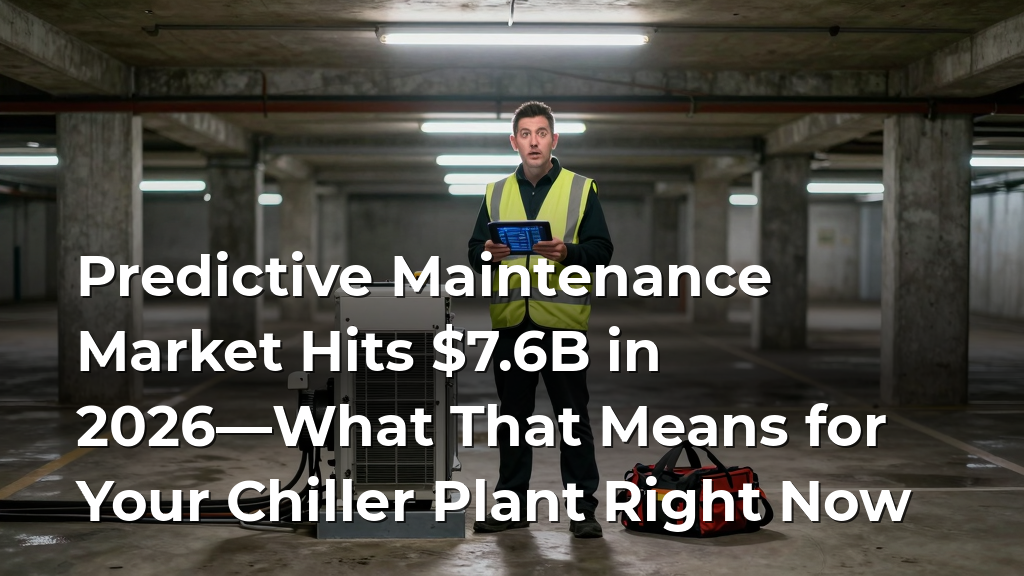

The predictive maintenance market is projected to reach $7.6 billion by 2026, growing at a compound annual rate of 27.9%. That number comes from a recent industry report, and it's the kind of figure that makes investors lean forward. But if you're the person responsible for a chiller plant in JLT or a hotel HVAC system in Mayfair, the question is different: what does this market growth actually mean for your building?
IoT Sensors and AI Analytics Are Driving the Numbers
The market growth is real, and it's being driven by two things getting cheaper and better at the same time. IoT sensors now cost a fraction of what they did five years ago. A vibration sensor on a pump motor that would have cost £200 in 2019 can now be had for under £50. The data these sensors produce is also more reliable — fewer false positives, better battery life, easier installation.
The second driver is AI analytics that actually work with building data. Not the kind that promises to predict every failure before it happens, but the kind that learns what normal looks like for a specific chiller in a specific climate. A 500-ton chiller in Dubai operates differently from the same model in Manchester. The AI needs to understand that.
Commercial real estate and facilities management are among the fastest adopters of this technology. Hotels in particular have a strong incentive: a chiller failure during a sold-out weekend in Riyadh means guest complaints, compensation costs, and a reputation hit that takes months to recover from. But the adoption curve is also being shaped by tightening regulatory frameworks. In the GCC, the push toward net-zero building codes and mandatory energy benchmarking — such as Dubai’s Al Sa’fat system or the UAE’s updated Estidama standards — is forcing operators to move from reactive maintenance schedules to verifiable, data-driven asset management. A predictive maintenance system doesn’t just reduce downtime; it generates the auditable trail of equipment performance that regulators increasingly demand for compliance reporting. Meanwhile, in the UK, the Building Safety Act 2022 places direct liability on building owners for the operational integrity of critical systems, making sensor-based condition monitoring a legal risk mitigation tool rather than a discretionary upgrade. This regulatory pressure is accelerating procurement cycles: operators who once treated predictive maintenance as a five-year capital project are now deploying IoT retrofits within a single budget year to meet compliance deadlines. The result is a market where the technology’s falling cost curve intersects with rising compliance costs, creating a structural shift in how building operations are funded and governed.
The Gap Between Promise and Plant Room Reality
We wrote about this gap before in Predictive Maintenance Software Promises 40% Cost Cuts. Most Facilities Teams See 8%. Here's Why. The short version: vendors sell a vision of perfect prediction, but buildings are messy. A sensor that loses calibration, a data feed that drops out, a maintenance team that doesn't trust the alert — these are the real-world constraints that eat into promised savings.
The 27.9% CAGR doesn't mean every building will see a 28% improvement in maintenance costs. It means more buildings are installing the technology. The actual results depend on installation quality, data hygiene, and whether the team using the system has the time and training to act on the alerts.
A 320-room resort on the Palm Jumeirah installed vibration sensors on all 12 of its air handling units last year. The system flagged a bearing degradation on AHU-7 three weeks before it would have failed. The engineering team replaced the bearing during a scheduled downtime window. No guest disruption, no emergency call-out. That's the promise working as intended. But the same resort had two false alarms in the first month that the team learned to ignore. The system needed tuning.
The regulatory layer adds another dimension to this gap. In the GCC, where many hospitality assets operate under municipal licensing that mandates quarterly preventive maintenance logs, predictive alerts can create a documentation conflict. A system that flags a component as "healthy" for six consecutive months may lead a facilities manager to skip a mandated inspection — only to have the regulator cite the missing paper trail during an audit. The technology does not yet reconcile its probabilistic outputs with the deterministic compliance frameworks that govern building operations. Similarly, in the UK, the CIBSE Guide M maintenance standards require evidence of routine checks, not just anomaly detection. A predictive system that reduces reactive call-outs by 60% still leaves the team accountable for logged visual inspections and filter changes that the sensors cannot verify. Until the software vendors build compliance reporting into their dashboards — mapping each prediction to a specific regulatory code — the plant room reality will lag the boardroom promise. The CAGR is real, but the return on that investment is mediated by how well the platform bridges the gap between a bearing's vibration signature and a regulator's clipboard.
What the Market Growth Means for Your Budget
When a market grows at nearly 28% annually, two things happen. First, prices for hardware and software come down as more suppliers compete. Second, the bar for what counts as a good system rises. The predictive maintenance platform you bought three years ago may already look dated compared to what's available now.
For facilities managers in the GCC, the climate makes predictive maintenance particularly valuable. A chiller running at 48°C ambient temperature is under more stress than one running at 25°C. The failure modes are different. The maintenance intervals need to be shorter. A system trained on European data won't work well in Dubai without retraining. This market growth means you can now demand region-specific models that account for sand ingress, humidity spikes, and the thermal cycling that happens during rapid cooling loads. Budgets that previously went toward reactive repairs or blanket preventive schedules can be reallocated to targeted sensor deployment on critical assets like AHUs and cooling towers. The ROI shifts from "avoiding downtime" to "extending asset life by 18–24 months," which directly impacts your capital replacement cycle.
For UK operators, the value is more about compliance and energy cost. The 2028 and 2030 EPC deadlines mean buildings need to prove they are running efficiently. A predictive maintenance system that keeps HVAC equipment at peak performance directly supports EPC ratings. It also reduces the kWh/m² that shows up on your energy bill and your ESG report. As the market matures, the cost of integrating these systems with existing BMS platforms has dropped by roughly 15–20% per connected point, making it feasible to retrofit older portfolios without a full controls upgrade. Your budget should now account for the data pipeline — not just the sensors, but the cloud storage and analytics subscription — because the real value lies in the trend lines, not the alerts. A system that only flags failures is table stakes; one that benchmarks your equipment against similar assets in your region is where the competitive edge lives.
Where Predictive Maintenance Works Best Today
The technology is not equally useful for every piece of equipment. The best candidates are rotating machinery with predictable failure patterns: pumps, fans, compressors, motors. These are the components where vibration analysis, temperature trending, and current draw monitoring can catch problems early. The physics of degradation in rotating assets follows a measurable curve — bearing wear, shaft misalignment, and impeller imbalance all produce detectable signatures before catastrophic failure occurs. This makes them ideal for condition-based monitoring rather than time-based replacement.
Static equipment like pipes and ductwork is harder to monitor predictively. Leaks and blockages tend to announce themselves suddenly. For those systems, the best approach is still good preventive maintenance — regular inspections, cleaning schedules, and pressure testing. However, even here, predictive methods are gaining ground. Acoustic emission sensors can now detect the ultrasonic noise of a pinhole leak in a pressurized pipe before it becomes visible. Thermal imaging of ductwork can identify insulation breakdown or airflow restrictions that precede a total blockage. The key is understanding that predictive maintenance is not a replacement for preventive schedules but a refinement layer that prioritizes inspection intervals based on actual asset condition rather than calendar dates.
The sweet spot for predictive maintenance in commercial buildings is the chiller plant. A chiller represents 30-40% of a building's total energy consumption in the GCC. A single efficiency gain of 5% from better maintenance can save thousands of dirhams or pounds per month. The ROI calculation is straightforward. But the regulatory context matters here too. In the UAE, the Dubai Supreme Council of Energy's Demand Side Management strategy targets a 30% reduction in energy use by 2030. Predictive maintenance on chillers directly supports compliance with these mandates by ensuring equipment operates at design efficiency. Similarly, the UK's Minimum Energy Efficiency Standards (MEES) increasingly penalize underperforming buildings. Operators who deploy predictive analytics on their chiller plants can document continuous efficiency improvements, which strengthens their position during energy audits and helps avoid costly retrofits. The technology thus serves a dual purpose: operational cost reduction and regulatory risk management.
What This Looks Like in Practice
If you're considering a predictive maintenance system for your building, start with the equipment that costs the most to fail. For a hotel, that's the chiller and the kitchen refrigeration. For an office building, it's the AHUs and the cooling tower. Install sensors on those first. Run the system for three months to establish baselines. Tune the alert thresholds based on what you learn.
This phased approach is not just practical—it's essential for regulatory compliance in the GCC and UK markets. In the UAE, for example, the Dubai Supreme Council of Energy's Demand Side Management strategy increasingly expects operators to demonstrate proactive asset management, not just reactive repairs. A predictive maintenance system that logs vibration trends on a chiller's compressor provides auditable evidence of due diligence, which can be critical during DEWA inspections or insurance audits. Similarly, in the UK, the Building Safety Act 2022 places a legal duty on building owners to manage risks from mechanical failures that could impact occupant safety. A three-month baseline period allows you to calibrate alerts to actual operating conditions—avoiding the false positives that plague off-the-shelf systems—while generating the historical data needed to prove compliance with statutory maintenance obligations. Without this tuning, you risk either nuisance alarms that desensitize your team or missed warnings that lead to catastrophic failure. The real value emerges when your system learns the difference between a normal load shift at 3 PM and a bearing fault that will seize the motor by midnight.
Talk to the HermanWa team about how we handle predictive maintenance across GCC and UK buildings. We've seen what works and what doesn't, and we build our systems to survive contact with real plant rooms.
— The HermanWa Team
Until next time — keep the evidence closer than the deadline.
Walk into your next senior management meeting with the answers
The free Director's Risk Check for UK portfolios takes five minutes. No sign-up to see your score.
- Your control score across compliance, evidence, oversight, cost and renewals
- The breach exposure in your portfolio, with the official source for each penalty
- A board-ready briefing with your three priorities and a 30/60/90-day plan
About HermanWa
HermanWa is a building compliance and operations platform for property and facilities teams in the United Kingdom and Singapore, with portfolios across the Gulf. It keeps one auditable file per building — statutory deadlines, inspection evidence, contractor work, energy and carbon — and its AI assistant, Herman, answers questions about your buildings in plain English. HermanWa tracks obligations including fire risk assessments and fire door checks, Building Safety Act duties, Legionella (ACOP L8), EICR, gas safety and EPC in the UK, and SCDF fire certificates, Periodic Facade and Structural Inspections, lift permits and Green Mark in Singapore. Directors can check their exposure with the free Director's Risk Check.