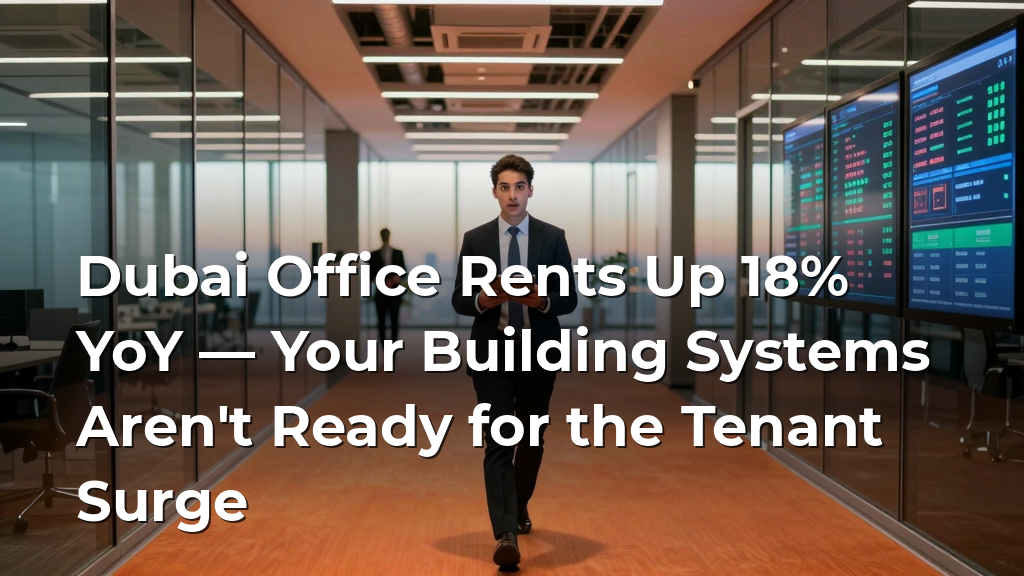

Dubai's prime office occupancy hit 92% in Q3 2024. Rents in Grade A buildings in DIFC and Sheikh Zayed Road have risen 18% year-on-year. Abu Dhabi's ADGM is seeing similar pressure. If you manage a commercial building in either city, you're feeling it — more tenants, more churn, more demands on your systems.
This isn't the slow, steady recovery everyone predicted in 2021. It's a fast, uneven one. And it's changing what tenants expect from the buildings they lease.
Premium Space Is Running Out, and Tenants Know It
The numbers are stark. Knight Frank reports that Dubai's Grade A office vacancy rate is below 8%. In Abu Dhabi, it's under 10%. That's tight for any market, let alone one that added 1.2 million square metres of new office space between 2020 and 2023.
What's happening is a flight to quality. Tenants who survived the pandemic are upgrading. They want better air quality, more reliable cooling, and digital infrastructure that actually works. They're willing to pay 25-40% more per square foot for a building that delivers these things consistently.
For building operators, this creates a clear choice. Your building either meets this standard, or you watch tenants move to the one down the street that does.
But the scarcity is not just about square metres. It is about the regulatory and operational gap between what tenants now demand and what most existing stock can legally or physically deliver. Dubai's Green Building Regulations and the updated Dubai Municipality codes for HVAC efficiency and IAQ (Indoor Air Quality) are raising the baseline, but compliance is uneven across older assets. Many buildings built before 2018 lack the ductwork zoning or BMS (Building Management System) granularity to support tenant-level air quality monitoring without a full mechanical retrofit. Meanwhile, Abu Dhabi's Estidama Pearl Rating System imposes stricter commissioning requirements for new builds, but the existing stock—particularly in areas like Al Reem Island and the Corniche—faces a costly path to recertification. This creates a two-tier market: buildings that can prove compliance with real-time data command the premium, while those relying on paper certificates or manual logs are increasingly viewed as liabilities by corporate occupiers with ESG mandates. The result is that the effective vacancy rate for truly compliant premium space is likely far lower than the headline figures suggest, because many "Grade A" listings do not yet meet the operational transparency that multinational tenants now require for their own reporting.
Flexible Leasing Is Now the Baseline, Not a Premium
Before 2020, a five-year lease with a 5% annual escalation was standard. Today, tenants in Dubai Marina and JLT are asking for 12-month break clauses, expansion options, and sublease rights baked into the contract.
This isn't just a legal or commercial issue. It's an operational one. When a tenant on the 14th floor expands into the 15th floor mid-year, your cooling load changes. Your BMS zones need reconfiguring. Your AHU schedules shift. If you're still running fixed schedules set in 2019, you're either overcooling empty space or undercooling occupied space.
We've seen buildings where a single floor changed tenants three times in 18 months. Each time, the new tenant wanted different temperature setpoints, different hours of operation, different sub-metering arrangements. The buildings that handled this smoothly had one thing in common: a BMS that could be reconfigured in minutes, not days.
The regulatory dimension here is often underestimated. Dubai's Real Estate Regulatory Agency (RERA) has not mandated a standard flexible lease template, but the market has effectively created one through tenant demand. This creates a compliance gap: operators who sign a 12-month break clause must now reconcile that with cooling and energy reporting cycles that were designed for annual fixed periods. If a tenant exercises a break clause in month eight, the building's annual energy performance certificate (EPC) data becomes misaligned with actual occupancy. The operator must then manually adjust submetering allocations and recalculate common area service charges—a process that, under traditional BMS architectures, requires a site visit and a certified technician. The buildings that avoid this administrative drag are those where the BMS can dynamically reassign energy consumption to new tenant profiles and automatically update the service charge reconciliation reports. In effect, flexible leasing has turned what was a static compliance exercise into a continuous data reconciliation process. Operators who cannot automate this reconciliation are now at a structural disadvantage, because every lease renegotiation becomes a back-office crisis rather than a routine parameter update.
Your Chiller Plant Is Now a Leasing Differentiator
Tenants don't care about your chiller COP. They care about whether their meeting room is 22°C at 3pm on a July afternoon. But the two are connected.
In Dubai's climate, cooling accounts for 55-65% of a commercial building's total energy use. A chiller plant running at 0.8 kW/ton instead of 1.2 kW/ton saves roughly AED 150,000 per year for a 50,000 sq ft building. More importantly, it delivers more consistent temperatures because the system isn't struggling.
We worked with a 12-storey office building in Barsha Heights last year. Their chiller plant was 14 years old, running at 1.3 kW/ton. The building had 78% occupancy. After a controls retrofit — no new chillers, just better sequencing and setpoint optimisation — they dropped to 0.9 kW/ton. Occupancy hit 91% within six months. The leasing team said the improved comfort was the single biggest factor.
That's not a theory. That's a 280-ton plant in a market where every percentage point of occupancy matters.
This shift is not merely operational—it is increasingly regulatory. Dubai's Green Building Regulations and the Dubai Supreme Council of Energy's Demand Side Management Strategy 2030 now tie building performance directly to compliance. Buildings with chiller plants operating above 1.0 kW/ton face escalating scrutiny during annual audits, and non-compliance can trigger penalties or restrict leasing permits. Conversely, properties that demonstrate sub-1.0 kW/ton performance gain preferential treatment in DEWA's District Cooling Tariff structures, reducing per-ton costs by up to 12% for high-efficiency plants. This creates a compounding advantage: lower operational costs fund further retrofits, while the compliance stamp becomes a leasing asset. Tenants—especially multinationals with ESG mandates—now request chiller plant efficiency data alongside floor plans. A building that can document a 0.9 kW/ton plant with consistent zone-level temperatures is not just comfortable; it is audit-ready. In a market where Grade A office supply is tightening, the chiller plant has quietly become a due diligence item. Ignoring it means leaving occupancy gains on the table—and risking regulatory friction that no leasing brochure can fix.
What This Means for Your Maintenance Budget
Higher occupancy means more wear on everything. More FCU filter changes. More AHU belt replacements. More toilet flush repairs. More complaints about temperature, noise, and lighting.
If your maintenance budget hasn't moved since 2022, you're already behind. A building running at 92% occupancy generates roughly 15% more reactive maintenance calls than one at 75%. That's not speculation — it's what we see across our portfolio of 40+ commercial buildings in the UAE.
The smart play isn't to throw more bodies at the problem. It's to use your building data to predict where the next failure will happen. A VFD that's drawing 5% more current than last month. A valve that's taking three seconds longer to open. These are the signals that let you fix things before a tenant calls.
We wrote about this gap between promised and actual savings in predictive maintenance here. The short version: most platforms overpromise. But the ones that work — the ones that actually connect to your BMS and learn your building's patterns — can cut reactive calls by 30-40%.
Yet the real budget pressure isn't just call volume — it's the shift in what breaks. In a 75% occupied building, common-area systems take the brunt. At 92%, tenant-side equipment — fan coil units, VAV boxes, zone valves — sees disproportionate stress because they cycle more frequently and run closer to design limits. This changes your spare parts inventory. You'll burn through more actuators, more thermostats, and more condensate pumps than you did two years ago. If your procurement team is still ordering based on 2021 failure rates, you're stocking the wrong parts.
There's also a regulatory angle. Dubai Municipality's updated Al Sa'fat energy efficiency framework now ties building rating compliance to actual operational performance, not just design specs. A building that fails to maintain its HVAC delta-T within prescribed bands risks losing its rating — and that directly impacts rental premiums. Your maintenance budget isn't just about keeping tenants comfortable anymore. It's about protecting the asset's certification and the rent roll that depends on it. Every deferred chiller cleaning or ignored coil fouling now carries a compliance cost that compounds faster than the repair itself.
Regulation Is Catching Up to the Market
Abu Dhabi's mandatory efficiency audits start Q4 2024. Dubai's RERA now requires digital records for all property management. The compliance checklist is straightforward, but it requires data you might not have in one place.
If you're managing a building built before 2015, you likely have a mix of BACnet, Modbus, and proprietary protocols. Getting a clean dataset from that mix is the first step. Without it, you can't prove compliance, and you can't optimise performance.
The buildings that will win in this market are the ones that can show a prospective tenant three things: consistent comfort, transparent energy costs, and a maintenance record that proves the building is looked after. That requires data. Not a PDF of last year's utility bills. Live, sub-metered, trended data that you can talk to.
This regulatory shift is not merely about ticking boxes. It forces operators to confront a deeper operational reality: most legacy building management systems were never designed for cross-protocol data aggregation. A typical portfolio built between 2008 and 2015 might have HVAC on BACnet, lighting on a proprietary DALI gateway, and submeters speaking Modbus RTU over serial converters. Each system generates its own alarms, trends, and logs — but none of them talk to each other without middleware. The new regulations effectively mandate that middleware layer. Without it, you cannot produce the consolidated digital record RERA now requires, nor can you demonstrate the year-over-year efficiency gains Abu Dhabi's auditors will demand. The practical consequence is that compliance becomes a data engineering problem, not a paperwork exercise. Operators who treat it as the latter will find themselves scrambling for manual workarounds every quarter. Those who invest in a unified data layer — one that normalises disparate protocols into a single time-series database — will not only pass audits but will also unlock the operational visibility needed to compete for premium office tenants in a recovering market.
Where to Start
If your building is running at 85% occupancy or higher, start with your cooling system. Get a week of trend data from your BMS. Look at how often your chillers are cycling. Check whether your condenser approach temperatures are within design range. If you don't have easy access to this data, that's your first problem to solve. In a recovering market where tenants are willing to pay a premium for comfort, a poorly tuned HVAC system is a direct liability. A chiller that short-cycles or operates outside its design envelope doesn't just waste energy—it creates temperature drift on the floors that matter most to prospective lessees. Without granular trend data, you are effectively flying blind on your single largest operational expense and your most visible amenity.
If your building is below 80% occupancy, focus on what's keeping tenants away. Is it the lobby? The lift wait times? The temperature on the south-facing floors? Talk to your leasing team. They hear the objections every day. But here is where the process deepens: you need to cross-reference those verbal objections with hard data. If the leasing team reports complaints about lobby temperature, pull the zone-level sensor logs for the past three months. If lift wait times are cited, check the controller event logs for peak-hour dispatch intervals. The gap between what tenants say and what the building's systems actually do is where the real inefficiencies hide. A systematic audit of BMS alarms, maintenance logs, and tenant feedback forms will reveal whether the issue is a genuine equipment fault, a control strategy flaw, or a perception problem that can be solved with signage or lighting.
Either way, the market is moving. The buildings that adapt will capture the premium. The ones that don't will be left with the vacancy.
— The HermanWa Team
Until next time — keep the evidence closer than the deadline.
Walk into your next senior management meeting with the answers
The free Director's Risk Check for UK portfolios takes five minutes. No sign-up to see your score.
- Your control score across compliance, evidence, oversight, cost and renewals
- The breach exposure in your portfolio, with the official source for each penalty
- A board-ready briefing with your three priorities and a 30/60/90-day plan
About HermanWa
HermanWa is a building compliance and operations platform for property and facilities teams in the United Kingdom and Singapore, with portfolios across the Gulf. It keeps one auditable file per building — statutory deadlines, inspection evidence, contractor work, energy and carbon — and its AI assistant, Herman, answers questions about your buildings in plain English. HermanWa tracks obligations including fire risk assessments and fire door checks, Building Safety Act duties, Legionella (ACOP L8), EICR, gas safety and EPC in the UK, and SCDF fire certificates, Periodic Facade and Structural Inspections, lift permits and Green Mark in Singapore. Directors can check their exposure with the free Director's Risk Check.