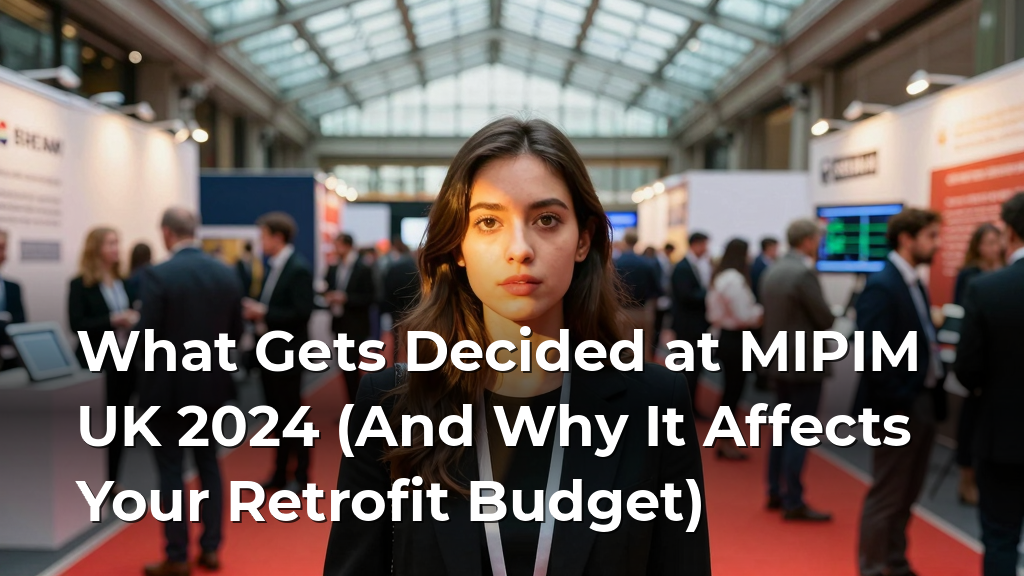

MIPIM UK 2024 returns to London on 30-31 October. The conference brings together 20,000 real estate investors, developers, and proptech vendors at the Business Design Centre in Islington. If you run buildings for a living, you should know what happens there. Not because you need another networking badge. Because the capital decisions made in those rooms determine your retrofit budget for the next five years.
Why a Building Operator Should Care About an Investment Conference
MIPIM UK is not a facilities management show. It is a capital allocation event. Pension funds, sovereign wealth funds, and private equity firms attend to decide where to put billions of pounds. Those decisions flow directly into your building's P&L.
When an investor decides a building needs a BREEAM Outstanding rating to attract tenants, that becomes a capex line item you will manage. When a fund mandates net-zero pathways across its portfolio, your chiller replacement schedule gets accelerated. When a developer commits to a new hotel in Manchester city centre, someone will need to commission its BMS and train the engineering team.
The 2024 edition has a specific focus on retrofit finance, operational efficiency, and proptech that actually delivers measurable outcomes. That is a shift from previous years, where the conversation centred on shiny new developments and speculative tech. For a building operator, this shift matters because it changes the compliance timeline. Retrofit finance mechanisms, such as green bonds or sustainability-linked loans, come with performance covenants tied to energy intensity or water usage. If your building is part of a portfolio that secures such financing, you will be responsible for reporting against those covenants quarterly. The operational efficiency track at MIPIM UK signals that investors are now scrutinising how a building runs, not just how it was designed. This means your preventive maintenance schedules, sub-metering accuracy, and tenant engagement protocols become due diligence items during capital raises. Furthermore, the emphasis on proptech with measurable outcomes implies that your existing tech stack—whether a BMS, an energy management platform, or a work order system—will be evaluated for its ability to produce auditable data. If it cannot, expect pressure to replace it with solutions that integrate directly into investor reporting dashboards. The conference is effectively rewriting the operational standards that will govern your daily workflow for the next five to ten years.
Three Things to Watch at MIPIM UK 2024
1. The Retrofit Finance Conversation
UK commercial buildings account for roughly 20% of the country's carbon emissions. The regulatory pressure to improve EPC ratings is real and accelerating. By 2028, all commercial rented properties in England and Wales must have an EPC rating of C or better. By 2030, that moves to B.
At MIPIM UK, expect multiple sessions on how to fund these upgrades. The UK Green Building Council, the Better Buildings Partnership, and several major lenders will present retrofit finance models. For a facilities manager, the key takeaway is this: the money is becoming available, but it comes with reporting requirements. You will need to prove energy savings, carbon reductions, and occupant comfort improvements. That means data. Granular, verifiable, hourly data from your building systems.
If your building still relies on manual meter reads or quarterly utility bills, you will struggle to access this capital. The investors at MIPIM UK are looking for buildings with digital infrastructure already in place.
2. The Proptech Reality Check
Proptech has a credibility problem with building operators. Too many platforms promise AI-driven optimisation and deliver a dashboard that looks nice but cannot talk to a chiller plant. MIPIM UK 2024 includes a dedicated Proptech Forum, and the organisers have explicitly asked vendors to demonstrate measurable outcomes, not just product demos.
This is a good sign. It means the investment community has started asking the same questions you ask: Does this software reduce energy consumption? Does it help my team respond faster to tenant complaints? Does it integrate with my existing BACnet or Modbus systems? Does it survive contact with a real building?
If you attend, spend time in the proptech area. Ask the vendors hard questions. Ask for references from buildings similar to yours. A platform that works well in a 50,000 sq ft London office may struggle in a 280-room hotel in Dubai Marina with a VRF system and a legacy BMS.
3. The Regulatory Timeline
Several sessions will cover the regulatory landscape for UK commercial property through 2030. The key dates to know:
- 2025: Minimum Energy Efficiency Standards (MEES) tighten. EPC E becomes the floor for new lets.
- 2028: EPC C minimum for all commercial rented properties.
- 2030: EPC B minimum. Net-zero carbon ready becomes mandatory for new developments.
These deadlines are not theoretical. They will affect your building's lettability, its valuation, and your operating budget. A building that cannot meet the 2028 standard will lose tenants to buildings that can. A building that meets the 2030 standard early will command a rental premium.
For a chief engineer or facilities manager, the practical implication is clear: start planning your retrofit pathway now. A phased approach over five years is cheaper and less disruptive than a crash programme in 2027.
What This Means for GCC Operators
If you manage buildings in Dubai, Abu Dhabi, Riyadh, or Doha, MIPIM UK still matters. The same institutional investors who attend MIPIM UK also invest in GCC real estate. The capital standards they apply in London will eventually apply in the Gulf. This is not a distant possibility; it is a process already underway, accelerated by the convergence of regulatory pressure and investor due diligence. The conversations at MIPIM UK this year made it clear that the gap between a "compliant" asset and a "premium" asset is now defined by the granularity of its operational data.
Dubai's RERA already mandates digital record-keeping for property managers. Abu Dhabi's mandatory efficiency audits begin in Q4 2024. Saudi Arabia's Mostadam certification is becoming a requirement for new developments. The global trend is clear: buildings must be efficient, compliant, and data-driven. But the deeper implication for GCC operators is that these regulations are not isolated local rules. They are part of a broader alignment with international reporting frameworks like GRESB and the EU Taxonomy. When a UK-based pension fund evaluates a tower in Riyadh, it applies the same data transparency criteria it uses for a London office. If your building cannot produce auditable energy consumption logs, real-time occupancy metrics, or maintenance histories in a standardized format, that fund will simply allocate capital elsewhere.
If your building systems cannot produce the data that investors and regulators now demand, you will face a choice. Invest in digital infrastructure now, or watch your building's value decline relative to competitors who already have it. The cost of retrofitting a legacy BMS to meet these standards is rising as demand for skilled integrators outstrips supply. Operators who delay risk not only lower valuations but also higher compliance penalties as regulators tighten enforcement timelines. The window for proactive investment is narrowing; the operators who act before the next audit cycle will define the market benchmark, while those who wait will be forced into reactive, more expensive upgrades.
Where to Start
MIPIM UK 2024 is a useful barometer for where the industry is heading. The capital decisions made there will shape your retrofit budget, your compliance timeline, and your building's competitive position. Pay attention to the retrofit finance models, the proptech vendors who can actually deliver, and the regulatory deadlines that are closer than they feel.
The real challenge isn't identifying the trends — it's knowing where to begin when your portfolio spans multiple vintages, tenures, and regulatory regimes. For operators across the GCC and the UK, the starting point is often the same: you need a single source of truth for building performance data that your existing BMS, energy meters, and compliance logs already generate but rarely talk to one another. Without that baseline, every retrofit decision becomes a guess, every compliance deadline a scramble, and every capital allocation a gamble on incomplete information. The forums at MIPIM will surface new financing mechanisms and vendor solutions, but none of them will work unless you have the operational data infrastructure to validate their claims against your actual buildings. This is where the gap between aspiration and execution widens — and where a platform that ingests, normalises, and acts on real-time building data becomes the prerequisite for every other investment you make.
If you want to see how a platform that talks to real building systems can help you prepare for what is coming, talk to the HermanWa team. We work with operators across the GCC and the UK who need to turn building data into action, not just dashboards.
— The HermanWa Team
Until next time — keep the evidence closer than the deadline.
Walk into your next senior management meeting with the answers
The free Director's Risk Check for UK portfolios takes five minutes. No sign-up to see your score.
- Your control score across compliance, evidence, oversight, cost and renewals
- The breach exposure in your portfolio, with the official source for each penalty
- A board-ready briefing with your three priorities and a 30/60/90-day plan
About HermanWa
HermanWa is a building compliance and operations platform for property and facilities teams in the United Kingdom and Singapore, with portfolios across the Gulf. It keeps one auditable file per building — statutory deadlines, inspection evidence, contractor work, energy and carbon — and its AI assistant, Herman, answers questions about your buildings in plain English. HermanWa tracks obligations including fire risk assessments and fire door checks, Building Safety Act duties, Legionella (ACOP L8), EICR, gas safety and EPC in the UK, and SCDF fire certificates, Periodic Facade and Structural Inspections, lift permits and Green Mark in Singapore. Directors can check their exposure with the free Director's Risk Check.