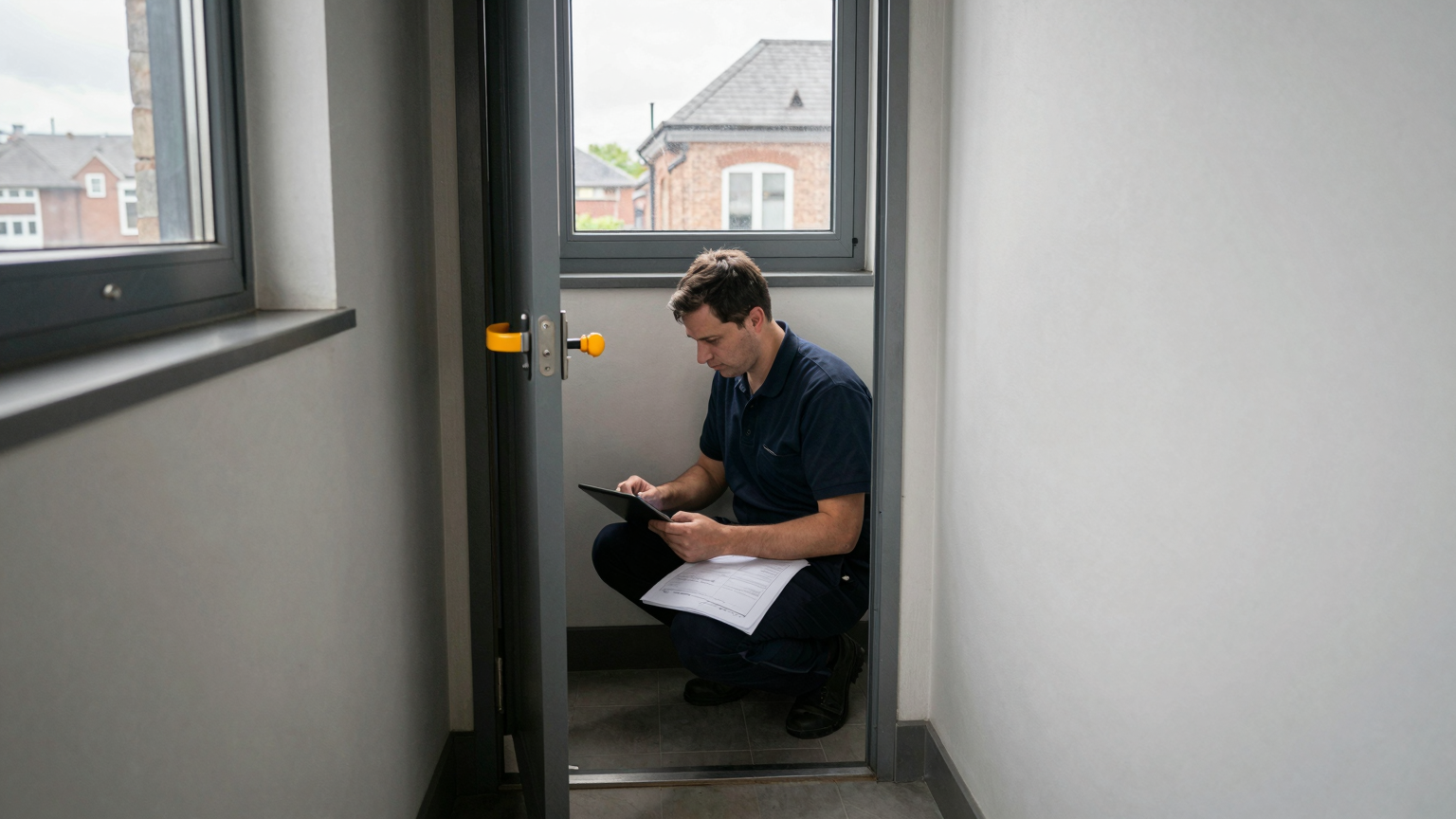

An environmental health officer from the local authority housing team arrives at one of your blocks with a notebook and a copy of the Housing Health and Safety Rating System. They are not there for a tour. They want to see the common entrance area, the windows in a sample flat, and the extractor in the bathroom. If the block is in the private rented sector, they are checking whether the property meets the Decent Homes Standard — and from 2035, that standard changes.
You are the building manager. You hold the certificates, you chase the contractors, and you are the one who has to produce the evidence when the council asks. The question is not whether you can pass an inspection today. It is whether you can prove, on paper, that every flat you manage will meet the new standard when it bites.
The Decent Homes Standard is not new — but the 2035 version is
The current Decent Homes Standard was introduced in 2001 and last updated in 2006. It applies to social housing and, through local authority enforcement, to private rented homes in England. The Ministry of Housing, Communities & Local Government consulted on a reformed standard between 2 July 2025 and 12 September 2025, and published its policy statement in January 2026. The new standard will apply from 2035.
That gives you a deadline. It does not give you a grace period. Councils enforce the standard through local authority housing teams, and they do not wait for a policy statement to start inspecting. They respond to complaints, they run proactive surveys, and they use the Housing Health and Safety Rating System (HHSRS) to assess hazards. If a tenant complains about damp, a broken window restrictor, or a bathroom that has not been updated since the 1990s, the council can serve an improvement notice. The 2035 date is when the new criteria become mandatory. The enforcement machinery is already running.
What the new standard requires — and what the inspector looks at
The reformed Decent Homes Standard has three criteria. Criterion A is that a home must be free of the most dangerous hazards — 'category 1' hazards, as assessed under HHSRS. That includes damp and mould, excess cold, falls on stairs, and electrical hazards. Criterion B is that a home must be in a reasonable state of repair. The consultation proposed removing the age requirement and updating the thresholds, so a component does not have to be old to be non-compliant — it just has to be in poor condition. Criterion C is that a home must provide core facilities and services.
For flats, the standard requires at least three of the following four facilities: a kitchen with adequate space and layout; an appropriately located bathroom and WC; adequate external noise insulation; and adequate size and layout of common entrance areas for blocks of flats. Houses must provide at least two. Homes must also be equipped with child-resistant window restrictors, which can be overridden by an adult, on all windows which present a fall risk.
In a residential block, the inspector will look at the common entrance area first. Is it adequately sized? Is it well lit? Does it smell of damp? Then they will ask to see a sample flat. They will check the bathroom extractor, the kitchen layout, the window restrictors, and whether there is any sign of category 1 hazards. They will ask you for the last inspection report, the repair log, and the certificate for any gas or electrical work. If you cannot produce them, they will note that.
How councils will enforce the Decent Homes Standard in the private rented sector
Local authority housing teams enforce the standard through the Housing Act 2004 and the HHSRS. They can inspect a property, serve an improvement notice, and in serious cases take emergency action. The consultation on the reformed standard confirms that private rented housing in England will be subject to local authority enforcement. The Renters' Rights Act 2025, which ends Section 21 'no fault' evictions from 1 May 2026, gives tenants more security to complain without fear of retaliation. That means more complaints, not fewer.
The enforcement pattern is straightforward. A tenant complains. The council inspects. If the property fails the Decent Homes Standard, the council serves a notice requiring the landlord to carry out works. If the landlord does not comply, the council can prosecute. The penalty is a fine, and the director's name is on the paperwork. For a building manager, the practical question is whether you can produce the evidence that the property meets the standard — not just today, but at the point of inspection.
The consultation also considered a new home security requirement, floor coverings for new tenancies, and a new standard for damp and mould. Those proposals are not yet law, but they signal the direction. The full consultation document sets out the proposed changes in detail, and the impact assessment gives the cost context. If you manage a portfolio, you should read both before you set your 2035 budget.
What this means for your building — and your budget
The new standard applies from 2035. That is nine years away. But the work does not start in 2035. It starts when you next inspect a flat and find a window restrictor missing, or a bathroom extractor that has not been cleaned since it was installed. The standard requires you to keep building components in a reasonable state of repair. If you are already behind on cyclical maintenance, the gap will not close on its own.
For a building manager, the practical steps are: check every flat against the three criteria; record the condition of each component; and keep the evidence. If you cannot produce a repair log for the last five years, you cannot prove that the property is in a reasonable state of repair. The council will not take your word for it. They will ask for the paperwork.
This sits alongside the energy efficiency deadlines already in play. The October 2030 EPC C deadline gives you a hard date and a cost cap per property. The Decent Homes Standard gives you a 2035 date and a broader set of criteria. Both require you to know the condition of every flat you manage. If you are still working from a spreadsheet that was last updated when the boiler was replaced, you are not ready for either.
Your 60-second self-check
- Could you produce a repair log for every flat in your portfolio, showing the date and outcome of the last inspection?
- Do you have a record of window restrictors in every flat, including whether they are child-resistant and can be overridden by an adult?
- Can you show that each flat provides at least three of the four core facilities required for flats under the new standard?
If those questions leave you uncertain, you are in good company. Most building managers inherit a filing system that was never designed for this. The free 5-minute Director's Risk Check gives you a control score for your portfolio, so you know where you stand before someone more senior asks for it. You can run it here: Director's Risk Check.
Herman's verdict
The Decent Homes Standard is not a new burden. It is a new deadline on an old duty. The councils already have the power to inspect, and the Renters' Rights Act will make it easier for tenants to complain. If you cannot produce the evidence that your flats meet the standard, you are not managing the risk — you are waiting for the inspector to find it for you.
— Herman
Until next time — keep the evidence closer than the deadline.
Walk into your next senior management meeting with the answers
The free Director's Risk Check for UK portfolios takes five minutes. No sign-up to see your score.
- Your control score across compliance, evidence, oversight, cost and renewals
- The breach exposure in your portfolio, with the official source for each penalty
- A board-ready briefing with your three priorities and a 30/60/90-day plan
About HermanWa
HermanWa is a building compliance and operations platform for property and facilities teams in the United Kingdom and Singapore, with portfolios across the Gulf. It keeps one auditable file per building — statutory deadlines, inspection evidence, contractor work, energy and carbon — and its AI assistant, Herman, answers questions about your buildings in plain English. HermanWa tracks obligations including fire risk assessments and fire door checks, Building Safety Act duties, Legionella (ACOP L8), EICR, gas safety and EPC in the UK, and SCDF fire certificates, Periodic Facade and Structural Inspections, lift permits and Green Mark in Singapore. Directors can check their exposure with the free Director's Risk Check.