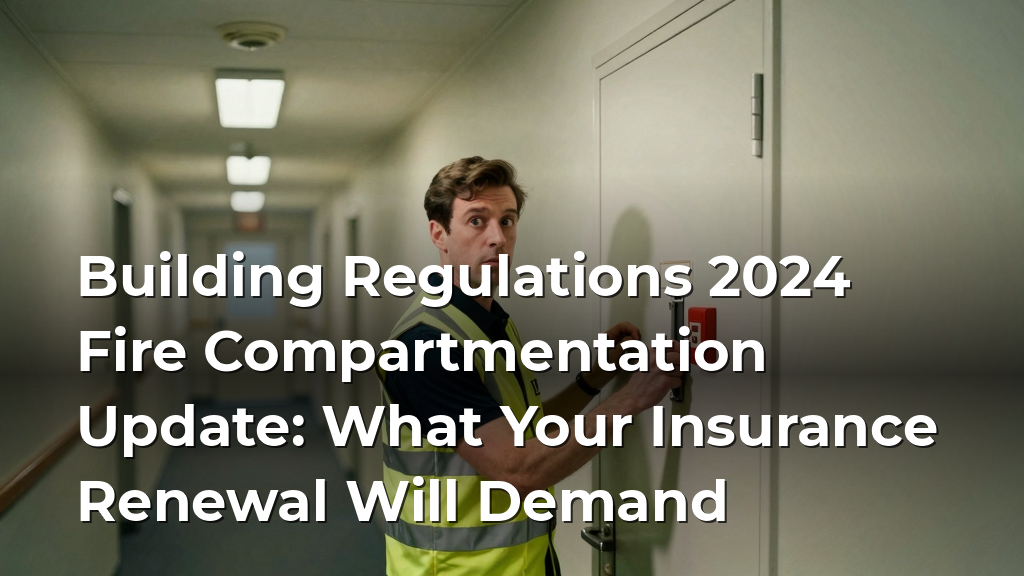

The Building Regulations 2024 update landed with a quiet thud that every facilities manager should hear. The new guidance on fire safety in compartmentation and escape routes is not a suggestion. It is the standard that building control bodies will enforce, and that insurers will ask about at renewal.
If you manage a commercial building, a multi-residential block, or a hotel in the UK, this affects your next fire risk assessment, your next capital plan, and your personal liability under the Fire Safety Act 2021. Here is what changed and what to do about it.
Compartmentation Standards Just Got Tighter
Compartmentation is the passive fire protection that stops fire and smoke moving from one part of a building to another. Think fire-resisting walls, floors, and the seals around every pipe and cable that passes through them.
The 2024 update clarifies that compartmentation must be continuous and fully documented. That means:
- Every service penetration — electrical, plumbing, data, HVAC ducts — must have a tested and certified fire stop.
- Fire-resisting walls must extend from the structural floor slab to the underside of the roof or the floor above. No gaps in ceiling voids.
- Compartment lines must be clearly marked on as-built drawings and verified by a competent person.
For existing buildings, the guidance is retrospective where material alterations are made. If you replace a ceiling, add a new data cable run, or install a new AHU, you must check that the compartmentation around that work meets the 2024 standard.
A 180-room hotel in Manchester city centre found this out the hard way last year. A routine fire risk assessment identified 47 unsealed penetrations in a single riser. The remediation cost £23,000 and took three weeks of night works. The alternative — a prohibition notice from the fire authority — would have closed six floors.
Escape Route Design: Width, Travel Distance, and Fire Doors
The 2024 update tightens three specific areas of escape route design.
Width. Escape routes must now accommodate the calculated occupant load with a minimum clear width of 1,200mm for the first 45 people, plus 5mm per additional person. That is wider than previous guidance for many buildings. If your corridor is pinched by a plant room door or a cleaning cupboard, measure it. If it does not meet the new width, you need a management plan or a physical alteration.
Travel distance. The maximum travel distance to a protected stairway or final exit has been reduced in some building types. For multi-residential blocks with a single stair, the limit is now 7.5 metres from any flat entrance to the stair door. For open-plan offices, the limit is 18 metres in one direction or 45 metres with two directions of travel. Check your floor plans against these numbers.
Fire doors. Every fire door on an escape route must be self-closing, fitted with intumescent strips and cold smoke seals, and certified to BS 476-22 or BS EN 1634-1. The 2024 update adds that fire doors must be inspected at least every six months by a competent person, with records kept for the lifetime of the door. That is not a suggestion. It is a compliance requirement.
If you have 200 fire doors in a building, that is 400 inspections per year. Budget for it.
Fire Detection Systems: What the 2024 Update Expects
The detection side of the 2024 update focuses on coverage and reliability.
All escape routes must have automatic detection. That includes corridors, stairways, and lobbies. In multi-residential buildings, detection must extend into common areas and, for new builds, into each flat. The standard is BS 5839-1 Category L2 or higher, depending on the building height and use.
Detection systems must be tested weekly, serviced every six months, and have a full inspection annually. The inspection must include a check of every detector, sounder, and control panel. Records must be kept for three years and made available to the fire authority on request.
For buildings with a BMS, the 2024 update encourages integration. A fire alarm signal should automatically trigger smoke control systems, release magnetic door holders, and send a notification to the building manager's phone. If your BMS does not do this, it is worth asking your system integrator whether a software update can add it.
One practical note: if your detection system uses radio-linked detectors, check the battery replacement schedule. A detector that chirps at 3am because its battery is low is not just annoying. It is a compliance gap until it is fixed.
What This Means for GCC Buildings
If you manage buildings in the GCC, the UK 2024 update is not directly enforceable. But it is a useful benchmark.
Dubai Municipality's fire and life safety code already requires compartmentation, escape route widths, and detection standards that are broadly similar. The 2024 UK update is more prescriptive on documentation and inspection frequency. If your building in Dubai or Riyadh meets the UK 2024 standard, it will comfortably exceed local requirements.
More importantly, international investors and insurers increasingly apply UK standards as a baseline. If you are preparing a building for sale or refinancing, having a fire safety file that matches the 2024 UK standard will speed up due diligence and may reduce your premium.
We covered the Fire Safety Act 2021 and its impact on multi-occupied buildings in an earlier post. The 2024 update is the operational detail that makes that legislation real.
Where to Start
Start with your fire risk assessment. If it was completed before January 2024, it may not reflect the new guidance. Ask your fire safety consultant to review it against the 2024 update, specifically compartmentation continuity, escape route widths, and detection coverage.
Then audit your documentation. Do you have as-built drawings showing compartment lines? Do you have inspection records for every fire door? Do you have a log of every service penetration and its fire stop certification? If the answer to any of these is no, that is your priority.
Finally, talk to your BMS provider about integration. A fire alarm that only sounds a siren is a missed opportunity. One that tells your BMS to close fire dampers, pressurise stairwells, and send a text to the duty manager is a system that works.
If you want to see how Herman can help you track fire safety inspections, log compartmentation records, and integrate your detection system with your building data, talk to the HermanWa team. We do not sell fire safety kit. We help you manage the compliance that comes with it.
— The HermanWa Team
Until next time — keep the evidence closer than the deadline.
Walk into your next senior management meeting with the answers
The free Director's Risk Check for UK portfolios takes five minutes. No sign-up to see your score.
- Your control score across compliance, evidence, oversight, cost and renewals
- The breach exposure in your portfolio, with the official source for each penalty
- A board-ready briefing with your three priorities and a 30/60/90-day plan
About HermanWa
HermanWa is a building compliance and operations platform for property and facilities teams in the United Kingdom and Singapore, with portfolios across the Gulf. It keeps one auditable file per building — statutory deadlines, inspection evidence, contractor work, energy and carbon — and its AI assistant, Herman, answers questions about your buildings in plain English. HermanWa tracks obligations including fire risk assessments and fire door checks, Building Safety Act duties, Legionella (ACOP L8), EICR, gas safety and EPC in the UK, and SCDF fire certificates, Periodic Facade and Structural Inspections, lift permits and Green Mark in Singapore. Directors can check their exposure with the free Director's Risk Check.