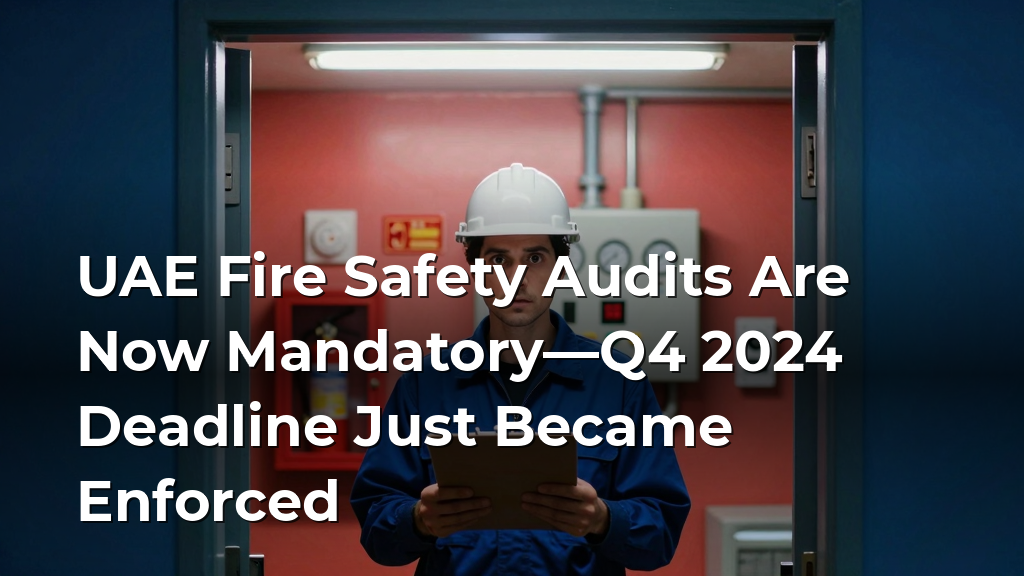

If you manage a commercial building, hotel, or healthcare facility in the UAE, you now have a new annual deadline. Starting Q4 2024, every facility in scope must undergo a third-party fire safety audit and obtain certification. This is not a recommendation. It is a mandatory program across all seven emirates, enforced by local civil defence authorities.
The regulation applies to existing buildings, not just new ones. If your building has a fire safety system — sprinklers, alarms, smoke control, emergency lighting — it must be inspected and certified annually by an approved third-party auditor. The audit covers system functionality, maintenance records, and occupant safety measures.
For facilities managers and hotel chief engineers already juggling chiller plant efficiency, tenant complaints, and carbon reporting, this is another compliance item. But it is also an opportunity to close gaps before enforcement begins.
What the Mandate Requires
The UAE Fire and Life Safety Code has always required periodic inspections. What changed is enforcement. The new program mandates:
- Annual third-party audit by a Dubai Civil Defence (DCD) approved fire safety consultant
- Certification of all active and passive fire protection systems
- Submission of audit reports to the relevant civil defence authority
- Display of valid fire safety certificate on premises
Non-compliance carries penalties. These include fines, closure orders, and potential liability if an incident occurs without a valid certificate. For hotels, a lapse could also affect your operating license renewal.
The scope covers commercial offices, hotels, healthcare facilities, educational institutions, and multi-tenant residential buildings above a certain height or occupancy threshold. If you manage a 280-room business hotel in Dubai Marina or a 15-storey office tower in Abu Dhabi's Al Reem Island, you are in scope.
Why This Matters for Your Building's Operations
Fire safety compliance is not just about passing an inspection. It is about knowing your systems work when they need to. A sprinkler system that has not been flow-tested in three years might pass a visual inspection. It will not pass a functional test under the new regime.
We have seen hotels where the fire alarm panel shows a fault that has been acknowledged but never resolved. We have seen commercial buildings where emergency lighting batteries are past their replacement date. These are the items the audit will catch.
The cost of remediation after a failed audit is higher than the cost of preparation. A failed audit means re-inspection fees, potential downtime, and reputational risk. For a hotel, a failed fire safety certificate can mean blocked bookings on OTAs until resolved.
For asset managers and building owners, this affects valuation. A building without a valid fire safety certificate cannot be legally occupied. If you are selling or refinancing, the certificate will be a due diligence item.
How to Prepare for the Audit
Start now. Do not wait for the Q4 deadline. Here is what to do:
1. Review Your Current Fire Safety Documentation
Gather all existing fire safety records: maintenance logs, test certificates, inspection reports, and previous audit findings. If you have digital records, this is straightforward. If you still rely on paper files, this is the moment to digitise them. RERA's 2024 mandate already made paper records a liability for Dubai buildings. The fire safety audit will compound that risk.
2. Conduct a Pre-Audit Walkthrough
Walk every floor. Check fire extinguisher tags. Test emergency lighting. Verify that fire doors close fully and are not wedged open. Check that sprinkler heads are not painted or obstructed. These are the items that fail most often.
If you have a BMS, pull the fire alarm test logs. If you have not run a full evacuation drill in the past 12 months, schedule one. The auditor will ask for drill records.
3. Engage an Approved Third-Party Auditor Early
Approved auditors will be in high demand as Q4 approaches. Book your audit now. Ask for a pre-audit assessment to identify gaps before the formal inspection. This costs less than a re-inspection.
4. Plan for Remediation Work
If your building has deferred maintenance on fire systems, budget for it now. Replacing a fire alarm panel or upgrading a sprinkler system takes time and money. If you wait until after a failed audit, you will pay rush premiums and face occupancy restrictions.
For heritage buildings or older properties, compliance may require system upgrades. The UK's Fire Safety Act 2021 created similar pressures for multi-occupied buildings. The UAE mandate is less complex but equally enforceable.
What This Means for Hotels and Hospitality
Hotels face additional scrutiny. Guest safety is the top priority for any operator. A fire incident in a hotel is catastrophic — not just for life safety, but for brand reputation.
The audit will check:
- Guest room smoke detectors and sprinklers
- Corridor fire doors and compartmentation
- Kitchen hood suppression systems
- Emergency evacuation plans and staff training records
- Back-of-house fire safety, including plant rooms and laundry areas
For a 320-room resort on the Palm Jumeirah, the audit scope is substantial. Start preparing now. Assign one person on your engineering team to own the fire safety certification process. Give them the time and budget to close gaps.
How Herman Can Help
Fire safety compliance generates data. Inspection reports, test logs, certification dates, remediation tickets. If you track this manually, you will miss a deadline eventually.
HermanWa's platform lets you store all fire safety documentation in one place, set reminders for annual audits, and track remediation work from detection to sign-off. You can ask Herman in plain English: "When is our next fire safety audit due?" or "Show me all open fire safety tickets."
For facilities managers who already use Herman for energy monitoring and maintenance tracking, adding fire safety compliance is a natural extension. One platform. One source of truth. No more hunting through email threads for last year's certificate.
If you manage multiple buildings, the platform gives you a portfolio-wide view of compliance status. You can see which properties have valid certificates and which need action, all from a single dashboard.
Where to Start
The Q4 2024 deadline is fixed. Enforcement will begin on schedule. Do not let a fire safety certificate become the reason your building cannot operate.
Review your current fire safety documentation today. Book your third-party audit this month. And if you want a simpler way to track compliance across your portfolio, see how Herman handles this.
— The HermanWa Team
Until next time — keep the evidence closer than the deadline.
Walk into your next senior management meeting with the answers
The free Director's Risk Check for UK portfolios takes five minutes. No sign-up to see your score.
- Your control score across compliance, evidence, oversight, cost and renewals
- The breach exposure in your portfolio, with the official source for each penalty
- A board-ready briefing with your three priorities and a 30/60/90-day plan
About HermanWa
HermanWa is a building compliance and operations platform for property and facilities teams in the United Kingdom and Singapore, with portfolios across the Gulf. It keeps one auditable file per building — statutory deadlines, inspection evidence, contractor work, energy and carbon — and its AI assistant, Herman, answers questions about your buildings in plain English. HermanWa tracks obligations including fire risk assessments and fire door checks, Building Safety Act duties, Legionella (ACOP L8), EICR, gas safety and EPC in the UK, and SCDF fire certificates, Periodic Facade and Structural Inspections, lift permits and Green Mark in Singapore. Directors can check their exposure with the free Director's Risk Check.