 Free checklist · UAEUAE Fire & Life Safety audit checklistEvery Civil Defence duty for an operating building, with who enforces it, how often, the published penalty and the steps to walk it.Get the free checklist →
The inspector stands at the hotel reception desk and asks the duty manager for the civil defence certificate for the building. The duty manager calls the facilities manager. The facilities manager calls the contractor. The contractor says the renewal is in progress. Somewhere in London or Singapore, a director who has never seen the certificate is now the person whose name sits on the file when the notice arrives.
That sequence is common in hotels and serviced apartments in Dubai, because the building is run by people who do not hold the paperwork and owned by people who are judged on it. If you own the asset from another country, the certificate is the point where your liability becomes visible.
The stakes: the certificate is the owner's problem, not the operator's
Dubai Civil Defence is the authority that inspects buildings for fire and life safety and issues the certificate that confirms the building meets the required standard. The certificate is not a courtesy document. It is the evidence that the building is fit to occupy and operate, and it is what the inspector, the insurer and the licensing authority will ask for. When it is missing or expired, the enforcement action does not stop at the building manager who could not produce it. It travels up the ownership chain to the entity that holds the asset.
For a hotel or serviced apartment, the exposure is wider than a single certificate. The building has guests sleeping in it, staff working in it, kitchens, plant rooms, and often a mixed-use podium underneath. Each of those areas has its own inspection point, and each one can fail independently.
Free checklist · UAEUAE Fire & Life Safety audit checklistEvery Civil Defence duty for an operating building, with who enforces it, how often, the published penalty and the steps to walk it.Get the free checklist →What the inspector actually looks at in a hotel or serviced apartment
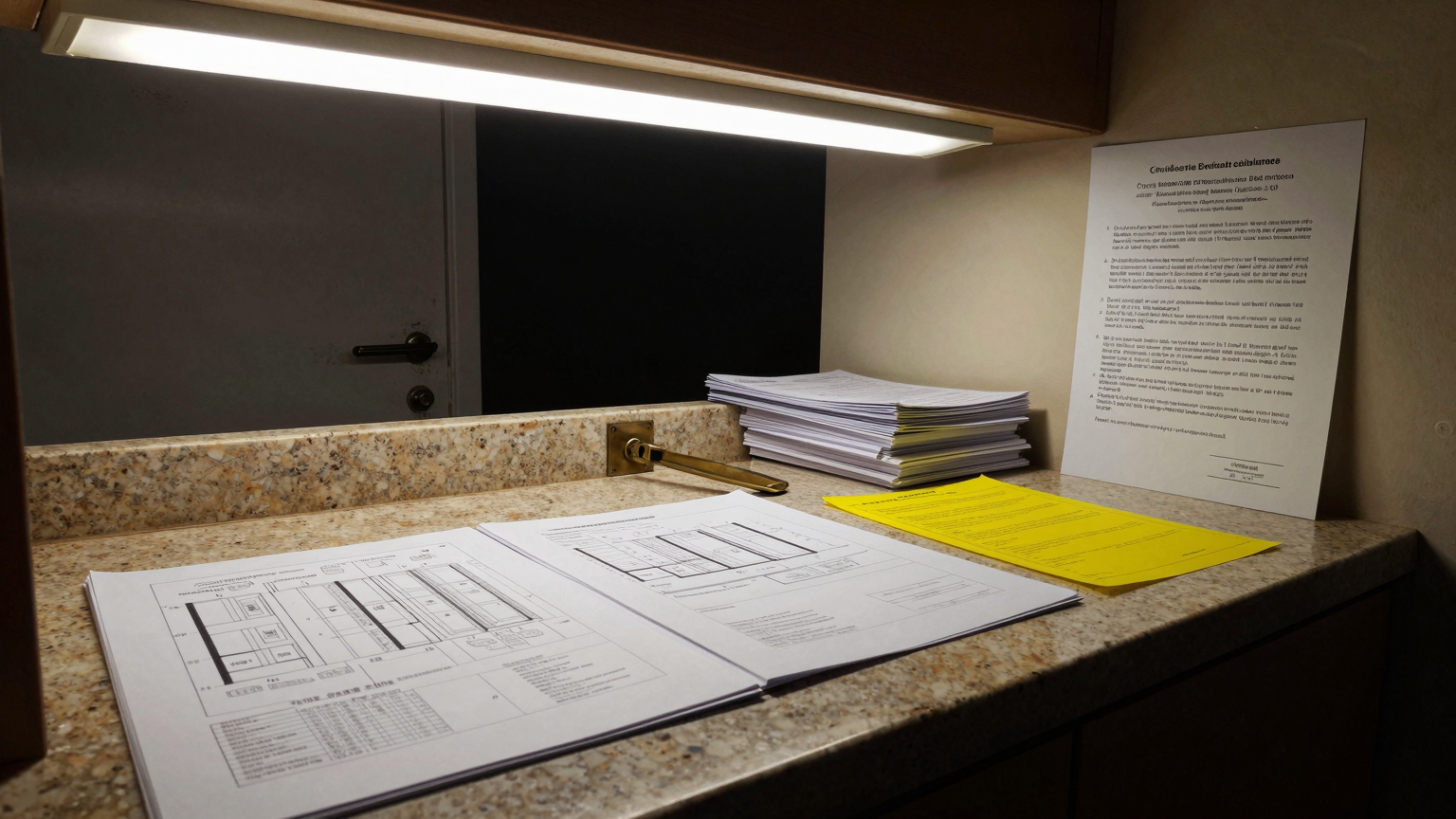
In a hotel, the inspection is not a single walk-through. The inspector looks at the fire alarm and detection system, the emergency lighting, the fire doors on guest floors and back-of-house corridors, the means of escape, the kitchen suppression system, and the records that show these have been maintained. In a serviced apartment block, the same list applies, with more attention to the shared corridors and the interface between the residential units and any retail or F&B space at ground level.
The certificate is the output of that inspection. It is not a substitute for the maintenance records, and the inspector will ask for both. A current certificate with no maintenance log behind it is a thin defence when something goes wrong.
This is where the building manager's week gets difficult. The contractor who services the fire system holds the service sheets. The MEP contractor holds the pump records. The lift contractor holds a separate file. The certificate sits somewhere in between, and nobody on site owns the whole picture. If you want to see how this plays out in the wider Dubai fire safety regime, the changes to the fire code and the move to smart fire systems have both added requirements that sit on top of the certificate itself.
What the regulator relied on, and which duty was missed
The enforcement pattern in Dubai building safety runs through a small number of duties. The owner or the entity responsible for the building must keep the fire safety systems maintained, must keep the records that prove it, and must hold a valid certificate. When an inspection finds a gap, the regulator relies on the maintenance record and the certificate date. If either is missing, the duty that was missed is usually the duty to keep and produce evidence, not the duty to install the system in the first place.
That distinction matters for a director. The system may be perfectly adequate. The failure is that nobody can prove it on the day. The Dubai Land Department's rules and regulations library and the Dubai Municipality legislation pages both set out the wider compliance framework that sits around the certificate, and the Ministry of Economy & Tourism's AML supervision pages show how the same evidence-based approach runs through other parts of the Dubai regulatory stack. The principle is consistent: the regulator asks for the document, and the document has to exist before the question is asked.
For a hotel owner in London or Singapore, the practical consequence is that the certificate is a portfolio-level risk item, not a site-level admin task. If you cannot see the certificate status for every Dubai asset in one place, you are relying on the operator to tell you, and the operator is relying on the contractor.
How you would fare in the same audit
Run the audit in your head. The inspector asks for the current civil defence certificate for the hotel. You have it. The inspector asks for the maintenance records for the fire alarm system for the last twelve months. The building manager produces the contractor's service sheets, but two visits are missing and the contractor has changed ownership. The inspector asks for the fire door inspection records for the guest floors. Those sit with a different contractor, and the file is incomplete.
The certificate was valid. The evidence behind it was not. In an enforcement breakdown, that is the gap that turns a routine inspection into a notice, and a notice into a board agenda item. The same pattern applies to the evacuation rules for mixed-use towers, where the interface between the hotel and the retail podium adds another set of records to the file.
The fix is not a new system. It is a single view of which certificates and records exist for each building, who holds them, and when they expire. That is the part most portfolios in this market are missing.
Your 60-second self-check
- Could you produce the current civil defence certificate for every Dubai hotel and serviced apartment you own, today, without calling the operator?
- Could you show the maintenance records behind that certificate for the last twelve months, including the fire alarm, emergency lighting and fire door inspections?
- Do you know which contractor holds each record, and what happens to that file when the contract changes?
The audit or the renewal will take days of your team's time. The free 5-minute Director's Risk Check takes less time than the phone call to the operator, and it gives you a control score and a board-ready briefing on where your Dubai portfolio's compliance exposure actually sits. Send it to the colleague who holds the certificates and let the check do the chasing.
Herman's verdict
A civil defence certificate is not a document that proves your building is safe. It is a document that proves you can prove it. The owners who get caught in Dubai are rarely the ones with the worst buildings. They are the ones who could not produce the file when the inspector asked.
— Herman
Until next time — keep the evidence closer than the deadline.
Walk your building before Civil Defence does
The free UAE Fire & Life Safety audit checklist: every duty with who enforces it, how often it recurs, the published penalty and the official source.
- Civil Defence completion certificate, fire system maintenance contract and Hassantuk
- Evacuation drills, gas systems, security systems and lifts
- The steps to walk each duty, ready to print or save as PDF
Prefer to talk it through? Book a 20-minute walkthrough
About HermanWa
HermanWa is a building compliance and operations platform for property and facilities teams in the United Kingdom and Singapore, with portfolios across the Gulf. It keeps one auditable file per building — statutory deadlines, inspection evidence, contractor work, energy and carbon — and its AI assistant, Herman, answers questions about your buildings in plain English. HermanWa tracks obligations including fire risk assessments and fire door checks, Building Safety Act duties, Legionella (ACOP L8), EICR, gas safety and EPC in the UK, and SCDF fire certificates, Periodic Facade and Structural Inspections, lift permits and Green Mark in Singapore. Directors can check their exposure with the free Director's Risk Check.