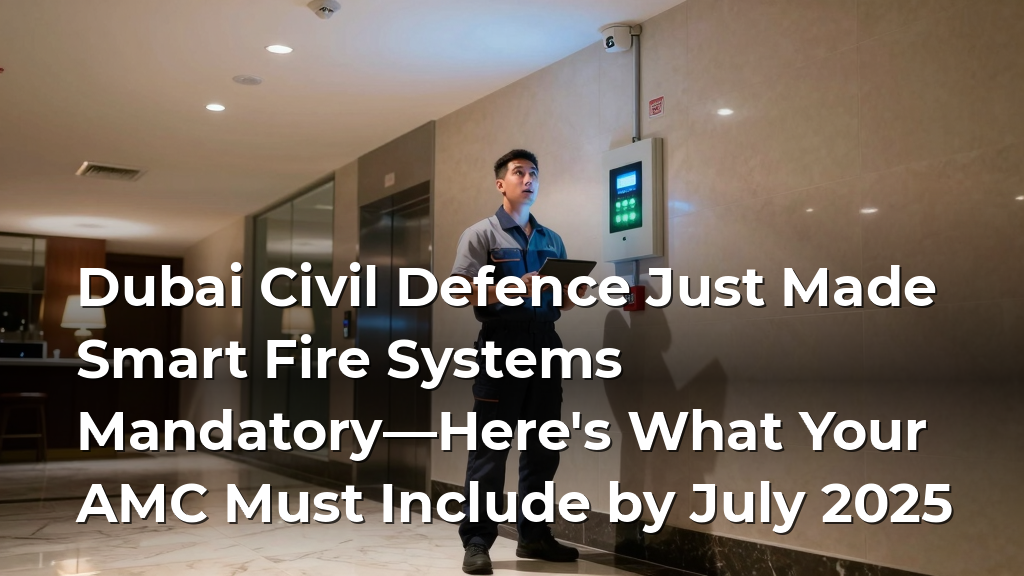

If you manage a hotel in Dubai, your fire safety compliance just got more expensive — and more connected. The 2025 update to the UAE Fire & Life Safety Code now requires all hotels to install IoT-enabled smart fire systems that link directly to Civil Defence control centres. This isn't a pilot programme or a voluntary guideline. It's a mandatory condition of your Annual Maintenance Contract (AMC) with a DCD-approved provider.
What the 2025 Code Actually Changes
The core requirement hasn't changed: every hotel must hold a valid AMC with a Dubai Civil Defence-approved company for its fire detection and alarm systems. What's new is the connectivity mandate. Your fire panel must now transmit real-time data — alarm activations, fault signals, system health status — to a central monitoring station that feeds into Civil Defence's command centre.
This means your existing fire alarm system needs to speak BACnet, Modbus, or an approved IoT protocol. If your current panel is a standalone unit with no network interface, you're looking at a retrofit. For a 200-room hotel in Deira, that typically runs between AED 45,000 and AED 80,000 depending on panel age and wiring complexity.
The deadline is staggered by building type. Hotels and hospitality properties are in the first wave. Compliance must be demonstrated by Q3 2025 for new AMC renewals. Existing contracts that don't meet the connectivity standard will not be renewed by DCD-approved providers.
Why Civil Defence Wants Your Data in Real Time
The logic is straightforward. In a fire event, every second matters. A traditional fire alarm system alerts occupants in the building, then someone calls Civil Defence. The response time from call to arrival is typically 6–8 minutes in central Dubai. With direct monitoring, Civil Defence receives the alarm signal within 30 seconds of activation, along with the exact zone and device that triggered it.
This isn't theoretical. In 2024, a 320-room hotel on the Palm Jumeirah experienced a kitchen grease fire at 2:47 AM. The smart-connected system alerted Civil Defence before the duty manager had finished dialling. The fire was contained to the kitchen. Damage was under AED 200,000. The hotel was operational again within 48 hours.
Without that connection, the same fire would likely have spread to the adjacent restaurant and lobby before the first truck arrived. The hotel would have been closed for at least two weeks. Revenue loss alone would have exceeded AED 1.5 million.
What Your Annual Maintenance Contract Must Now Cover
The DCD-approved AMC is no longer just about quarterly inspections and battery replacements. The 2025 code specifies minimum service scope:
- Monthly remote health checks of all connected devices via the monitoring platform
- Quarterly on-site inspection of all detectors, sounders, and manual call points
- Annual full-system functional test with documented results submitted to Civil Defence
- 24/7 monitoring centre response with escalation to the hotel's designated fire safety manager
- Software updates and cybersecurity patches for the IoT gateway and panel firmware
If your current AMC provider doesn't offer these services, you need a new provider. The DCD publishes an updated list of approved companies quarterly. As of January 2025, 47 companies hold approval. Only 22 of those currently offer IoT-connected monitoring. Expect that number to rise quickly as the deadline approaches.
The Cost of Non-Compliance
Civil Defence enforcement has teeth. Hotels found without a valid AMC face fines starting at AED 10,000 for the first offence, escalating to AED 50,000 for repeat violations. In 2024, three hotels in Bur Dubai were temporarily closed after failing to produce valid AMC documentation during a spot inspection.
Beyond fines, there's insurance. Most commercial property insurers in the UAE now require proof of DCD-compliant AMC as a condition of coverage. If your AMC lapses or doesn't meet the 2025 standard, your insurer may deny a fire-related claim. For a 200-room hotel with building value of AED 80 million, that's an uninsured risk most operators cannot afford.
There's also the reputational cost. A fire incident in a non-compliant hotel attracts media attention. The DCD publishes enforcement actions quarterly. Being named in that report damages booking confidence and corporate accounts.
How Smart Monitoring Changes Your Daily Operations
For the chief engineer or facilities manager, the practical change is significant. Your fire panel now generates data you can actually use. The monitoring platform shows which zones have the most false alarms, which detectors are approaching end-of-life, and whether your system is communicating properly with Civil Defence.
One hotel in Dubai Marina reduced its false alarm rate by 60% within three months of installing smart monitoring. The data showed that three detectors in the pool area were triggering from humidity. A simple relocation to a drier position solved it. Previously, the engineering team would have replaced the detectors quarterly without ever identifying the root cause.
This is where the line between compliance and operational efficiency blurs. The same IoT infrastructure that satisfies Civil Defence can also feed into your building management system. You can see fire panel status alongside chiller performance, lighting schedules, and occupancy data. It's one more data stream that helps you run the building better.
What This Looks Like in Practice
Start with your current AMC. Check the renewal date and whether your provider is DCD-approved for IoT-connected systems. If they aren't, begin the search for a replacement now — the good providers will book up as the Q3 2025 deadline approaches.
Next, audit your fire alarm panel. Does it have a network port? Can it communicate via BACnet or Modbus? If not, get a quote for a replacement or retrofit. Factor that into your 2025 capital budget.
Finally, talk to your BMS integrator. The same network infrastructure that connects your fire panel can connect your energy meters, your HVAC controls, and your maintenance logs. If you're already running a platform like Herman, the fire data becomes one more conversation you can have with your building in plain English.
Compliance is the minimum. The real value is in knowing your building is safer, your team is more efficient, and your next insurance renewal won't come with a nasty surprise.
— The HermanWa Team
Until next time — keep the evidence closer than the deadline.
Walk into your next senior management meeting with the answers
The free Director's Risk Check for UK portfolios takes five minutes. No sign-up to see your score.
- Your control score across compliance, evidence, oversight, cost and renewals
- The breach exposure in your portfolio, with the official source for each penalty
- A board-ready briefing with your three priorities and a 30/60/90-day plan
About HermanWa
HermanWa is a building compliance and operations platform for property and facilities teams in the United Kingdom and Singapore, with portfolios across the Gulf. It keeps one auditable file per building — statutory deadlines, inspection evidence, contractor work, energy and carbon — and its AI assistant, Herman, answers questions about your buildings in plain English. HermanWa tracks obligations including fire risk assessments and fire door checks, Building Safety Act duties, Legionella (ACOP L8), EICR, gas safety and EPC in the UK, and SCDF fire certificates, Periodic Facade and Structural Inspections, lift permits and Green Mark in Singapore. Directors can check their exposure with the free Director's Risk Check.