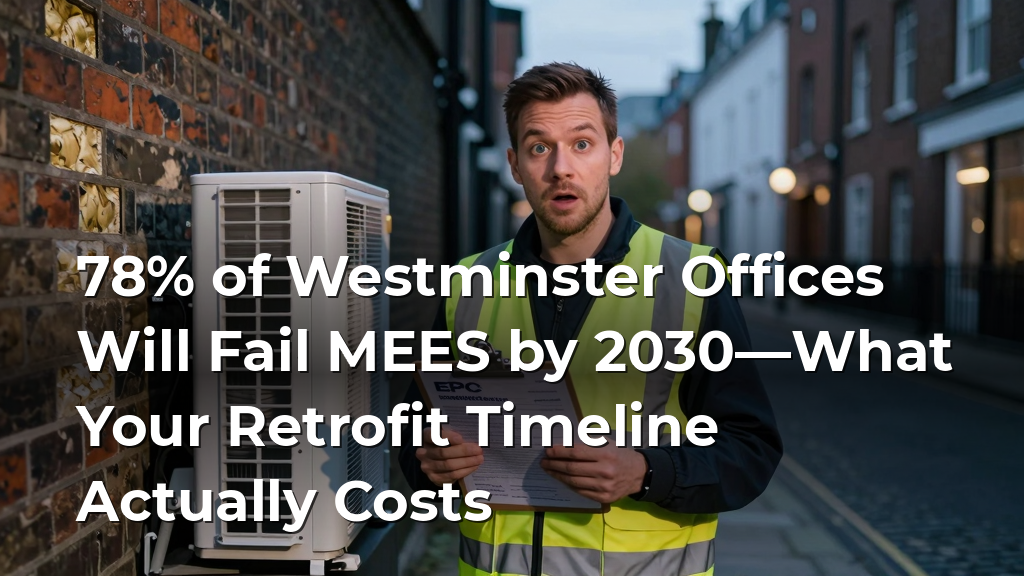

Seventy percent of London offices are on track to fail the upcoming energy efficiency deadline. That's not a prediction from a sustainability consultant trying to sell you an audit. That's the finding from Robert Irving Burns (RIB), a property consultancy that analysed government data and found 78% of Westminster offices and 71% of City of London offices will fail to meet the Minimum Energy Efficiency Standards (MEES) expected by the early 2030s.
For the facilities managers, chief engineers, and asset managers who actually run these buildings, this isn't a policy debate. It's a practical problem with a hard deadline and a price tag. Here's what the numbers mean for your portfolio, your budget, and your next quarterly review.
The 2030 deadline is closer than it looks
The UK government has signalled that commercial properties will need an EPC rating of at least B to be leased by the early 2030s. That's a jump from the current minimum of E, which has been in place since 2018. The gap between E and B is not small. It typically means upgrading building fabric, heating and cooling systems, lighting, and often the building management system (BMS) itself.
RIB estimates that more than 12,000 offices across central London need significant upgrades. In Westminster alone, over three-quarters of offices risk obsolescence. That word — obsolescence — is not hyperbole. A building that cannot be legally leased has no income stream. It becomes a liability on the balance sheet.
Antony Antoniou, CEO of RIB, put it plainly: achieving compliance requires enormous capital expenditure, and current market conditions — labour shortages, financing constraints, supply chain delays — make the early 2030s deadline virtually impossible for many landlords.
What this means for facilities managers on the ground
If you manage a commercial building in London, you are likely already feeling the pressure. Tenants are asking about EPC ratings before they sign leases. The highest EPC rating of A is held by just 4% of office properties in the City of London, according to RIB. That scarcity is already forcing potential tenants to delay moves or look elsewhere.
For the facilities team, the work breaks down into three categories:
- Fabric improvements — insulation, glazing, air sealing. These are disruptive, expensive, and often require the building to be partially vacated during works.
- HVAC upgrades — replacing chillers, AHUs, and FCUs with higher-efficiency units. This is where the biggest energy savings live, but also where the biggest capital sits.
- Controls and analytics — upgrading the BMS, installing submeters, and using data to actually manage energy use rather than just report it. This is the lowest-cost, fastest-payback category, but it requires ongoing attention, not just a one-time install.
A 2024 study by the UK Green Building Council found that the average cost to bring a commercial building from EPC E to B is between £50 and £150 per square metre, depending on the age and condition of the building. For a 10,000 square metre office in the City, that's £500,000 to £1.5 million. Not small. But the cost of doing nothing is worse: a stranded asset with zero rental income.
The two-tier market is already forming
RIB's report describes a future where London has a two-tier office market. Buildings with high EPC ratings will command premium rents and attract blue-chip tenants. Buildings that fail to upgrade will sit empty or sell at a discount to specialist funds that have the capital and expertise to do the retrofit work.
We are already seeing this play out. Firms like Blackstone, Brookfield, and Henderson Park are actively buying commercial real estate at a discount, investing in green refurbishments, and selling or leasing the upgraded property at a premium. That's a viable strategy if you have billions in dry powder. For a family office or a mid-sized landlord with a single building in Mayfair, it's a different story.
For facilities managers, this means your role is shifting. You are no longer just keeping the building running. You are now a key part of the asset value preservation strategy. The data you collect — energy consumption, chiller efficiency, zone temperatures, occupancy patterns — is what justifies the capital expenditure to the board or the owner. If you cannot show where the energy is going, you cannot make the case for the retrofit.
Where GCC operators should pay attention
This is a UK story, but it has implications for GCC-based operators who own or manage UK assets. Many hospitality and real estate groups based in Dubai, Abu Dhabi, and Riyadh have London portfolios. If you are one of them, the clock is ticking on your UK holdings.
The GCC has its own energy efficiency trajectory — the UAE's Building Energy Code, Dubai's Demand Side Management Strategy 2030, and Saudi Arabia's Mostadam rating system all push in the same direction. But the UK deadline is harder and faster. The MEES B rating is mandatory for leasing. There is no grace period for overseas owners.
If you manage a GCC portfolio and a UK portfolio, the technology stack you use matters. A platform that can monitor energy across both climates, both regulatory regimes, and both sets of tenant expectations saves you from running two separate systems. That is where a tool like Herman becomes useful — not as a magic wand, but as a single pane of glass for buildings that span 5,000 kilometres.
What this looks like in practice
Start with your EPC register. Pull the current ratings for every building in your portfolio. Identify which ones are below B and when their current EPC expires. That gives you a timeline.
Next, do a quick energy audit. You do not need a full TM44 or CIBSE audit to start. You need to know where the biggest leaks are. If your chiller plant is running at 0.8 kW/ton when it should be at 0.5, that is a project. If your BMS is scheduling heating and cooling simultaneously in the same zone, that is a fix you can make this week.
Finally, talk to your tenants. They are already asking about EPC ratings. If you can show them a plan — here is when we upgrade the glazing, here is when we replace the chiller, here is how we will maintain comfort during the works — you build trust. And trust keeps tenants in place while you do the work.
The 2030 deadline is not a distant threat. It is four years away. For a building that needs a new chiller plant, a facade upgrade, and a BMS replacement, that timeline is tight. Start now.
If you want to see how Herman can help you track EPC compliance, monitor energy use across your portfolio, and generate the data you need to justify retrofit spend, talk to the HermanWa team.
— The HermanWa Team
Until next time — keep the evidence closer than the deadline.
Walk into your next senior management meeting with the answers
The free Director's Risk Check for UK portfolios takes five minutes. No sign-up to see your score.
- Your control score across compliance, evidence, oversight, cost and renewals
- The breach exposure in your portfolio, with the official source for each penalty
- A board-ready briefing with your three priorities and a 30/60/90-day plan
About HermanWa
HermanWa is a building compliance and operations platform for property and facilities teams in the United Kingdom and Singapore, with portfolios across the Gulf. It keeps one auditable file per building — statutory deadlines, inspection evidence, contractor work, energy and carbon — and its AI assistant, Herman, answers questions about your buildings in plain English. HermanWa tracks obligations including fire risk assessments and fire door checks, Building Safety Act duties, Legionella (ACOP L8), EICR, gas safety and EPC in the UK, and SCDF fire certificates, Periodic Facade and Structural Inspections, lift permits and Green Mark in Singapore. Directors can check their exposure with the free Director's Risk Check.