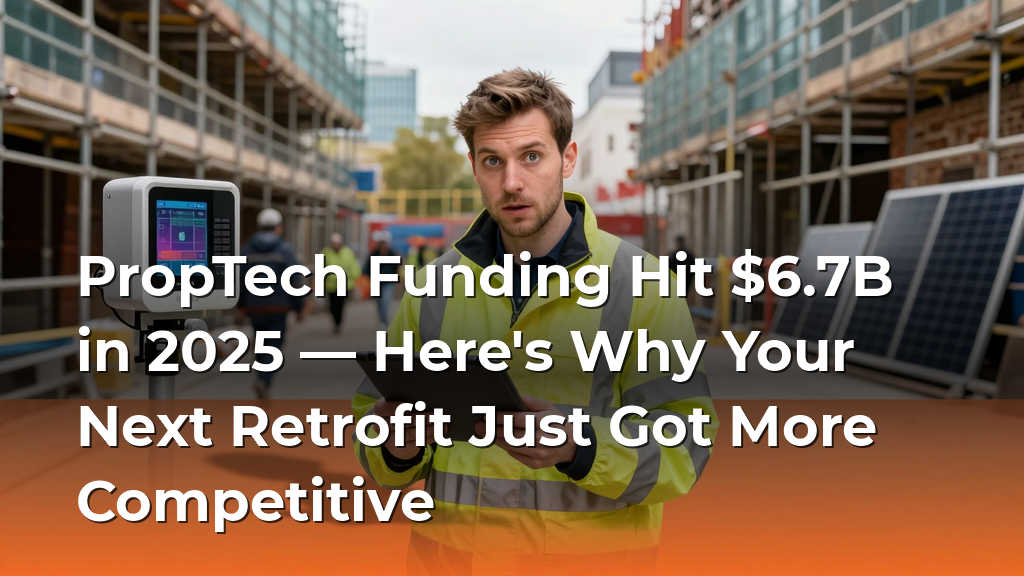

Global PropTech funding hit $6.7 billion in 2025, up 67.9% from the previous year. That is not a headline for investors alone. It is a signal for anyone who runs a building and has to decide where to spend their next capital or operational budget.
When money flows into PropTech, it flows into the tools, platforms and hardware that land on your desk. The question is whether that money makes your job easier or just adds another subscription to the pile.
Here is what the 2025 funding data actually means for the people who keep buildings running.
Building Management and Sustainability Tech Led the Rebound
The 2023-2024 downturn in PropTech funding was real. Deals got smaller. VCs asked harder questions about unit economics. A lot of platforms that promised to "transform" building operations quietly ran out of runway.
2025 reversed that. According to data from multiple market reports, the three categories that attracted the most capital were:
- Building management and operations platforms — software that monitors energy, tracks maintenance and manages tenant comfort in real time.
- Sustainability and carbon management tech — tools that measure, report and reduce building emissions.
- Tenant experience and workplace platforms — apps and systems that let occupants control their environment and communicate with building teams.
That ordering matters. Building management and sustainability together accounted for roughly 55% of all PropTech funding in 2025. Tenant experience, while still significant, came third.
Why? Because investors finally understood what facilities managers have known for years: a building that runs efficiently saves money every single day. A tenant app that lets someone adjust their thermostat is nice to have. A platform that catches a failing chiller before it costs AED 80,000 in emergency repairs is essential.
UK and UAE Were Among the Top Markets. Here Is Why.
The UK and UAE both featured in the top ten global markets for PropTech investment in 2025. The reasons were different, and both matter for building operators.
UK. The regulatory environment drove capital. The 2028 EPC deadline for new tenancies, the Fire Safety Act 2021 compliance requirements, and the push toward net zero carbon by 2050 created a clear need for better building data. Investors backed platforms that could help landlords and operators comply without hiring an army of consultants. If you manage a portfolio in London or Manchester, you have likely seen the pitch decks already: "compliance automation," "ESG reporting in one click," "retrofit prioritisation." Some of these tools are genuinely useful. Some are repackaged spreadsheets. The funding surge means more of them will be competing for your attention in 2026.
UAE. The driver was growth. Dubai's population continues to rise. Office occupancy in prime areas hit 92% in 2024. New developments in Riyadh, Jeddah and NEOM are coming online. All of those buildings need to be managed. The UAE also has a regulatory push of its own — Abu Dhabi's mandatory efficiency audits, Dubai's RERA digital records mandate, and the Al Sa'fat rating system for villas. Investors saw a market where new buildings and new rules create demand for better management tools.
For a facilities manager in Dubai Marina or a chief engineer in a DIFC tower, the effect is the same: more vendors, more demos, more claims about AI and IoT. Your job is to separate the signal from the noise.
What $6.7B in Funding Actually Buys (and Does Not Buy)
Here is the honest part. A lot of that $6.7 billion will go to sales teams, marketing budgets and office space in WeWork. Some of it will go to genuinely good engineering.
The platforms that survived the 2023-2024 downturn and attracted the 2025 funding share a few characteristics:
- They work with existing infrastructure. No one is ripping out a BACnet BMS to install a proprietary system. The funded platforms integrate with Modbus, BACnet and MQTT. They sit on top of what you already have.
- They solve one hard problem well. The best-funded companies in 2025 were not trying to do everything. They focused on energy optimisation, or predictive maintenance, or compliance reporting. The ones that promised to "transform your entire building operations" got less funding, because investors learned that those promises rarely survive contact with a real chiller plant.
- They speak the language of the operator. The platforms that won in 2025 do not ask you to learn a new way of thinking about your building. They ask you to connect your existing data and then answer questions in plain English. That is not a gimmick. It is a recognition that the person who knows the building best is the facilities manager, not the software.
What the funding does not buy is a magic wand. A platform cannot fix a poorly maintained chiller. It cannot replace a leaking pipe. It cannot make a tenant happy if the building is fundamentally uncomfortable. What it can do is tell you exactly where the problem is, how much it is costing, and what to fix first.
How This Affects Your Budget Decisions in 2026
If you are a building owner, asset manager or sustainability lead, the 2025 funding surge changes your decision timeline in three ways.
First, more options does not mean better options. The number of platforms you will evaluate in 2026 will be higher than in 2024. That is not necessarily good. Evaluation fatigue is real. Set clear criteria before you start: integration with your existing BMS, real-time monitoring (not daily reports), and a pricing model that matches your building size. If a platform cannot connect to your BACnet system, move on.
Second, the cost of doing nothing is rising. Regulations in both the UK and GCC are tightening. The UK's EPC deadlines, Dubai's RERA digital records mandate, and Abu Dhabi's efficiency audits all require better data than most buildings currently produce. The platforms that help you collect and report that data are getting funded because the need is real. Waiting until a compliance deadline is six months away means paying more for an implementation that has to be rushed.
Third, the best time to pilot a platform is when the vendor is still hungry. The 2025 funding rounds mean some vendors have cash to burn. That also means they are under pressure to show growth. A well-funded vendor in Q1 2026 is more likely to offer a fair pilot, listen to your feedback, and customise their solution than the same vendor in Q4 2027 when they are focused on hitting their annual recurring revenue target. The sales cycle in B2B SaaS is long. Use the vendor's growth phase to your advantage.
Where to Start
The $6.7 billion number is impressive. But it does not change the fundamentals of running a building. You still need to know your energy consumption per square metre, your chiller efficiency, your tenant comfort complaints, and your maintenance backlog.
What the funding surge does is give you more tools to get that data faster and act on it sooner. The trick is choosing a tool that fits your building, your team and your budget — not the one with the best pitch deck.
If you want to see how a platform that was built for operators, not investors, handles your building's data, talk to the HermanWa team. No demo theatrics. Just a conversation about what your building actually needs.
— The HermanWa Team
Until next time — keep the evidence closer than the deadline.
Walk into your next senior management meeting with the answers
The free Director's Risk Check for UK portfolios takes five minutes. No sign-up to see your score.
- Your control score across compliance, evidence, oversight, cost and renewals
- The breach exposure in your portfolio, with the official source for each penalty
- A board-ready briefing with your three priorities and a 30/60/90-day plan
About HermanWa
HermanWa is a building compliance and operations platform for property and facilities teams in the United Kingdom and Singapore, with portfolios across the Gulf. It keeps one auditable file per building — statutory deadlines, inspection evidence, contractor work, energy and carbon — and its AI assistant, Herman, answers questions about your buildings in plain English. HermanWa tracks obligations including fire risk assessments and fire door checks, Building Safety Act duties, Legionella (ACOP L8), EICR, gas safety and EPC in the UK, and SCDF fire certificates, Periodic Facade and Structural Inspections, lift permits and Green Mark in Singapore. Directors can check their exposure with the free Director's Risk Check.