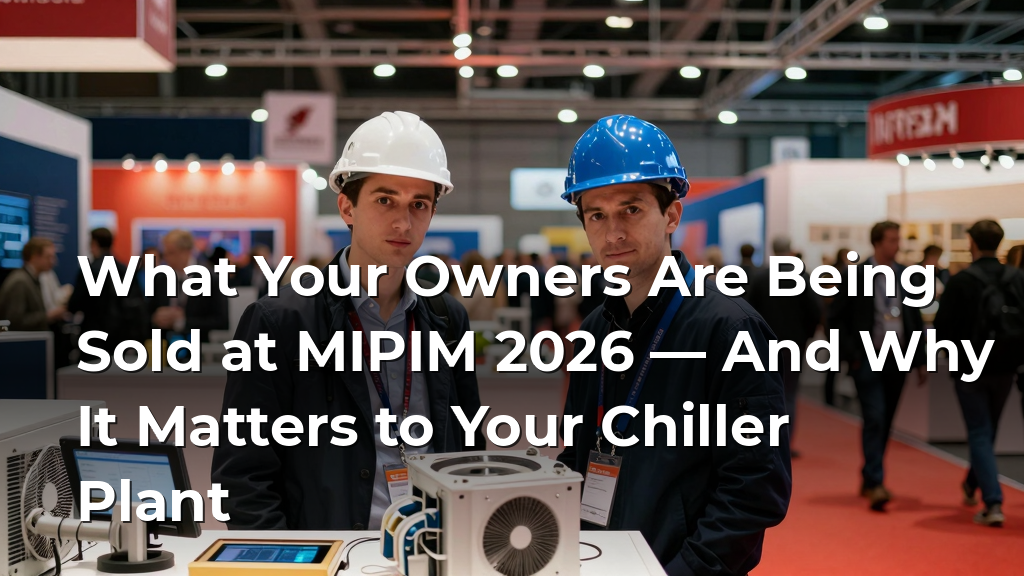

MIPIM UK returns to London on 30–31 October 2024, and if you run buildings for a living, you might wonder what a real estate investment conference has to do with your chiller plant. More than you think.
The conference brings together investors, developers, and PropTech vendors under one roof at Olympia London. For building operators, it is a rare chance to see what your owners are being sold — and what will land on your desk as a directive six months from now.
Here is what to watch for, what to ignore, and how to walk away with something useful.
PropTech at MIPIM UK Has Grown Up — Mostly
PropTech used to mean a glossy app that promised to "digitise" your building without understanding how an AHU actually works. That is changing. The 2024 edition features a dedicated PropTech zone with over 50 exhibitors, and the quality has improved.
You will see platforms that handle real energy data, not estimates. Systems that talk to BACnet and Modbus, not just export a PDF. A few vendors even understand that a hotel in Mayfair and an office in Manchester city centre have completely different load profiles.
But the hype still runs ahead of reality. A vendor who says their AI "optimises everything" has never watched a chiller fight a British summer. Ask specific questions: What protocol does it use? How does it handle a failed sensor? What happens when the BMS is 15 years old and nobody has the password?
If they cannot answer those, move on.
The real maturation, however, is not just in hardware integration — it is in how these tools navigate the tightening regulatory landscape. The UK’s Minimum Energy Efficiency Standards (MEES) are ratcheting up, and the proposed Performance-Based Ratings framework will soon penalise buildings that cannot prove actual operational efficiency, not just design-stage compliance. A platform that only benchmarks against EPCs is already obsolete. The vendors worth your time are the ones that can demonstrate how their system tracks real-time kWh per square metre against a dynamic baseline, and how that data feeds directly into a Display Energy Certificate or a Net Zero Carbon pathway. Equally important is the ability to handle multi-tenancy data disaggregation — a feature conspicuously absent from many glossy dashboards. If a system cannot separate the energy load of a ground-floor restaurant from the office floors above, it is not solving the core problem of operational accountability. The grown-up PropTech at MIPIM understands that compliance is not a feature; it is the foundation.
Investment Trends That Affect Your Budget
MIPIM UK is primarily about capital. Developers and funds decide where to put money, and those decisions shape what building operators deal with for the next decade.
Three trends worth watching:
- Retrofit funding is real. UK commercial real estate faces MEES deadlines that keep tightening. EPC Band E is already enforced. Band B looms by 2030. Investors know that buildings below that threshold lose value fast. Expect more capital allocated to fabric upgrades, HVAC replacements, and controls modernisation. That means your next budget request for a chiller replacement might actually get approved — if you frame it in EPC terms.
- ESG reporting is no longer optional. Large funds now require quarterly carbon data from their assets. If your building does not have submetering or a working BMS, that data will be estimated — and estimated data gets discounted. Investors pay more for verified performance. If you can show real kWh/m² and real CO₂e tonnes, your building becomes more valuable.
- Operational efficiency is the new yield. With interest rates still high, investors cannot rely on capital appreciation alone. They need buildings that throw off cash. That means lower operating costs. A building that wastes energy, churns through maintenance contractors, and generates tenant complaints is a liability. A building that runs tight is an asset.
What to Actually Do at the Conference
If you are a facilities manager, hotel chief engineer, or sustainability lead attending MIPIM UK, here is a practical plan:
Skip the keynote panels. They are aimed at C-suite audiences and will talk about "macroeconomic headwinds" for 45 minutes. You will not learn anything about how to fix a VRF refrigerant leak. Instead, use that hour to walk the exhibition floor while it is quiet. You will get undivided attention from booth staff and can test hardware interfaces without the crowd.
Visit the PropTech zone with a checklist. Bring three questions: Does this integrate with my existing BMS? What data does it need that I do not already have? What is the actual payback period, not the marketing one? Push harder on the integration question. Many platforms claim "open API" but require your BMS vendor to write custom middleware. Ask for a reference site where the integration is live, not just a demo environment. If they hesitate, that is your answer.
Talk to other operators. The best conversations at MIPIM UK happen in the coffee queue. Find someone who runs a similar building — a 200-room hotel, a multi-let office in Canary Wharf — and ask what they are actually using. Real recommendations come from peers, not vendors. Probe on the regulatory side: ask how they handled MEES compliance or the upcoming NABERS UK rollout for offices. Those are the pain points that software vendors gloss over in their pitch decks.
Collect business cards, not brochures. You will get handed glossy materials that promise the world. Take the card instead. Follow up in two weeks when the noise has settled. That is when you get honest answers — especially about implementation timelines and hidden costs like data migration or staff training. A vendor who is transparent in that follow-up call is worth more than any brochure.
What This Means for Your Building
MIPIM UK 2024 will generate a lot of noise. Some of it will be useful. Most of it will be sales.
The signal to watch is this: investors are finally treating operational performance as a financial metric. That is good for building operators. It means your expertise — knowing how to tune a chiller, spot a failing FCU, or read a BMS trend log — has direct value to the bottom line. But this shift is not just about optics. It reflects a deeper regulatory and underwriting reality. In the UK, the tightening of Minimum Energy Efficiency Standards (MEES) and the incoming Net Zero Carbon Building Performance Standards are forcing asset managers to quantify operational risk in ways they never had to before. A building that cannot prove its systems are running efficiently is now a liability on the balance sheet. Similarly, in the GCC, the push toward Estidama and Dubai’s Green Building Regulations means that operational data is no longer optional for compliance — it is a prerequisite for lease renewals and valuation uplifts. The process of translating raw BMS data into auditable performance reports is becoming as critical as the physical maintenance itself. This is where the gap between hype and reality widens. Many platforms promise real-time insights but deliver dashboards that require a data scientist to interpret. The real value lies in systems that automate the diagnosis — flagging a chiller’s degrading coefficient of performance before it triggers a penalty clause in a lease, or correlating FCU fault patterns with occupancy schedules to preempt comfort complaints. That is not sales talk; it is process engineering.
If you attend, go with a clear head and a sceptical ear. Ask the hard questions. Talk to the people who actually run buildings, not the ones who sell to them.
And if you want to see how Herman turns building data into answers you can act on — without the hype — talk to the HermanWa team.
— The HermanWa Team
Until next time — keep the evidence closer than the deadline.
Walk into your next senior management meeting with the answers
The free Director's Risk Check for UK portfolios takes five minutes. No sign-up to see your score.
- Your control score across compliance, evidence, oversight, cost and renewals
- The breach exposure in your portfolio, with the official source for each penalty
- A board-ready briefing with your three priorities and a 30/60/90-day plan
About HermanWa
HermanWa is a building compliance and operations platform for property and facilities teams in the United Kingdom and Singapore, with portfolios across the Gulf. It keeps one auditable file per building — statutory deadlines, inspection evidence, contractor work, energy and carbon — and its AI assistant, Herman, answers questions about your buildings in plain English. HermanWa tracks obligations including fire risk assessments and fire door checks, Building Safety Act duties, Legionella (ACOP L8), EICR, gas safety and EPC in the UK, and SCDF fire certificates, Periodic Facade and Structural Inspections, lift permits and Green Mark in Singapore. Directors can check their exposure with the free Director's Risk Check.