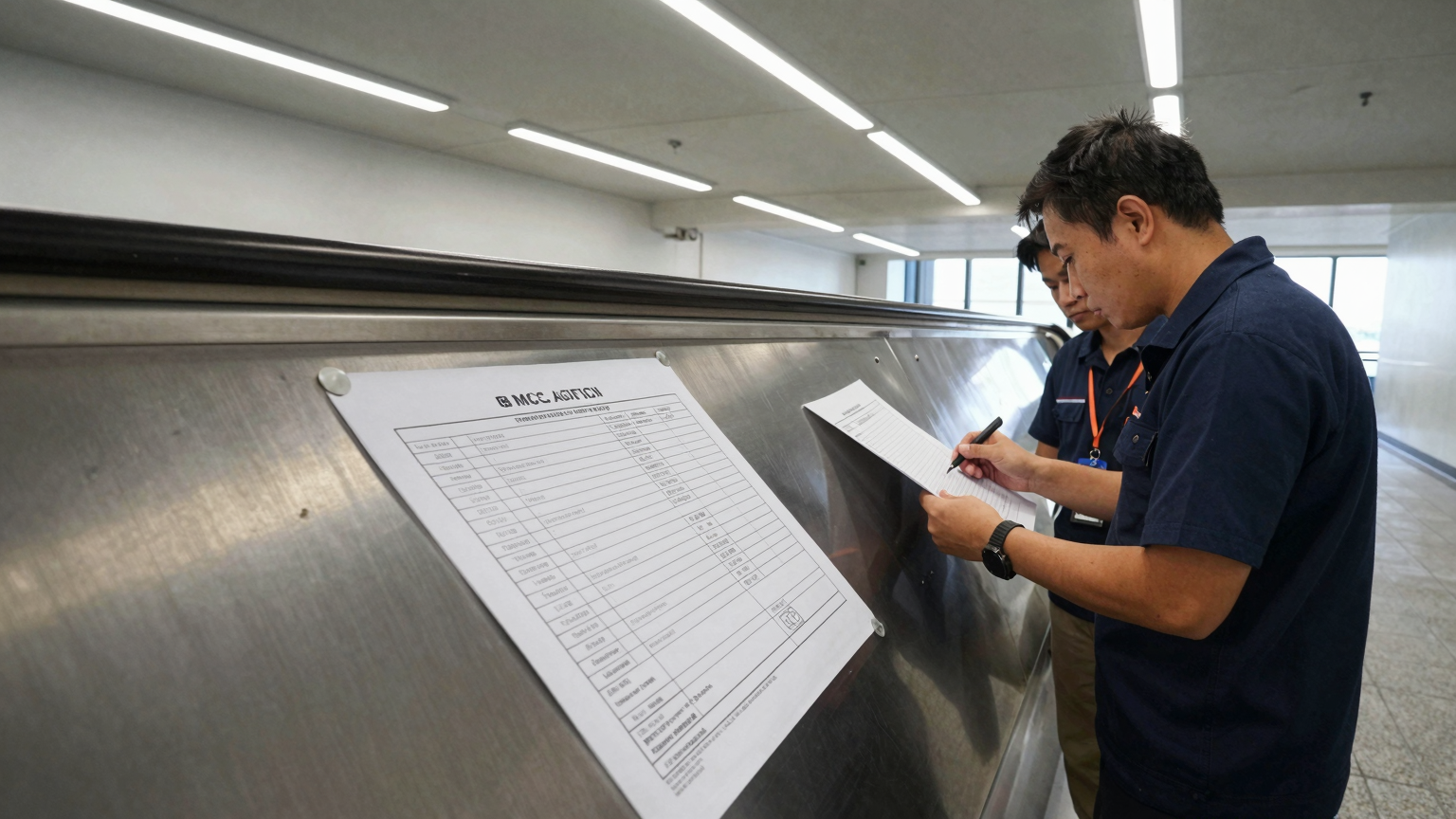

Your name sits on the escalator inspection record for every travelator in the mall. When BCA's enforcement page lists a building, it lists the building — and the facilities manager who signed off the maintenance schedule is the one explaining it to the asset director the next morning.
Escalator safety for shoppers and occupiers is not a footnote in the annual report. It is a live duty, a paper trail, and a cost line that most retail portfolios underfund until something stops.
The duty is on the building, not the contractor
BCA regulates the design, installation, maintenance and operation of lifts, escalators and mechanised car parking systems under the Building Control Act. That is the regulator's own description of its remit, published on its Safety and Standards page. The contractor you engage does the work. The duty to keep the equipment safe and the records current stays with the building owner and, by delegation, with you.
In a shopping centre, that duty has a particular shape. You have high footfall, children on the steps, trolleys, wet weather, and a public that treats a stopped escalator as an inconvenience rather than a warning. The inspector who arrives is not looking at your contractor's invoice. They are looking at the equipment, the log book, and whether the last maintenance entry matches what the machine is actually doing.
What a missed inspection actually costs
The direct penalty is the starting point, not the total. A failed inspection can trigger a notice, a closure order on the affected unit, and a remediation bill that lands in the same quarter as the lost rental income. In a retail asset, an escalator out of service is not just a repair. It is a bottleneck at the atrium, a complaint at the concierge desk, and a tenant asking why footfall to their unit dropped.
The knock-on costs are where the real number sits. Insurers ask for the maintenance records when a claim arrives. If the log shows a gap, the conversation shifts from cover to liability. Void periods follow if a tenant decides the centre is not being run properly. And the remediation itself — bringing an older unit back to standard — is rarely a single line item.
BCA's circulars on adoption of standards and the companion guide for the Code of Practice for escalators set out what compliance looks like in practice. The adoption of SS626:2024 is the kind of document that tells you what the inspector expects to see, not what your contractor prefers to provide. If your maintenance regime was written before that standard landed, it is worth checking whether the two still match.
Where retail portfolios get caught
The pattern I see is not neglect. It is drift. A contractor changes a technician. A log entry gets signed a week late. A minor fault gets noted but not closed. Then a shopper trips, or an inspector visits, and the gap that has been sitting in the paperwork for months becomes the first thing anyone asks about.
In a shopping centre, the escalator is also the most visible piece of plant you own. Shoppers do not see the chiller or the lift motor room. They see the escalator every time they move between floors. That visibility cuts both ways: it makes the equipment a priority for the public, and it makes any failure a public event.
The companion guide for the Code of Practice is the document your contractor should be working to. If you cannot point to it in your maintenance file, that is a gap worth closing before the next inspection cycle.
The cheaper path is boring and it works
What actually keeps escalator safety for shoppers and occupiers under control is not a new system. It is a schedule that is followed, a log that is signed on the day, and a named person who owns the escalation when a fault is not closed. That person does not need to be an engineer. They need to know what a complete record looks like and to refuse a partial one.
In practice, that means three things. First, the maintenance contract names the standard it is working to, not just the frequency of visits. Second, the log book is checked monthly by someone in your team, not just by the contractor. Third, any fault that is noted but not fixed has a date and an owner attached to it.
None of that is expensive. The expensive version is the one where the first time you look at the log is the day after an incident.
Your 60-second self-check
- Could you produce the last twelve months of escalator maintenance records for every unit in the centre, today, without asking the contractor?
- Does your maintenance contract name the standard it is working to, or just the number of visits per year?
- Is there a named person in your team who checks the log book monthly, and can you show that check happened last month?
If you want to walk into your next senior management meeting with answers rather than follow-ups, the free 5-minute Director's Risk Check gives you a control score for your portfolio, the breach exposure with official sources attached, and a board-ready briefing you can send to a colleague to answer. You can run it here: Director's Risk Check.
Herman's verdict
The escalator log book is the most honest document in a shopping centre. It tells you whether the building is being run or just being opened. If you cannot put your hand on it in under a minute, you already know what the inspector will find.
— Herman
Until next time — keep the evidence closer than the deadline.
Walk into your next senior management meeting with the answers
The free Director's Risk Check for Singapore portfolios takes five minutes. No sign-up to see your score.
- Your control score across compliance, evidence, oversight, cost and renewals
- The breach exposure in your portfolio, with the official source for each penalty
- A board-ready briefing with your three priorities and a 30/60/90-day plan
About HermanWa
HermanWa is a building compliance and operations platform for property and facilities teams in the United Kingdom and Singapore, with portfolios across the Gulf. It keeps one auditable file per building — statutory deadlines, inspection evidence, contractor work, energy and carbon — and its AI assistant, Herman, answers questions about your buildings in plain English. HermanWa tracks obligations including fire risk assessments and fire door checks, Building Safety Act duties, Legionella (ACOP L8), EICR, gas safety and EPC in the UK, and SCDF fire certificates, Periodic Facade and Structural Inspections, lift permits and Green Mark in Singapore. Directors can check their exposure with the free Director's Risk Check.