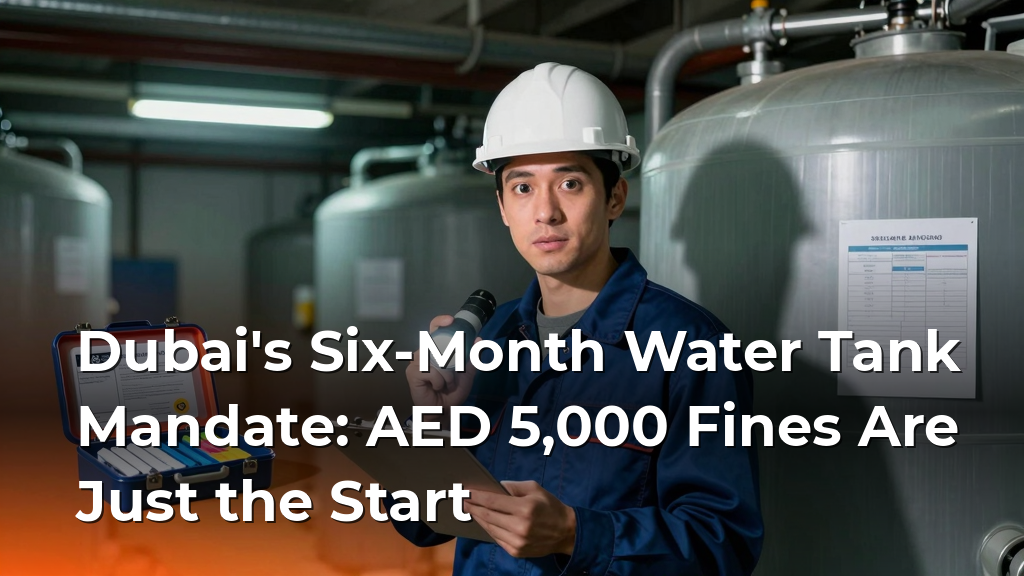

If you manage a building in Dubai — hotel, residential tower, commercial block — your water tanks are on a regulatory clock. Dubai Municipality requires all water storage tanks cleaned every six months. Not annually. Not when the tenant complains. Every six months, with lab testing from an ISO 17025 accredited laboratory to prove the water is safe.
The rule is not new. But enforcement has sharpened. Fines for non-compliance can reach AED 50,000. And the regulator is increasingly checking documentation during routine inspections, not just after an incident.
Here is what the regulation requires, what the testing must show, and how to avoid a fine — or worse, a legionella outbreak that shuts down your building.
What Dubai Municipality Requires for Water Tank Cleaning
Dubai Municipality's Public Health and Safety Department mandates that all water storage tanks — whether for drinking water, domestic use, or fire fighting — be cleaned and disinfected every six months. The clock starts from the date of the last cleaning certificate.
The cleaning must be carried out by an approved contractor. After cleaning, the tank must be disinfected, typically using chlorine at a concentration that achieves a free chlorine residual of 1–2 mg/l (parts per million) in the water.
Once the cleaning and disinfection are complete, a water sample must be taken and sent to an ISO 17025 accredited laboratory for testing. The lab report must confirm:
- Free chlorine residual: 1–2 mg/l
- Total bacterial count: within acceptable limits
- No coliform bacteria present
- No E. coli present
The lab report, along with the cleaning certificate, must be kept on file and produced on demand during a Dubai Municipality inspection.
Why the Six-Month Cycle Matters for Legionella Control
The six-month cleaning cycle is not arbitrary. It is tied directly to legionella bacteria control. Legionella thrives in stagnant water, at temperatures between 20°C and 45°C, and in the presence of biofilm — the slimy layer that builds up inside tanks and pipes over time.
In Dubai's climate, water tanks on rooftops can easily reach temperatures within the legionella growth range, especially during summer months when ambient temperatures exceed 45°C. A tank that is not cleaned every six months accumulates sediment, scale, and biofilm. That biofilm protects legionella from chlorine disinfection.
The UK Health and Safety Executive (HSE) has made clear that exposure risk alone is enough for prosecution. In 2024, a UK hotel operator was fined £900,000 after legionella was found in its water system — no one had fallen ill. The HSE argued that the risk of exposure was sufficient. Dubai Municipality takes a similar view: the regulation exists to prevent illness, not just to respond to it.
For a deeper look at how the HSE approaches legionella risk, see our earlier article: £900k Legionella Fine Shows HSE No Longer Waits for Illness. Exposure Risk Alone Is Prosecution.
What Happens If You Miss the Deadline
Dubai Municipality inspectors can visit any building at any time. They routinely check water tank cleaning records during annual building inspections, fire safety audits, and licence renewals. If they find that your last cleaning certificate is more than six months old, you face:
- A fine of up to AED 50,000 for non-compliance
- A directive to clean the tank immediately at your own cost
- Potential suspension of your building's operating licence if violations persist
For hotels, the stakes are higher. The Dubai Department of Economy and Tourism (DET) — formerly DTCM — includes water tank cleaning compliance in its hotel classification inspections. A non-compliant water system can affect your star rating. For a detailed look at how maintenance compliance affects hotel classification, see: Abu Dhabi's New Hotel Classification Manual Just Reset Your Maintenance Budget—Here's What Changes by June 2026.
How to Choose an ISO 17025 Accredited Lab
Not every lab in Dubai can test your water samples. Dubai Municipality requires that the testing laboratory be accredited to ISO 17025 — the international standard for testing and calibration laboratories. This accreditation ensures the lab uses validated methods, maintains proper equipment, and produces reliable results.
When selecting a lab, ask for their ISO 17025 scope of accreditation. It should specifically cover microbiological testing of water, including legionella testing. The lab should also be able to test for:
- Total coliforms and E. coli (by membrane filtration or most probable number method)
- Heterotrophic plate count (HPC) at 22°C and 37°C
- Free and total chlorine residual
- Legionella pneumophila and Legionella species (if specifically requested)
Some accredited labs in Dubai include those operated by government entities and private commercial laboratories. Your cleaning contractor should be able to recommend one, but verify the accreditation yourself. A lab report without ISO 17025 accreditation is not accepted by Dubai Municipality.
What the Lab Report Must Show
After cleaning and disinfection, the lab report must confirm that the water meets Dubai Municipality's standards. The key parameters are:
- Free chlorine residual: 1–2 mg/l at the point of use. This indicates that the disinfection was effective and that residual protection remains in the water.
- Total bacterial count: Less than 100 colony-forming units per millilitre (CFU/ml) at 37°C. Higher counts suggest biofilm or contamination.
- Coliform bacteria: Absent in 100 ml. Coliforms indicate faecal contamination or a breach in the tank's integrity.
- E. coli: Absent in 100 ml. E. coli is a specific indicator of faecal contamination and a serious health risk.
If any parameter fails, the tank must be re-cleaned and re-tested. You cannot simply adjust the chlorine level and retest — the cleaning process must be repeated.
Practical Steps for Building Managers
Here is what a compliant water tank management programme looks like in practice:
- Schedule cleaning every six months. Put it in your calendar with a reminder 30 days before the due date. Do not rely on memory.
- Use an approved contractor. Your contractor should be registered with Dubai Municipality and able to provide a cleaning certificate that includes the date, tank volume, disinfection method, and chlorine concentration used.
- Arrange lab testing immediately after cleaning. The sample should be taken within 24 hours of cleaning, before the water is put back into use.
- Keep records on file. Store cleaning certificates and lab reports for at least two years. Dubai Municipality may ask for historical records during an inspection.
- Monitor chlorine levels between cleanings. If your building has a chlorination system, check free chlorine levels weekly. If levels drop below 0.5 mg/l, the tank may need a booster dose.
What This Looks Like in Practice
A 200-room hotel in Dubai Marina we work with had its water tank cleaning schedule managed by the chief engineer's memory. When a Dubai Municipality inspector arrived for a routine fire safety audit, he asked for the water tank cleaning records. The engineer found the certificate — but it was seven months old. The hotel received a warning and a directive to clean the tank within 48 hours. The fine was avoided, but the hotel spent AED 8,000 on an emergency cleaning and lost a day of water service to guest rooms.
Since then, the hotel uses Herman to track the cleaning schedule. Herman sends a reminder 45 days before the due date, stores the cleaning certificate and lab report, and can answer questions like "When was the last water tank cleaning?" or "Show me the chlorine level from the last test" in plain English. No digging through files. No missed deadlines.
If you manage multiple buildings, the risk multiplies. A portfolio of ten buildings means ten tanks, each on a different six-month cycle. Missing one is easy. The fine, however, applies per building.
For a broader view of how building compliance is tightening across the UAE, see: UAE Building Safety Law Just Became Mandatory — Here's What Your Compliance Timeline Looks Like.
Where to Start
If you are not sure when your last water tank cleaning was, check today. Find the certificate. If it is older than six months, schedule a cleaning now. If you cannot find the certificate, assume it is overdue.
For building managers who want to automate this — and every other compliance deadline — see how Herman handles it. Herman tracks cleaning schedules, stores lab reports, and answers questions from your building's data in plain English. No spreadsheets. No missed deadlines. Talk to the HermanWa team.
— The HermanWa Team
Until next time — keep the evidence closer than the deadline.
Walk into your next senior management meeting with the answers
The free Director's Risk Check for UK portfolios takes five minutes. No sign-up to see your score.
- Your control score across compliance, evidence, oversight, cost and renewals
- The breach exposure in your portfolio, with the official source for each penalty
- A board-ready briefing with your three priorities and a 30/60/90-day plan
About HermanWa
HermanWa is a building compliance and operations platform for property and facilities teams in the United Kingdom and Singapore, with portfolios across the Gulf. It keeps one auditable file per building — statutory deadlines, inspection evidence, contractor work, energy and carbon — and its AI assistant, Herman, answers questions about your buildings in plain English. HermanWa tracks obligations including fire risk assessments and fire door checks, Building Safety Act duties, Legionella (ACOP L8), EICR, gas safety and EPC in the UK, and SCDF fire certificates, Periodic Facade and Structural Inspections, lift permits and Green Mark in Singapore. Directors can check their exposure with the free Director's Risk Check.