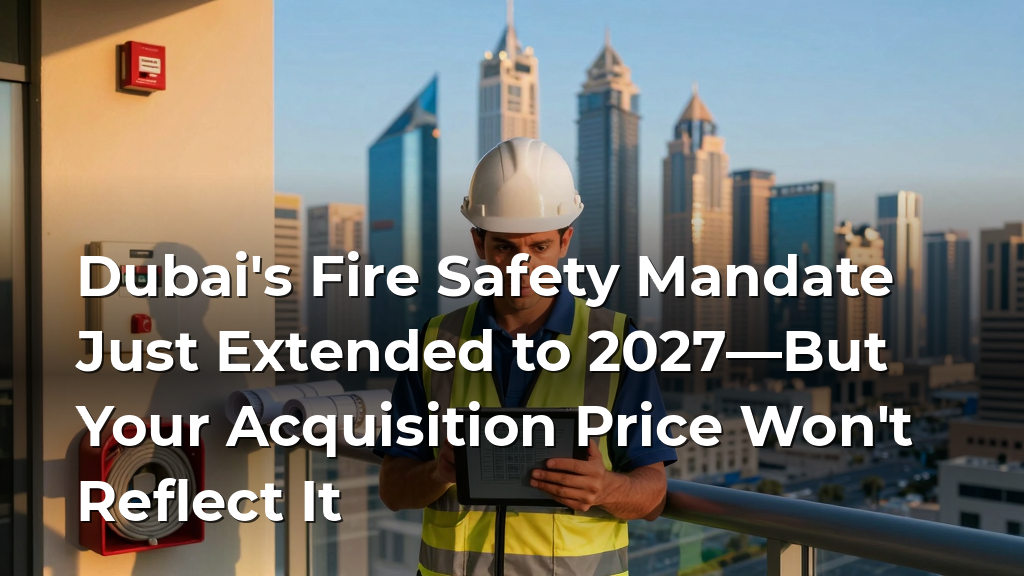

If you run a hotel in Dubai, you already know the fire safety landscape has been shifting. The DUBAICODE Amendment for Fire Safety Systems in the Hospitality Sector just made those shifts mandatory. And while the implementation timeline has been extended — giving operators more breathing room than initially expected — the requirements themselves are substantial.
Here is what the amendment actually says, what it means for your property, and where you should start spending your budget.
The Amendment Targets Three Specific Systems
The DUBAICODE amendment focuses on fire detection, alarm communication, and suppression systems in hospitality facilities. It applies to hotels, resorts, hotel apartments, and serviced residences across all Dubai jurisdictions — including free zones.
Three areas are now mandatory:
- Upgraded smoke detection in guest rooms and corridors. The new standard requires addressable detection that pinpoints the exact device in alarm, not just the zone. This means your fire alarm panel shows room 1207, not just the 12th floor east wing.
- Voice alarm systems in all buildings over four storeys. Not just a bell or strobe. A voice message that tells occupants what is happening and where to go. This is already common in newer builds. Older properties will need retrofits.
- Automatic sprinkler coverage in all back-of-house areas. Kitchens, laundry rooms, storage areas, plant rooms. If it is not a guest-facing space and it does not have sprinklers, it likely needs them now.
The amendment also tightens requirements for fire alarm monitoring and communication with Dubai Civil Defence. Your system must now report directly to DCD's central monitoring station, not just to a third-party control room.
The Extended Timeline: What It Actually Means
When the amendment was first circulated, operators feared a 12-month compliance window. The final version gives more time. Existing hotels have until December 2027 to complete all upgrades. New hotels must comply at the design stage, with certification required before occupancy.
That sounds generous. But here is the reality: if your property needs a full voice alarm system and back-of-house sprinkler retrofits, you are looking at a 12-to-18-month project from design through commissioning. And that is before you factor in procurement lead times for fire alarm panels and sprinkler heads, which are currently running 8 to 14 weeks globally.
If you have not started planning, you are already behind.
What This Costs: A Realistic Estimate
We have been running the numbers with several operators. For a 200-room business hotel in Dubai Marina, the upgrade package typically includes:
- Replacing a conventional fire alarm panel with an addressable panel and adding voice alarm capability: AED 180,000 to AED 250,000
- Retrofitting sprinklers in back-of-house areas (kitchen, laundry, storage, plant rooms): AED 120,000 to AED 200,000 depending on ceiling access and existing pipework
- Upgrading detection devices in guest rooms and corridors to addressable units: AED 80,000 to AED 120,000
- DCD monitoring connection and commissioning: AED 25,000 to AED 40,000
Total: roughly AED 405,000 to AED 610,000 per property. That is not pocket change. But it is also not a surprise if you have been tracking the direction of Dubai's fire safety regulations over the past three years.
For comparison, the UAE Fire Safety Audits that became mandatory in Q4 2024 already forced many operators to identify these gaps. The amendment simply closes the loophole that let some properties delay the actual installation.
Why the Hospitality Sector Gets Its Own Amendment
Hotels are different from offices and residential buildings. Guests are unfamiliar with the layout. They may be asleep, in the shower, or under the influence of alcohol. They do not know where the nearest exit is. And they are not trained to respond to a fire alarm the way a permanent occupant might be.
Dubai Civil Defence has been explicit about this. The amendment is a direct response to fire incidents in hospitality properties globally — including several near-misses in the region where early detection and clear voice communication would have made a significant difference.
The extended timeline reflects the scale of the retrofit challenge, not a softening of intent. DCD expects full compliance by the end of 2027. Properties that miss that deadline will face operational restrictions, including the possibility of suspended trade licences.
What Your Compliance Timeline Looks Like
If you manage a hotel built before 2020, here is a realistic schedule:
- Q2 2025: Complete a gap analysis. Walk every back-of-house area with your fire consultant. Identify every room that lacks sprinklers. Test every detection device. Map your current alarm panel's capabilities.
- Q3 2025: Submit your design and material schedule to DCD for approval. Order long-lead items — panels, sprinkler heads, voice alarm components.
- Q4 2025 to Q2 2026: Install back-of-house sprinklers. This is the most disruptive work. It requires ceiling access, pipework, and often temporary relocation of kitchen or laundry operations.
- Q3 2026 to Q2 2027: Replace or upgrade detection devices and the alarm panel. Commission the voice alarm system. Connect to DCD monitoring.
- Q3 to Q4 2027: Final testing, certification, and documentation.
This schedule assumes no major surprises. If your building has asbestos in ceiling spaces, or if your existing pipework is incompatible with new sprinkler heads, add six months.
Where Most Hotels Will Get Stuck
Three problems keep coming up in conversations with chief engineers:
1. Ceiling access in operational areas. Retrofitting sprinklers in a kitchen that runs 18 hours a day is not straightforward. You need a phased approach, often working overnight or during planned shutdowns. Budget for premium labour rates.
2. Existing alarm panel compatibility. Many older panels cannot support addressable detection or voice alarm modules. You may need a full panel replacement, which means rewiring the entire detection loop. That is a bigger job than swapping a circuit board.
3. DCD monitoring integration. The direct connection requirement means your system must speak the right protocol. Some third-party monitoring providers have been slow to update their interfaces. Verify compatibility before you buy hardware.
These are solvable problems. But they take time and money. The hotels that start now will have an easier path than those that wait until 2027.
What This Looks Like in Practice
The DUBAICODE amendment is not a theoretical exercise. It is a specific, enforceable set of requirements with a clear deadline. The extended timeline is a gift — use it.
Start with the gap analysis. Walk every room. Talk to your fire consultant. Get your design submitted to DCD. Then order the hardware and schedule the installation around your occupancy cycles.
If you want to track your compliance progress alongside your energy and maintenance data, see how Herman handles this. The platform can log inspection dates, flag overdue items, and give you a single dashboard for all your regulatory obligations — fire safety, energy reporting, maintenance schedules, and more.
— The HermanWa Team
Until next time — keep the evidence closer than the deadline.
Walk into your next senior management meeting with the answers
The free Director's Risk Check for UK portfolios takes five minutes. No sign-up to see your score.
- Your control score across compliance, evidence, oversight, cost and renewals
- The breach exposure in your portfolio, with the official source for each penalty
- A board-ready briefing with your three priorities and a 30/60/90-day plan
About HermanWa
HermanWa is a building compliance and operations platform for property and facilities teams in the United Kingdom and Singapore, with portfolios across the Gulf. It keeps one auditable file per building — statutory deadlines, inspection evidence, contractor work, energy and carbon — and its AI assistant, Herman, answers questions about your buildings in plain English. HermanWa tracks obligations including fire risk assessments and fire door checks, Building Safety Act duties, Legionella (ACOP L8), EICR, gas safety and EPC in the UK, and SCDF fire certificates, Periodic Facade and Structural Inspections, lift permits and Green Mark in Singapore. Directors can check their exposure with the free Director's Risk Check.