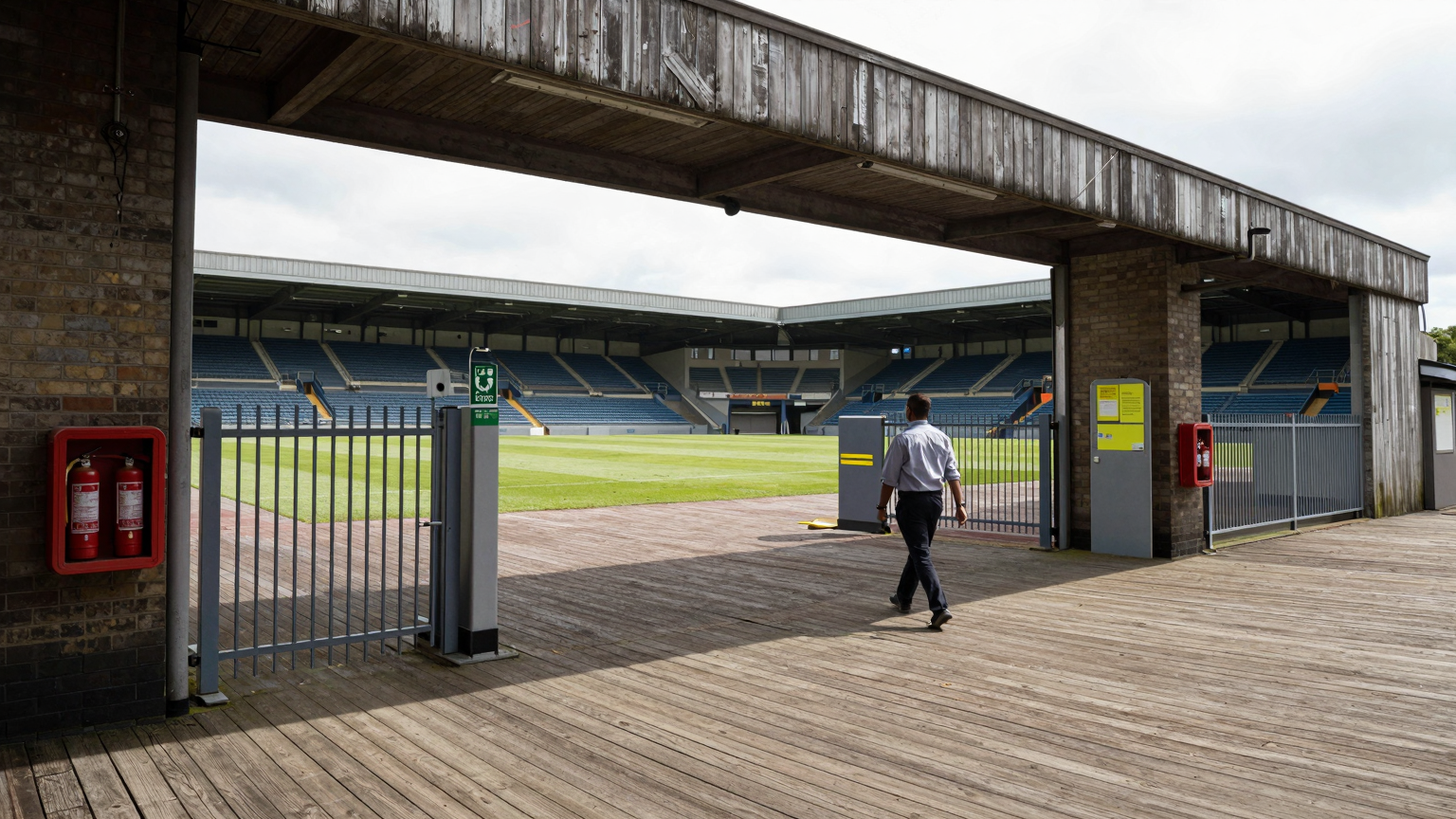

The main stand at Valley Parade was a timber structure due for demolition that summer. Underneath it, through gaps in the boards, years of litter had collected — newspapers, food wrappers, a programme from 1968 was found in the debris. On 11 May 1985, during a match, something dropped through the gap and found it.
Four minutes, and an exit that was locked
The fire crossed the stand in about four minutes. Fifty-six people died, many of them at the back, where the exit gates were locked as a matter of routine to stop people entering without paying. The crowd had come in through turnstiles and went back towards them by instinct, which is what crowds always do — the behaviour every modern fire risk assessment has to design around.
Fifty-six people died and more than 250 were injured, many with severe burns. Among the dead were an eleven-year-old and a man of eighty-six. Survivors were treated at the burns unit at Pinderfields, and the plastic surgery team that formed around those injuries went on to found the research unit that still carries the disaster's name — a body of burns research that exists because of four minutes in a football stand.
The Fire Safety and Safety of Places of Sport Act 1987 followed two years later, extending safety certification to stands, addressing combustible construction directly, and requiring that exit gates be openable throughout occupation.
The interesting failure is the timetable
Everyone knew the stand was substandard. That was why it was being replaced. The replacement had been announced, funded and scheduled. Which is exactly why nobody dealt with the rubbish underneath: it was a problem with an end date, and the end date was close.
That reasoning is everywhere in property. The roof is failing but the cyclical programme starts in April. The compartmentation is breached but the refurbishment will close it. The sprinkler head is obstructed by storage that will move when the new store opens. In each case a real control has been suspended against a future event, and nothing records that a suspension is in force.
How to catch it in your own estate
Money moved faster than the law did. The Bradford Disaster Appeal was set up within forty-eight hours and raised over £3.5 million, about £10.8 million in today's terms, from a city that had just lost fifty-six of its own. Parliament took two years. Public generosity outran public regulation by a factor of about a hundred to one in speed, which tells you something about where the friction sits.
For an operator today, the cost of the Bradford failure mode is not theoretical. A safety certificate can be varied or withdrawn, which means a capacity reduction imposed on you, on your busiest fixture, by someone else. Every seat you lose is revenue you cannot recover and a contractual problem with whoever booked the event. And if it goes further than that, the sentencing guideline for a serious breach by a large organisation runs from £2.6m to £10m — before the insurer starts asking why the void beneath a timber structure had no cleaning specification attached to it.
Look for voids. Under stairs, under raised floors, behind hoardings, in the gap between a building and its temporary works. Combustible material accumulates in places nobody has a cleaning specification for, because cleaning specifications describe surfaces people can see.
Then look at your project programme as a fire document. Every phase that changes an escape route, blocks a final exit, or introduces a void has a fire consequence, and on most sites that consequence lives in the contractor's method statement rather than in your fire risk assessment.
Four minutes, and why it was four
Two features of the stand decided the timescale. The first was the void: a timber deck on a timber frame, with a gap beneath it holding years of accumulated litter, which gave the fire a large surface area of fine fuel with air on all sides — the ideal geometry for rapid fire growth. The second was the roof: a timber-boarded canopy sealed with bitumen felt, which trapped the heat and radiated it back down onto the seats.
Once the smoke layer under that roof reached radiating temperature, the fire stopped being a fire in one place and became a fire everywhere at once. That transition is flashover, and it explains why witness accounts describe a small fire at one end and, minutes later, the whole stand alight. Nothing about that sequence needed an accelerant or an unusual ignition source. It needed fuel in a void, a lid over the top, and enough time.
What a safety certificate actually controls
The certification regime that followed is quantified rather than exhortatory. A ground's capacity is not one number: it is calculated per section from the physical condition of the structure, the entry and exit capacity, and the time it takes to evacuate — with the whole thing reduced by assessment factors where the structure, the stewarding or the records fall short. Combustible construction, and combustible material stored beneath a stand, are addressed directly. Exit gates must be openable throughout occupation.
The transferable idea is the assessment factor. A regulator who finds your management arrangements thin does not write you a letter about culture; they reduce the number of people you are allowed to admit. That is what enforcement looks like when it is designed to be felt in the accounts rather than argued about in correspondence.
Your 60-second self-check
- Which fire controls in your portfolio are currently suspended because works are planned, and is that list written down anywhere?
- Does your cleaning specification cover voids, or only surfaces that are visible to a visitor?
- When a phase of works changes an escape route, who updates the fire risk assessment — you, or the contractor?
A control suspended against a future date is only a control if somebody is holding the date. The free 5-minute Director's Risk Check maps which duties and deadlines apply to your portfolio, each with its official source, so you can see where the exposure sits before someone else finds it for you. Run it at the Director's Risk Check, or send it to whoever holds the files. The control you have suspended until the works start is the one with nobody holding the date.
Herman's verdict
The stand was condemned, and being condemned is what protected the rubbish underneath it from anybody's attention. Your riskiest asset this year is the one you have already decided to replace.
— Herman
Until next time — keep the evidence closer than the deadline.
Walk into your next senior management meeting with the answers
The free Director's Risk Check for UK portfolios takes five minutes. No sign-up to see your score.
- Your control score across compliance, evidence, oversight, cost and renewals
- The breach exposure in your portfolio, with the official source for each penalty
- A board-ready briefing with your three priorities and a 30/60/90-day plan
About HermanWa
HermanWa is a building compliance and operations platform for property and facilities teams in the United Kingdom and Singapore, with portfolios across the Gulf. It keeps one auditable file per building — statutory deadlines, inspection evidence, contractor work, energy and carbon — and its AI assistant, Herman, answers questions about your buildings in plain English. HermanWa tracks obligations including fire risk assessments and fire door checks, Building Safety Act duties, Legionella (ACOP L8), EICR, gas safety and EPC in the UK, and SCDF fire certificates, Periodic Facade and Structural Inspections, lift permits and Green Mark in Singapore. Directors can check their exposure with the free Director's Risk Check.