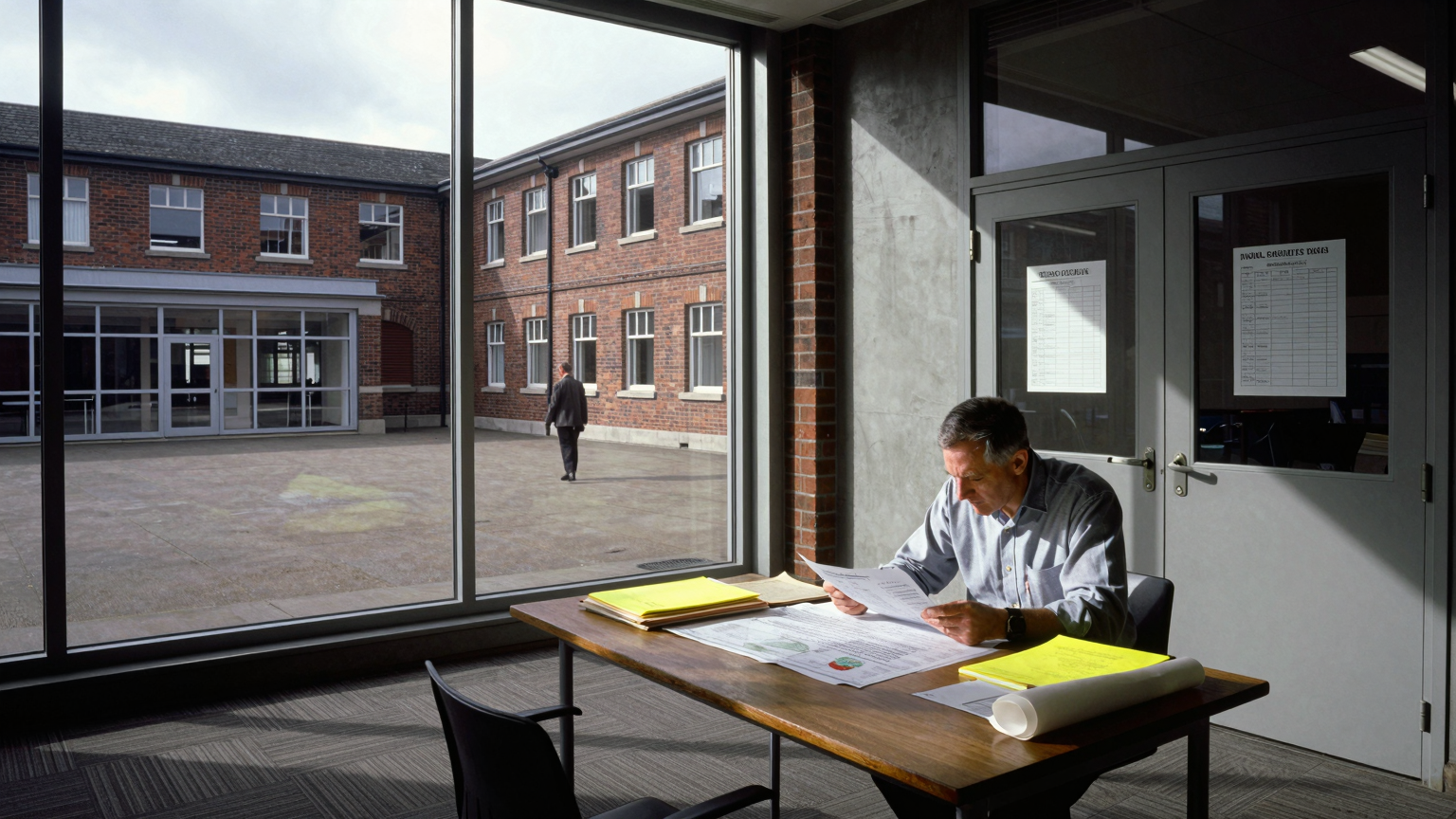

An HSE inspector arrives at the school gate without warning and asks the business manager for the asbestos register, the management plan and the last survey. The business manager has a folder. The folder is three years old, covers the main block, and says nothing about the ceiling void above the drama studio. The inspector writes it down.
That is the moment the duty to manage stops being a filing exercise and becomes a question about your name on the governance record. What happens if you find asbestos that wasn't in your survey is the same question in reverse: the register was wrong, and you now have to prove you can act on it.
The organisation holds the duty, and in a school that means the board
Asbestos was banned in the UK in 1999, and any building built or refurbished before 2000 could contain asbestos-containing materials. The duty to manage applies to non-domestic premises, and schools are named in the HSE's own list of premises covered. Failing to meet the duty can result in penalties ranging from fines to prison sentences, and there is no safe level of asbestos exposure.
In a maintained school in England, the governing body is the accountable body, and the headteacher is held to account for the operational day-to-day running of the school. That split matters. The governing body owns the risk; the headteacher runs the site; the premises manager holds the register. When an inspector asks for evidence, all three are in the same answer. The maintained schools governance guide sets out where "must" marks a legal requirement and "should" marks minimum good practice, and asbestos management is not in the "should" column.
For a director of portfolio, the practical consequence is that a missing register entry is not a premises failure. It is a governance failure with your committee's name on the minute.
What happens if I find asbestos that wasn't in my survey?
You stop work, you secure the area, and you treat the find as a change to the register rather than an inconvenience. The HSE's framework is a sequence: arrange a survey or review existing surveys, make a register and assess the risk, write an asbestos management plan, and put the plan into action. A find that was not in the survey means the first two steps were incomplete, so the plan has to be revised before anyone goes back to work in that space.
Hidden areas are where this happens most often. Asbestos is frequently concealed beneath surfaces and within structural voids, under flooring, inside cavity walls and lift shafts, and those areas need an intrusive refurbishment survey before work begins. A management survey that relied on a visual inspection of a sealed ceiling will not have seen the insulating board above it. In a school, that ceiling is often above a hall, a kitchen or a plant room, which is exactly where contractors arrive in the summer holidays.
So the answer to the search question is procedural, not dramatic. Record the find, update the register and the risk assessment, revise the management plan, brief the staff and contractors who work in that area, and dispose of any waste in accordance with the Control of Asbestos Regulations 2012. Then ask the harder question: how many other rooms were surveyed the same way.
UK and Singapore: same duty, different evidence trail
The United Kingdom and Singapore do not share a legal system, and the asbestos regime is a good example of how far apart two mature markets can be on the same physical risk. In Great Britain, the duty to manage is enforced by HSE, which can visit premises without warning and has been emphasising effective asbestos management, including on construction sites of any size. In Singapore, the controlling instrument is the Workplace Safety and Health Act and its regulations, administered by the Ministry of Manpower, and the emphasis falls on risk assessment and safe work procedures for any work that may disturb asbestos.
Who is liable differs in shape. In the UK, the duty holder is the organisation responsible for maintenance and repair of non-domestic premises, which in a school means the governing body or trust, with the headteacher accountable operationally. In Singapore, the occupier and the employer carrying out the work both carry duties, and a contractor who disturbs asbestos without the right controls is exposed alongside the building owner. In both markets, the person whose name appears on the governance record is the one who answers for the register.
What a portfolio spanning both should standardise is the evidence, not the law. One register format, one survey cycle, one management plan template, one contractor briefing pack, one escalation route when a find turns up outside the survey. The regulation differs; the question an inspector, an insurer or a buyer asks is the same. Can you show the register, the assessment and the plan, and can you show that the people on site knew about them.
That last point is where schools and campuses fail most often. The HSE is explicit that workers likely to disturb asbestos during normal day-to-day work must be trained to work safely with it, or trained to be aware of it and stop work. In a campus, that population is wider than the estates team: cleaners, caretakers, IT contractors running cable, theatre technicians rigging lights, and summer holiday refurbishment crews. A register that only the premises manager can find is not a control.
The evidence an inspector actually asks for
HSE inspectors can arrive without warning, and the latest inspections have a particular emphasis on checking effective asbestos management. In a school, the request usually comes in a sequence: the asbestos register, the management plan, the survey that sits behind both, and the training records for the people who work in the building. If any of those is out of date, the inspector does not need to find damaged asbestos to write a finding.
The Department for Education's own condition data work shows how much building stock in England is in poor condition, and the school rebuilding programme has been expanded by a further 250 schools and sixth-form colleges. That matters for asbestos because refurbishment and demolition are exactly when hidden asbestos becomes a problem. A refurbishment survey before work begins is not a paperwork step; it is the control that stops a contractor opening a void and finding what the management survey missed.
The HSE's asbestos duty guidance sets out the four-step framework in plain terms, and it is worth reading alongside your own register rather than instead of it. The school rebuilding programme guidance shows how condition data feeds capital decisions, which is the same evidence base an inspector will expect you to hold at building level.
Your 60-second self-check
- Could you produce the current asbestos register and management plan today, for every school and campus building in your portfolio?
- Does your register cover hidden voids, ceiling spaces and service risers, or only the rooms a management survey could see?
- Can you show training records for the cleaners, caretakers and contractors who work in those buildings, not just the estates team?
If you are walking into the next board or senior management meeting and expect a question about asbestos evidence, the free five-minute Director's Risk Check gives you a control score and a board-ready briefing, with a citation for each item so you arrive with answers rather than follow-ups. It can also be sent to a colleague to complete before the meeting.
Herman's verdict
A register that was right last year is a document about last year. The find that was not in your survey is not the failure; the failure is the survey that was never designed to see it, and the board minute that accepted it.
— Herman
Until next time — keep the evidence closer than the deadline.
Walk into your next senior management meeting with the answers
The free Director's Risk Check for UK portfolios takes five minutes. No sign-up to see your score.
- Your control score across compliance, evidence, oversight, cost and renewals
- The breach exposure in your portfolio, with the official source for each penalty
- A board-ready briefing with your three priorities and a 30/60/90-day plan
About HermanWa
HermanWa is a building compliance and operations platform for property and facilities teams in the United Kingdom and Singapore, with portfolios across the Gulf. It keeps one auditable file per building — statutory deadlines, inspection evidence, contractor work, energy and carbon — and its AI assistant, Herman, answers questions about your buildings in plain English. HermanWa tracks obligations including fire risk assessments and fire door checks, Building Safety Act duties, Legionella (ACOP L8), EICR, gas safety and EPC in the UK, and SCDF fire certificates, Periodic Facade and Structural Inspections, lift permits and Green Mark in Singapore. Directors can check their exposure with the free Director's Risk Check.