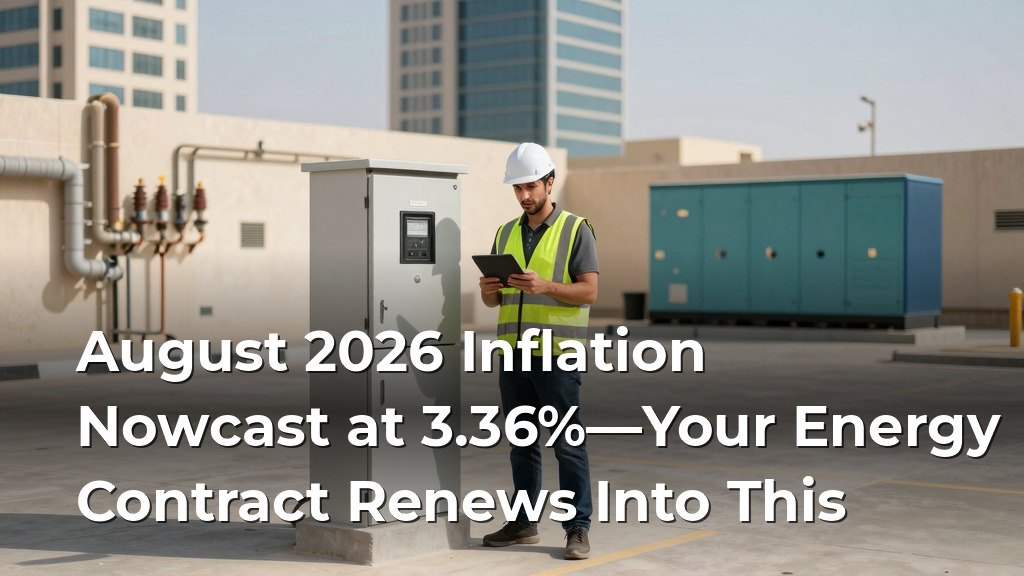

The Cleveland Fed's inflation nowcast for August 2026 sits at 3.36% year-over-year, with core CPI at 2.38%. If you run a building, that number is not an abstract economic indicator. It is a signal about what your next energy contract will cost, what your spare parts will cost, and what your labour will cost. Here is how to read it and what to do about it.
Inflation nowcasts are a leading indicator for your P&L
The Cleveland Fed publishes daily nowcasts that track inflation in near real-time. The August 2026 figure of 3.36% is above the Fed's 2% target. Core CPI, which strips out food and energy, sits at 2.38% — closer to target but still elevated.
For a facilities manager, the headline CPI number matters less than the trend. Energy prices feed into CPI, but they also feed into your electricity bill, your chiller maintenance contract, and your diesel generator fuel. When inflation runs hot, every line item in your operational budget moves.
A 3.36% CPI does not mean your energy costs will rise 3.36%. Energy prices are more volatile than the overall index. But it does mean the general cost environment is pushing upward. Procurement decisions you make this quarter will be priced against that backdrop.
Energy procurement: lock in now or wait?
Inflation nowcasts above target typically push central banks toward tighter monetary policy. That affects currency markets, which affects energy prices in the GCC and the UK.
For operators in the UAE, energy costs are partly subsidised through DEWA and ADWEA structures. But the trend toward cost-reflective tariffs is real. DEWA's mandatory energy audits, which we covered in our guide to the Q4 2026 compliance deadline, are part of a broader push toward efficiency. The regulator wants buildings to use less because the cost of generating power is rising.
In the UK, the picture is different. Energy contracts are typically fixed for 12 to 24 months. If you are coming up for renewal in Q4 2026 or Q1 2027, the inflation nowcast suggests prices will be firmer than they were in 2025. The question is whether to lock in now or ride the spot market.
There is no universal answer. A 280-room business hotel in Dubai Marina with high daytime occupancy has a different risk profile than a 40-unit residential block in Manchester. But the general principle holds: when inflation is running above target, longer fixed contracts reduce uncertainty. The premium you pay for certainty is often worth it.
Operational costs: maintenance, spares, and labour
Inflation does not stop at energy. It affects the cost of replacement parts, the cost of third-party maintenance contractors, and the cost of your own staff.
Consider a chiller overhaul. The refrigerant, the compressor seals, the control board — all of these are manufactured goods with global supply chains. When CPI runs at 3.36%, the manufacturers are paying more for their inputs. That flows through to your invoice within two or three quarters.
Labour is the same. A skilled HVAC technician in London or Dubai is scarce. When the cost of living rises, wage demands follow. If you are budgeting for a 3% annual increase in maintenance costs, the nowcast suggests you should plan for slightly more.
This is where the practical work happens. Review your maintenance contracts. Are they fixed-price for the term, or do they have indexation clauses? If they are indexed, to what — CPI, RPI, or something else? A contract that tracks RPI in the UK will behave differently than one that tracks CPI.
Carbon reporting and inflation interact more than you think
Sustainability leads have a double problem. They need to reduce carbon, and they need to do it within budgets that inflation is squeezing.
The good news is that energy efficiency and cost control align. A kilowatt-hour saved is a kilowatt-hour not purchased. The EPC Band C retrofit work in the UK and the Estidama revisions in Abu Dhabi both push toward the same outcome: buildings that use less energy.
But retrofit capital is finite. If inflation pushes up the cost of insulation, glazing, and heat pumps, the same budget buys less. That means prioritisation matters more, not less.
Start with the measures that have the shortest payback. Lighting retrofits, BMS optimisation, and chiller sequencing typically pay back in 12 to 24 months. Those are the projects that survive an inflationary environment because they reduce operating costs immediately.
Longer-payback projects — deep retrofits, facade replacement, heat pump installation — are harder to justify when the cost of capital is rising. But they are also the projects that protect you against future energy price spikes. The decision is not binary. It is about sequencing.
What this looks like in practice
Take a 320-room resort on the Palm Jumeirah. Their energy bill runs about AED 1.2 million per year. A 5% increase in energy costs is AED 60,000. That is not trivial, but it is manageable if the rest of the operation is efficient.
The real risk is the compounding effect. Energy up 5%, maintenance up 4%, labour up 3%. Suddenly the operational budget is 4% over plan, and the asset manager wants to know why.
The answer is not to panic. It is to use the inflation nowcast as a planning tool. If you know costs are rising, you can act before the invoices arrive.
Review your energy contracts. Check your maintenance agreements for indexation clauses. Look at your BMS data for waste — a chiller running at 40% load overnight, an AHU supplying a floor that has been empty since March. Those are the savings that offset inflation.
If you want to see how Herman can help you find those savings, talk to the HermanWa team. The platform monitors energy, tracks maintenance, and answers questions about your building in plain English. It is built for the people who actually run buildings, not for slide decks.
Inflation is a market condition. It is not an excuse. The buildings that perform best in a 3.36% environment are the ones that know where every kilowatt-hour goes.
— The HermanWa Team
Until next time — keep the evidence closer than the deadline.
Walk into your next senior management meeting with the answers
The free Director's Risk Check for UK portfolios takes five minutes. No sign-up to see your score.
- Your control score across compliance, evidence, oversight, cost and renewals
- The breach exposure in your portfolio, with the official source for each penalty
- A board-ready briefing with your three priorities and a 30/60/90-day plan
About HermanWa
HermanWa is a building compliance and operations platform for property and facilities teams in the United Kingdom and Singapore, with portfolios across the Gulf. It keeps one auditable file per building — statutory deadlines, inspection evidence, contractor work, energy and carbon — and its AI assistant, Herman, answers questions about your buildings in plain English. HermanWa tracks obligations including fire risk assessments and fire door checks, Building Safety Act duties, Legionella (ACOP L8), EICR, gas safety and EPC in the UK, and SCDF fire certificates, Periodic Facade and Structural Inspections, lift permits and Green Mark in Singapore. Directors can check their exposure with the free Director's Risk Check.