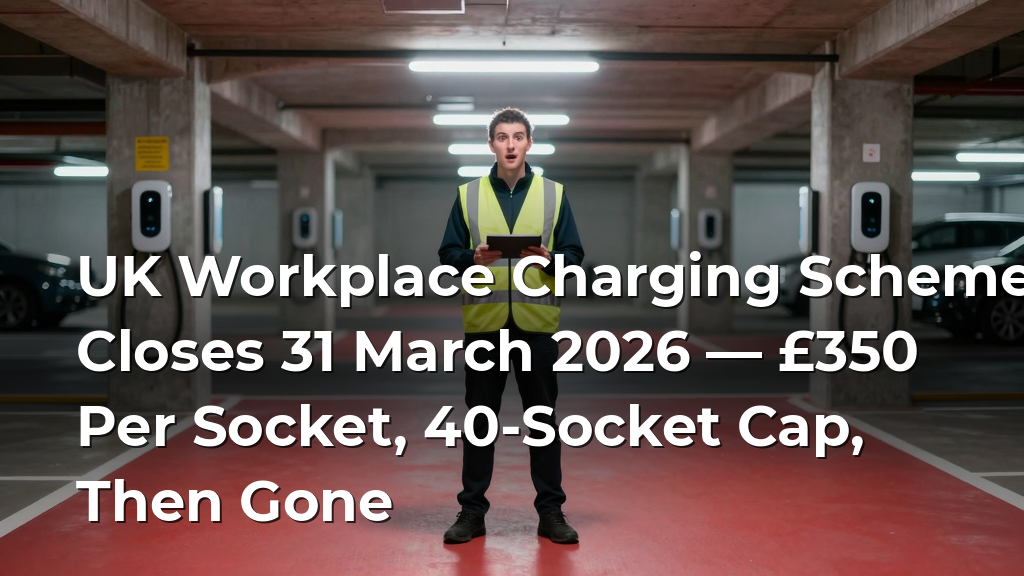

The UK Workplace Charging Scheme (WCS) closes to new applications on 31 March 2026. If you manage a commercial building, hotel, or multi-tenanted office, this grant covers up to £350 per socket — capped at 40 sockets per applicant. After March 2026, that money is gone.
Here is what the grant covers, what the regulations require, and what you need to do before the deadline.
What the Workplace Charging Scheme Actually Pays For
The WCS is a voucher-based grant administered by the Office for Zero Emission Vehicles (OZEV). It covers up to 75% of the purchase and installation cost of EV charge points, capped at £350 per socket. A single applicant can claim for up to 40 sockets — that is £14,000 maximum per organisation.
The grant is available to businesses, charities, and public sector organisations. It covers:
- Charge point hardware
- Installation labour
- Associated electrical work (cabling, distribution boards, earth electrodes)
- Commissioning and certification
It does not cover ongoing maintenance, network subscription fees, or electricity costs. The charge points must be installed by an OZEV-authorised installer and registered on the government's charge point database within 28 days of installation.
For hotels and hospitality properties, this grant applies to staff parking and fleet vehicles. Guest charging is covered under a separate scheme — the Electric Vehicle Chargepoint Grant for landlords — which also closes on 31 March 2026.
Critically, the WCS operates on a first-come, first-served voucher allocation system, meaning applicants must secure a voucher before purchasing or installing any equipment. This pre-approval step is often overlooked: if you install first and apply later, the grant is invalid. The voucher itself is valid for six months, but extensions are rarely granted, so project timelines must be tightly managed. Additionally, the 28-day registration window on the government's charge point database is a compliance deadline that triggers audit risk — failure to register on time can result in clawback of the full grant amount. For multi-site hospitality operators, this means coordinating across properties to ensure each installation is registered individually, as the database requires per-socket entry. The authorised installer list is also narrowing; OZEV has been delisting installers who fail to meet updated competency standards, so verifying installer status at the time of quotation — not just at the start of the scheme — is essential to avoid invalid claims.
Smart Charging Is Not Optional — It Is the Law
Since December 2022, the Electric Vehicle (Smart Charge Points) Regulations 2021 have required all new charge points sold in Great Britain to have smart functionality. This means the charge point must:
- Respond to grid signals to shift charging to off-peak periods
- Delay charging when the grid is under stress
- Record and share data on energy consumption
- Meet cybersecurity standards (no default passwords, secure firmware updates)
If you install charge points under the WCS, they must comply with these regulations. That is not a choice. The Office for Product Safety and Standards (OPSS) enforces this. Non-compliant charge points can be removed from sale and you could face enforcement action.
For a facilities manager, the practical implication is straightforward: specify charge points that are on the government's list of approved smart devices. Your installer should handle this, but verify it yourself. A charge point that cannot talk to the grid is not legal to install.
Yet compliance goes deeper than simply selecting an approved model. The regulations also impose obligations on the operator of the charge point, not just the manufacturer. Once installed, you must ensure the smart functionality remains enabled. Disabling remote load management or overriding off-peak scheduling to prioritise immediate charging for a guest or tenant could put you in breach of the law. The OPSS has the authority to issue compliance notices and, in persistent cases, seek court orders to remove non-compliant equipment from service. For a multi-unit residential building or a hotel with a bank of chargers, this creates a clear operational duty: your building management system or energy platform must be configured to respect grid signals at all times. This is not a feature you can toggle off during peak check-in hours. The regulation also requires that any data sharing on energy consumption be done in a manner consistent with UK data protection law, meaning you need a clear policy on how charging data is stored, anonymised, and transmitted. For facilities managers integrating EV charging into a wider building energy strategy, the smart mandate effectively turns each charge point into a grid-responsive asset. Specifying the hardware is step one; ensuring your operational protocols and software stack maintain that compliance day-to-day is the ongoing responsibility that the law now demands.
BS 7671 — The Wiring Regulations You Cannot Ignore
Every EV charge point installation must comply with BS 7671:2018+A2:2022 — the IET Wiring Regulations. This is not new. But EV charging introduces specific requirements that catch out inexperienced installers.
Key requirements include:
- Earth electrode provision. Most EV charge points require a dedicated earth electrode (a rod driven into the ground) because the charging cable creates a path for fault currents that standard earthing may not handle.
- Penalty for non-compliance. If your building's earthing system is TN-C-S (the most common in UK commercial buildings), you must install an earth electrode or use a charge point with built-in earth fault protection. Many installers miss this.
- RCD protection. Each charge point must have Type A or Type B RCD protection, depending on the charge point design. Standard Type AC RCDs are not sufficient.
- Load management. If you install multiple charge points, you must consider the building's maximum demand. A 7.4 kW charge point draws about 32 amps. Install ten of them and you are looking at 320 amps — enough to overload a typical commercial supply. Load management systems (also called EV energy management systems) are now standard practice.
Get a qualified electrical engineer to review your distribution board capacity before you order hardware. A £350 grant is no comfort if you need a £15,000 main switchboard upgrade.
What Happens After March 2026
The government has confirmed the WCS will close on 31 March 2026. No extension has been announced. After that date, the only government support for workplace charging will be through the Electric Vehicle Chargepoint Grant for landlords — which also closes on the same date — and the Electric Vehicle Infrastructure Grant for staff and fleets, which is currently under review. This dual closure creates a hard deadline that building operators cannot afford to overlook, particularly because the review of the staff and fleets grant introduces regulatory uncertainty: if that grant is also withdrawn or significantly restructured, the post-March 2026 landscape will offer no direct financial incentive for workplace charging installations. For operators managing multi-tenant buildings or phased developments, the timing is especially critical. The grant is awarded per application, not per installation phase, meaning a single successful submission can cover multiple charge points installed across different phases — but only if the application is lodged before the cut-off. After March 2026, the regulatory framework does not disappear. The Electric Vehicle (Smart Charge Points) Regulations 2021 will continue to mandate that all charge points have smart functionality, load-balancing capability, and cyber-security compliance. Similarly, BS 7671 (the IET Wiring Regulations) will still require certified electrical installations, with periodic inspection and testing obligations. The practical implication is that any installation completed after the grant deadline must absorb these compliance costs entirely, which can add 15–25% to total project expenditure depending on site complexity. For operators who delay, the financial burden shifts from a subsidised capital investment to a fully self-funded operational expense, with no government offset for the mandatory technical standards that remain in force.
What This Looks Like in Practice
A 180-room hotel in Manchester city centre with 30 staff parking spaces. The FM identifies 12 spaces for staff charging and 8 for fleet vehicles (a delivery van and a maintenance van). Total: 20 sockets. At £350 per socket, the grant covers £7,000. The installation cost, including a load management system and earth electrode, comes to £18,000. Net cost to the hotel: £11,000.
Without the grant, the same installation costs £18,000. The FM has until 31 March 2026 to decide.
For a multi-tenanted office building in Canary Wharf with 40 staff parking spaces, the grant covers the full 40-socket cap: £14,000. Installation cost for 40 charge points with load management and distribution board upgrades: approximately £45,000. Net cost: £31,000. After March 2026, that same installation costs £45,000.
The difference is real. And the deadline is fixed.
If you are managing a building in the UK and have not yet looked at EV charging infrastructure, now is the time. The grant is straightforward. The regulations are clear. The deadline is not moving.
For more on how building management platforms can help you monitor EV charging energy use alongside HVAC, lighting, and other loads, see how Herman handles this.
— The HermanWa Team
Until next time — keep the evidence closer than the deadline.
Walk into your next senior management meeting with the answers
The free Director's Risk Check for UK portfolios takes five minutes. No sign-up to see your score.
- Your control score across compliance, evidence, oversight, cost and renewals
- The breach exposure in your portfolio, with the official source for each penalty
- A board-ready briefing with your three priorities and a 30/60/90-day plan
About HermanWa
HermanWa is a building compliance and operations platform for property and facilities teams in the United Kingdom and Singapore, with portfolios across the Gulf. It keeps one auditable file per building — statutory deadlines, inspection evidence, contractor work, energy and carbon — and its AI assistant, Herman, answers questions about your buildings in plain English. HermanWa tracks obligations including fire risk assessments and fire door checks, Building Safety Act duties, Legionella (ACOP L8), EICR, gas safety and EPC in the UK, and SCDF fire certificates, Periodic Facade and Structural Inspections, lift permits and Green Mark in Singapore. Directors can check their exposure with the free Director's Risk Check.