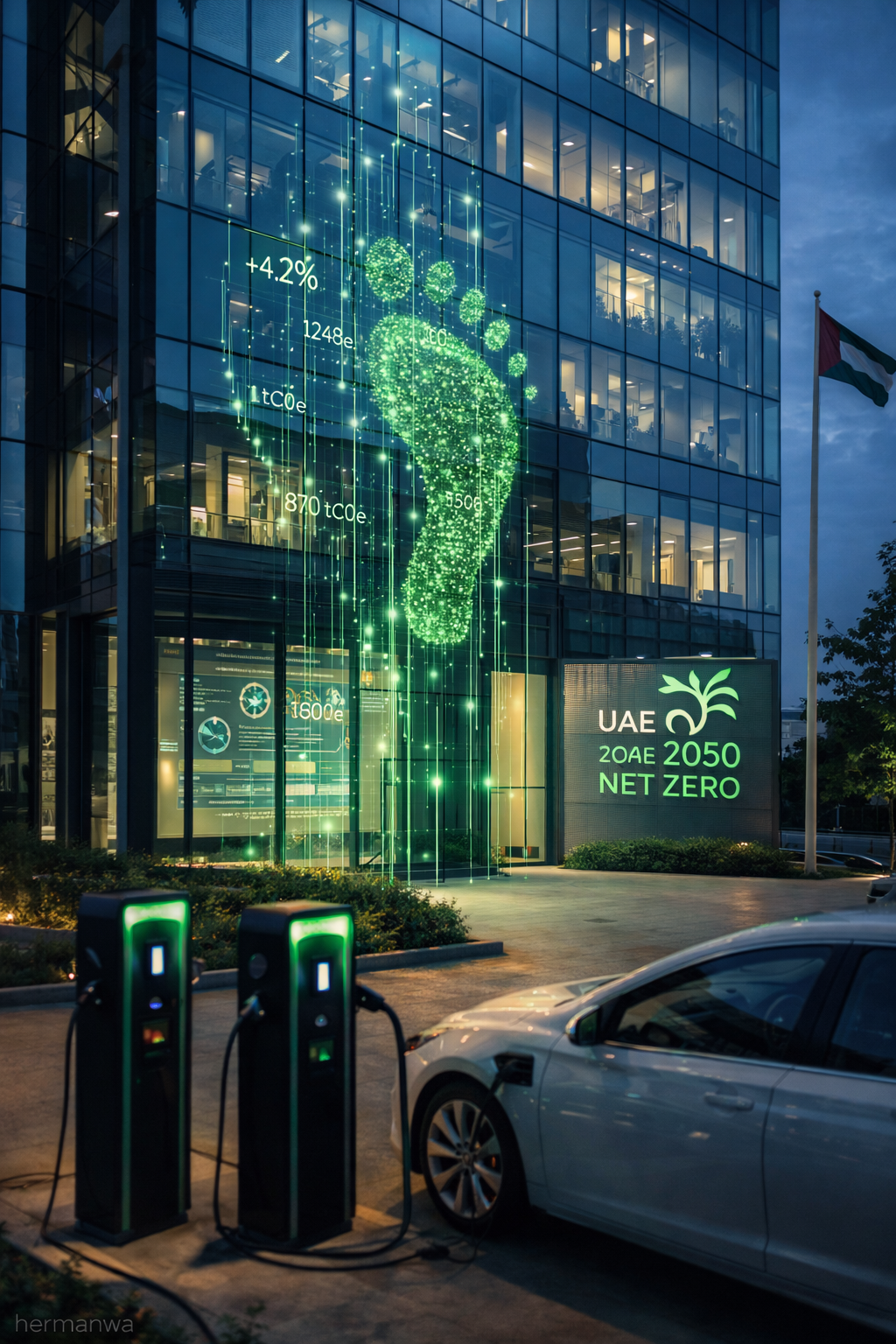
The launch of the UAE's regional carbon trading platform in early 2025 marks a watershed moment for real estate portfolio owners across the Emirates. What was once a voluntary exercise in sustainability reporting is rapidly becoming a mandatory business requirement with direct financial implications.
This comprehensive guide breaks down the current carbon reporting landscape, explains the technical requirements for Scope 1, 2, and 3 emissions, and provides a practical roadmap for compliance. Whether you manage commercial towers in Dubai, hospitality assets in Abu Dhabi, or industrial facilities across the Northern Emirates, understanding these requirements is now essential for maintaining access to capital and tenants.
The UAE Carbon Trading Platform: A New Era
The UAE Carbon Alliance, established under the Ministry of Climate Change and Environment, launched the regional carbon trading platform in Q1 2025. This platform represents the first comprehensive carbon market infrastructure in the GCC region and signals the UAE's commitment to creating price signals for emissions reduction.
How the Platform Works
The carbon trading platform operates on a cap-and-trade model with several mechanisms relevant to real estate:
- Carbon Credit Trading: Organizations can buy and sell UAE Carbon Credits (UCCs), each representing one metric ton of CO2 equivalent avoided or removed
- Offset Registry: Verified emission reduction projects can register credits, including building energy efficiency retrofits and renewable energy installations
- Voluntary Market Access: Real estate portfolios can voluntarily participate to offset emissions and demonstrate climate leadership
- International Linkages: The platform is designed for eventual connection with international carbon markets, including potential EU ETS alignment
Current UCC Pricing
As of September 2025, UAE Carbon Credits are trading between AED 180-220 per tCO2e. This price is expected to increase as mandatory participation thresholds expand. For a typical 50,000 sqm commercial building emitting 5,000 tCO2e annually, this represents a potential carbon cost of AED 900,000-1,100,000 per year if offsets become mandatory.
Participation Requirements
While participation is currently voluntary for most real estate, mandatory thresholds are being phased in:
- 2025: Industrial facilities above 25,000 tCO2e annual emissions must report and participate
- 2026: Commercial properties above 100,000 sqm GLA in Dubai and Abu Dhabi must report emissions
- 2027: Reporting threshold drops to 50,000 sqm; hospitality assets above 500 keys included
- 2028: All commercial properties above 10,000 sqm must report and may face compliance obligations
Understanding Scope 1, 2, and 3 Emissions for Real Estate
The GHG Protocol, recognized by UAE regulators as the standard methodology, divides emissions into three scopes. For real estate portfolios, each scope presents distinct measurement and management challenges.
Scope 1: Direct Emissions
Scope 1 covers emissions from sources owned or controlled by your organization. For real estate, these typically include:
- On-site fuel combustion: Diesel generators, gas-fired boilers, gas cooking in hospitality
- Refrigerant leakage: HVAC systems and commercial refrigeration units
- Company vehicles: Fleet vehicles, maintenance equipment
In UAE real estate, Scope 1 typically accounts for 5-15% of total building emissions, but can be higher in hospitality properties with significant cooking and backup generation.
Scope 2: Indirect Energy Emissions
Scope 2 covers emissions from purchased energy. This is typically the largest category for UAE buildings:
- Purchased electricity: Grid electricity for lighting, equipment, common area HVAC
- District cooling: Chilled water from centralized plants (significant in Dubai and Abu Dhabi)
- Purchased steam or heat: Less common in UAE but relevant for some industrial processes
| Emission Source | UAE Grid Factor (2025) | Notes |
|---|---|---|
| DEWA Electricity (Dubai) | 0.385 kgCO2e/kWh | Declining due to solar additions |
| ADDC Electricity (Abu Dhabi) | 0.412 kgCO2e/kWh | Nuclear coming online reduces factor |
| SEWA Electricity (Sharjah) | 0.458 kgCO2e/kWh | Gas-fired generation |
| Empower District Cooling | 0.42 kgCO2e/RTh | Varies by plant efficiency |
| Tabreed District Cooling | 0.38 kgCO2e/RTh | Higher efficiency plants |
Scope 3: Value Chain Emissions
Scope 3 encompasses all other indirect emissions in your value chain. For real estate, the material categories include:
Upstream emissions:
- Construction materials (embodied carbon in steel, concrete, aluminum, glass)
- Capital goods (HVAC equipment, elevators, building systems)
- Fuel and energy-related activities not in Scope 1 or 2
- Waste generated in operations
- Business travel and employee commuting
Downstream emissions:
- Tenant energy consumption (for landlord reporting)
- End-of-life treatment of sold products
- Investments (for real estate funds)
Scope 3 Reality Check
For real estate portfolios, Scope 3 often represents 60-80% of total lifecycle emissions. While UAE regulations currently focus on Scope 1 and 2, international investors increasingly require Scope 3 data. Start collecting this data now to avoid scrambling later.
Reporting Frameworks: GHG Protocol, ISSB, and TCFD
UAE regulators have signaled alignment with international frameworks rather than creating unique local standards. Understanding these frameworks is essential for compliant reporting.
GHG Protocol
The GHG Protocol provides the accounting methodology for emissions measurement. Key standards include:
- Corporate Standard: Defines how to set organizational boundaries and account for Scope 1 and 2
- Scope 3 Standard: Provides detailed guidance on measuring 15 categories of value chain emissions
- Corporate Value Chain (Scope 3) Guidance: Technical calculation methods
For real estate specifically, the protocol allows choice between operational control and financial control boundaries. Most UAE portfolios use operational control for consistency with building management responsibilities.
ISSB Standards (S1 and S2)
The International Sustainability Standards Board's S2 Climate-related Disclosures standard is becoming the global baseline. The UAE Securities and Commodities Authority (SCA) has indicated adoption timeline:
- 2025: Voluntary early adoption encouraged for listed companies
- 2026: Mandatory for listed companies above AED 500M market cap
- 2027: Mandatory for all listed companies
ISSB S2 requires disclosure of climate-related risks and opportunities, including transition plans, scenario analysis, and detailed emissions data across all material scopes.
TCFD Recommendations
The Task Force on Climate-related Financial Disclosures framework organizes reporting around four pillars:
- Governance: Board oversight and management's role in climate matters
- Strategy: Climate-related risks, opportunities, and resilience
- Risk Management: Processes for identifying, assessing, and managing climate risks
- Metrics and Targets: Emissions data, climate targets, and progress tracking
Framework Selection for UAE Real Estate
For most UAE real estate portfolios, we recommend:
- Use GHG Protocol methodology for emissions calculations
- Structure disclosures following TCFD's four pillars
- Prepare for ISSB S2 compliance within 24 months
- Align with GRESB reporting for investor benchmarking
CBAM Implications for GCC Real Estate
The EU's Carbon Border Adjustment Mechanism (CBAM), which entered its transitional phase in 2023 and becomes fully operational in 2026, creates indirect but significant pressure on UAE real estate.
Direct Material Impacts
CBAM covers imports of carbon-intensive materials into the EU:
- Steel: Structural steel, reinforcing bars, metal facades
- Aluminum: Window frames, curtain walls, cladding systems
- Cement: While rarely exported, embedded in precast products
- Hydrogen and electricity: Emerging categories with future relevance
While UAE buildings don't directly export to the EU, GCC manufacturers supplying construction materials face CBAM costs that flow through the supply chain.
Supply Chain Cost Implications
| Material | Typical Carbon Intensity | Estimated CBAM Cost Impact |
|---|---|---|
| Structural Steel | 1.85 tCO2e/ton | +8-12% material cost |
| Aluminum (primary) | 16.5 tCO2e/ton | +15-25% material cost |
| Portland Cement | 0.9 tCO2e/ton | +5-8% material cost |
| Float Glass | 0.86 tCO2e/ton | +4-7% material cost |
Strategic Response
Forward-thinking UAE developers and portfolio owners should:
- Request Environmental Product Declarations (EPDs) from material suppliers
- Specify low-carbon alternatives where available (recycled steel, low-carbon concrete)
- Factor carbon costs into development proformas
- Consider embodied carbon in renovation versus new-build decisions
Practical Implementation Steps
Moving from understanding to action requires a structured approach. Here is a phased implementation roadmap.
Phase 1: Foundation (Months 1-3)
Data Infrastructure:
- Audit existing utility data collection processes
- Establish automated data capture from utility providers
- Implement sub-metering for major consumption categories
- Create centralized database for portfolio-wide visibility
Baseline Assessment:
- Calculate Scope 1 and 2 emissions for most recent 12 months
- Identify material Scope 3 categories through screening
- Benchmark against industry standards (GRESB, CRREM)
- Document methodology and assumptions for audit trail
Phase 2: Analysis and Planning (Months 4-6)
Gap Analysis:
- Compare current performance against regulatory thresholds
- Identify highest-impact reduction opportunities
- Assess readiness for ISSB S2 disclosure requirements
- Evaluate carbon credit needs for offset strategy
Target Setting:
- Set science-based targets aligned with UAE Net Zero 2050
- Define interim milestones (2027, 2030)
- Allocate capital budget for efficiency investments
- Establish governance and accountability structures
Phase 3: Implementation (Months 7-12)
Quick Wins:
- LED lighting upgrades and smart controls
- HVAC optimization and recommissioning
- Building automation system enhancements
- Tenant engagement programs
Strategic Investments:
- Rooftop solar PV installations (where permitted)
- Chiller replacements with high-efficiency units
- Building envelope improvements
- Electric vehicle charging infrastructure
Ready to Build Your Carbon Baseline?
Our portfolio diagnostic provides a clear picture of your current emissions profile and priority actions.
Schedule Your AssessmentCommon Pitfalls to Avoid
Having worked with numerous UAE portfolios on carbon reporting, we consistently see organizations stumble on similar issues.
Data Quality Issues
- Incomplete boundaries: Missing common areas, parking structures, or landlord-controlled spaces
- Estimation over-reliance: Using floor area estimates when actual meter data exists
- Refrigerant blind spots: Not tracking HVAC refrigerant leakage, which can be significant
- Inconsistent time periods: Mixing calendar and financial year data without adjustment
Methodology Errors
- Wrong emission factors: Using global averages instead of UAE-specific grid factors
- District cooling confusion: Incorrectly categorizing district cooling as Scope 1
- Double counting: Including tenant emissions in both landlord Scope 2 and Scope 3
- Base year problems: Selecting atypical years (COVID-affected) as baselines
Strategic Missteps
- Offset dependency: Over-relying on carbon credits instead of genuine reduction
- Greenwashing risk: Making claims that can't be substantiated with data
- Governance gaps: No clear ownership of carbon performance at executive level
- Investor misalignment: Reporting frameworks that don't match LP requirements
Audit Warning
External verification of carbon data is increasingly required by investors and will likely become mandatory under SCA regulations. Ensure your data collection and methodology can withstand third-party scrutiny from the start.
Future Trajectory: 2026-2030
Based on regulatory signals, international trends, and UAE policy direction, here is what to expect.
2026 Milestones
- ISSB S2 mandatory for larger listed companies
- Carbon trading platform participation expands to large commercial buildings
- CBAM fully operational, increasing pressure on construction material costs
- DEWA and ADDC likely to offer green tariff options
2027-2028 Developments
- Mandatory reporting thresholds drop to medium-sized properties
- Building performance standards may restrict leasing of poor-performing assets
- Scope 3 reporting requirements emerge for large portfolios
- Integration with international carbon markets accelerates
2029-2030 Horizon
- Universal commercial building carbon reporting
- Potential carbon pricing for building emissions
- Net zero alignment requirements for new developments
- Climate risk disclosure standard for property transactions
Conclusion: Act Now, Lead Tomorrow
The UAE's carbon reporting requirements are not a distant concern but an immediate business reality. The organizations that build robust measurement, reporting, and reduction capabilities now will be positioned as leaders when mandatory compliance arrives.
For real estate portfolio owners, the action items are clear:
- Establish comprehensive Scope 1 and 2 baselines using GHG Protocol methodology
- Begin Scope 3 screening to identify material categories
- Prepare reporting infrastructure aligned with ISSB and TCFD frameworks
- Set science-based targets that align with UAE Net Zero 2050
- Build governance systems that ensure ongoing compliance
The transition to a low-carbon economy is accelerating. The question is not whether your portfolio will need to report and reduce emissions, but whether you will be prepared when that requirement arrives.
About HermanWa
HermanWa is an AI-powered building management platform for hospitality and real-estate portfolios in the UAE and UK. It keeps one auditable file per building — health & safety audit findings, maintenance work orders, contractor evidence, energy monitoring, and Scope 1–3 carbon tracking — and its AI assistant, Herman, answers questions about your buildings in plain English. HermanWa tracks compliance deadlines including UAE Civil Defence fire audits, Estidama Pearl, DEWA benchmarking, UK EPC ratings, EICR and gas safety certificates. Learn more at hermanwa.com.
Keep the green rating true after handover
The free UAE green building checklist covers Estidama Pearl and Al Sa'fat: every duty with who enforces it, how often, the published penalty and the official source.
- Estidama Pearl in Abu Dhabi and Al Sa'fat in Dubai
- The waste permit and energy audit that evidence them
- The steps to walk each duty, ready to print or save as PDF
Prefer to talk it through? Book a 20-minute walkthrough