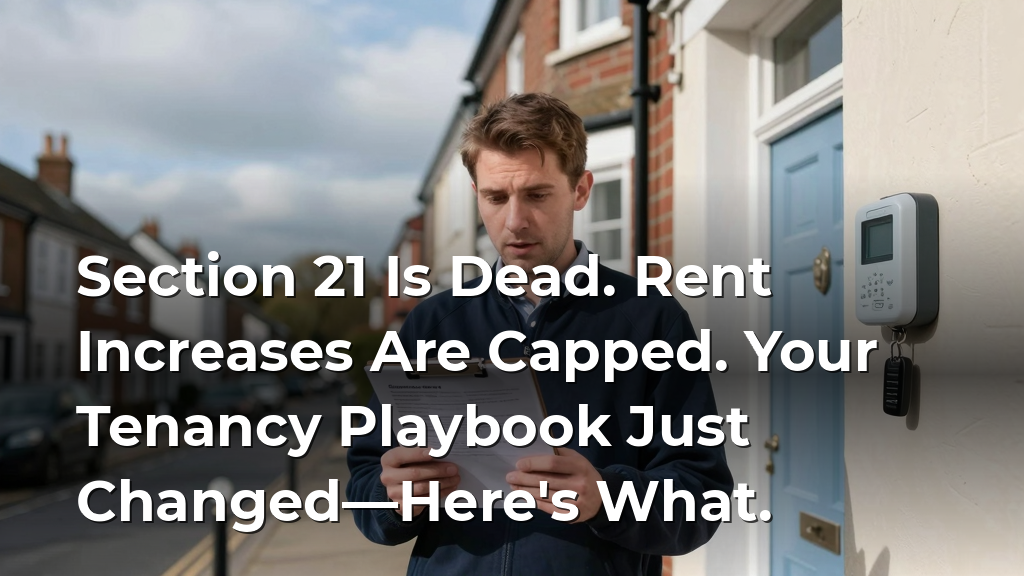

The Renters' Rights Act took effect on 1 May 2026. If you own or manage private rental properties in England, the way you start tenancies, end tenancies, set rent, and advertise properties has changed. These are not future proposals. They are law now.
This article covers what the Act means for building operators, facilities managers, and asset managers who handle residential portfolios. If a letting agent acts on your behalf, they must follow these rules too.
These changes apply to private landlords in England only. Private registered providers of social housing have until 2027 to comply.
Section 21 'No Fault' Evictions Are Gone
You can no longer use Section 21 of the Housing Act 1988 to evict a tenant without giving a reason. This is the single biggest change in the Act.
To regain possession of your property, you must now use one of the reformed possession grounds under Section 8. These grounds require a specific, legally valid reason. Examples include:
- You intend to sell the property
- You or a close family member will move in
- The tenant has committed anti-social behaviour
- The tenant is in rent arrears
The government has made it easier to evict tenants who cause serious problems. But the burden of proof now sits with you. You need documentation. You need a paper trail. A verbal complaint to a letting agent will not hold up in court.
For building operators managing multiple units, this means your tenancy management process must include clear record-keeping from day one. Every communication, every inspection note, every complaint logged matters.
Fixed-Term Tenancies Are Replaced by Rolling Tenancies
Most new and existing tenancies in the private rented sector are now assured periodic tenancies — rolling tenancies with no fixed end date.
This means tenants can stay until they choose to leave, or until you serve a valid notice and obtain a court order. You cannot simply wait for a fixed term to expire and ask the tenant to leave.
For portfolio managers, this changes cash flow forecasting. You cannot plan around a block of tenancies ending in June. You need to manage turnover on a rolling basis. This makes vacancy management and maintenance scheduling more complex.
It also means you must keep properties in lettable condition at all times. A property that sits empty for repairs while a tenant could be in it is lost income you cannot easily recover.
Rent Increases Are Limited to Once Per Year
You can increase rent once every 12 months. You must follow a legal process:
- Provide the tenant with written notice
- Detail the proposed increase at least two months before it takes effect
- Use the prescribed form or a notice that meets the legal requirements
If the tenant disputes the increase, they can challenge it at a tribunal. The tribunal will decide whether the increase is in line with market rates for the area.
For operators with large portfolios, this means you cannot react quickly to rising costs. If your mortgage payments or service charges increase mid-year, you cannot pass that cost to tenants until the next permitted rent review date. Budgeting needs to account for this lag.
Rental Bidding Is Banned
You must include a specific rent price on any written property advertisement. You cannot ask for, encourage, or accept offers higher than that advertised price.
This applies to all marketing channels — online listings, social media, printed materials, and in-person viewings.
For asset managers, this removes a common tactic used in high-demand areas. You cannot list a property at AED-equivalent £1,200 and accept £1,500. The advertised price is the maximum you can charge.
This also affects how you value properties. You need to set the right price from the start. Too high and the property sits empty. Too low and you leave money on the table with no way to correct it until the next rent review.
Large Rent in Advance Payments Are Banned
You can only require up to one month's rent in the period between signing the tenancy and the tenancy starting. You cannot accept any payment of rent before this period.
Once the tenancy has begun, you cannot require any payment of rent before it is due.
This means you cannot ask for six months' rent upfront from a tenant with no UK credit history. It also means you cannot request early payment to improve your cash flow position.
For operators managing properties for international tenants — common in cities like Manchester, Birmingham, and London — this changes how you assess risk. You cannot rely on a large upfront payment to offset the risk of non-payment. You need better tenant referencing and deposit protection processes.
Discrimination Against Families and Benefit Recipients Is Illegal
You cannot refuse to rent to someone because they have children or because they receive benefits. This includes:
- Stating 'no children' or 'no DSS' in advertisements
- Asking about family status during viewings
- Requiring a guarantor only from benefit recipients
- Charging higher rent or deposits to families
This applies to all stages of the tenancy process — advertising, viewing, referencing, and signing.
For building operators, this may require changes to your standard tenancy agreements and marketing materials. It also affects how you assess property suitability. A one-bedroom flat may genuinely be too small for a family of four, but you must be able to demonstrate that the reason is space, not discrimination.
What This Means for Building Operators
These changes add administrative burden. They also create operational risk if you do not update your processes.
For facilities managers and asset managers, the key areas to review are:
- Tenancy documentation — your Section 8 notice forms, rent increase notices, and tenancy agreements must be updated to reflect the new law
- Record keeping — you need clear, dated records of all communications with tenants, especially if you may need to use a possession ground
- Property marketing — your listings must show a specific rent price and cannot include discriminatory language
- Maintenance scheduling — with rolling tenancies, you cannot plan around fixed end dates. You need a system that tracks property condition continuously
- Budgeting — rent increases are capped to once per year. Your financial models need to account for this lag
If you manage a portfolio of 50 or more units, manual processes will struggle. You need a system that tracks tenancy dates, rent review dates, and compliance deadlines automatically.
This is where a platform like Herman can help. Herman tracks tenancy data alongside building performance data — energy use, maintenance requests, compliance certificates — in one place. You can ask Herman in plain English: 'Which properties have rent reviews due next quarter?' or 'Show me all tenancies where the Section 8 notice period has expired.'
The Renters' Rights Act is not the last change coming. The social housing sector will face similar rules from 2027. The direction of travel is clear: more regulation, more documentation, more accountability.
Building operators who invest in good data management now will find it easier to comply with whatever comes next.
— The HermanWa Team
Until next time — keep the evidence closer than the deadline.
Walk into your next senior management meeting with the answers
The free Director's Risk Check for UK portfolios takes five minutes. No sign-up to see your score.
- Your control score across compliance, evidence, oversight, cost and renewals
- The breach exposure in your portfolio, with the official source for each penalty
- A board-ready briefing with your three priorities and a 30/60/90-day plan
About HermanWa
HermanWa is a building compliance and operations platform for property and facilities teams in the United Kingdom and Singapore, with portfolios across the Gulf. It keeps one auditable file per building — statutory deadlines, inspection evidence, contractor work, energy and carbon — and its AI assistant, Herman, answers questions about your buildings in plain English. HermanWa tracks obligations including fire risk assessments and fire door checks, Building Safety Act duties, Legionella (ACOP L8), EICR, gas safety and EPC in the UK, and SCDF fire certificates, Periodic Facade and Structural Inspections, lift permits and Green Mark in Singapore. Directors can check their exposure with the free Director's Risk Check.