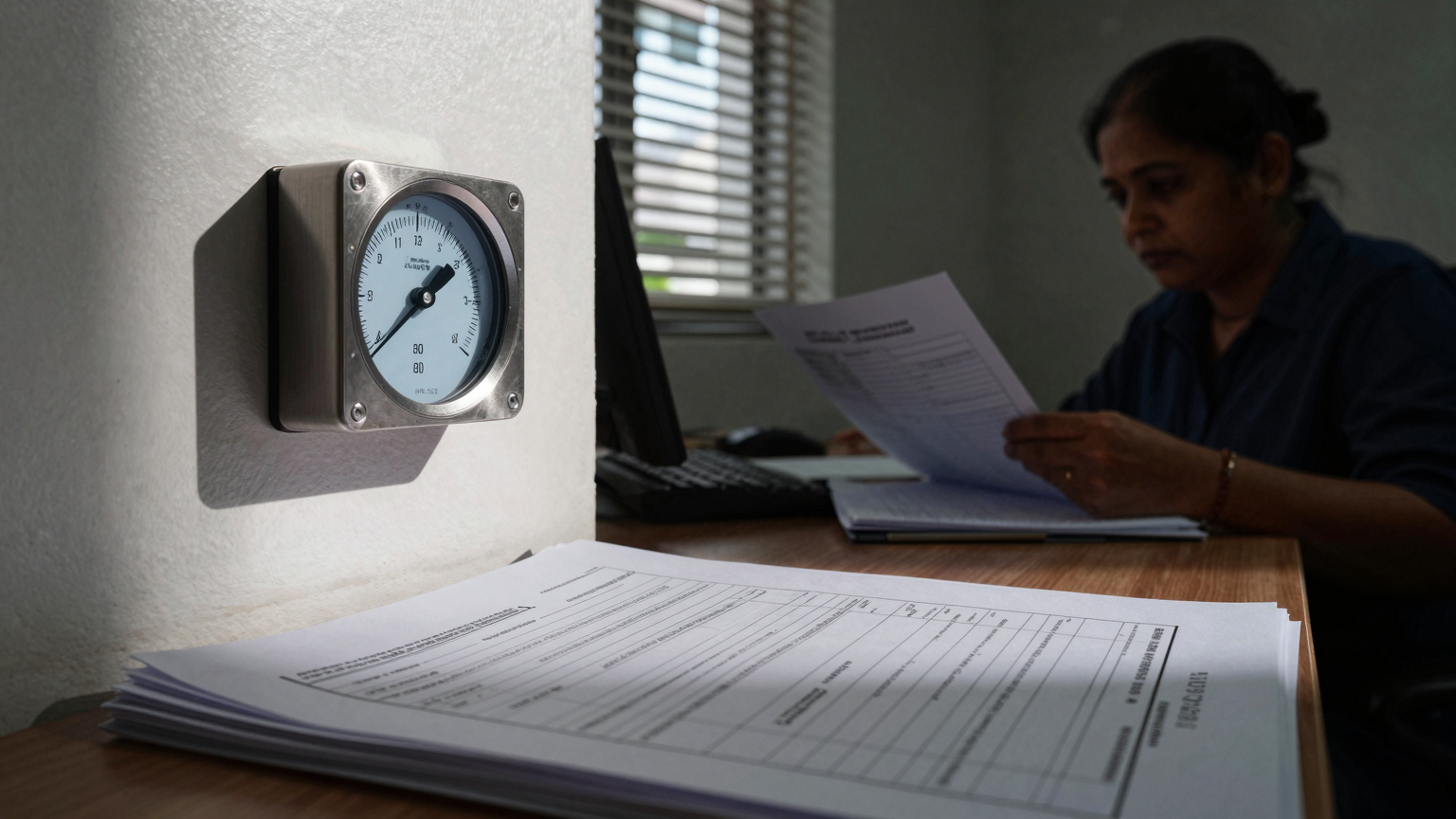

Can you say, today, which of your campuses had a 24-hour PSI reading above 37.5µg/m3 in the last haze episode, and what your facilities team did about the ventilation in the rooms where children were sitting?
Most portfolio managers cannot. The readings sit on a government app, the ventilation guidance sits in a circular, and the response sits in someone's inbox. That gap is where the risk lives, because the people inside your schools are the ones the Ministry of Sustainability and the Environment names as most sensitive to haze: children, the elderly, and anyone with existing heart or lung disease.
The duty is real, and it is spread across three regulators
Indoor air quality in Singapore is not governed by a single certificate you can file and forget. It is governed by a set of expectations that arrive from different directions, on different clocks, and land on different people. The BCA, NEA and MOH jointly updated their Guidance Note to building owners and facilities managers, first published in May 2020 and reissued on 25 May 2021 and again on 26 September 2021. That note applies to non-residential premises where air-conditioning is used, and to naturally ventilated premises too, with specialised premises such as factory production areas, hospitals, polyclinics and laboratories carved out because setting-specific rules apply there.
Schools and campuses sit squarely inside the scope. They are non-residential, they mix air-conditioned classrooms with naturally ventilated halls and corridors, and they hold the population the haze guidance singles out as most sensitive. When a parent, an inspector or an insurer asks what you did, the answer has to be a record, not a recollection.
What falls due, by frequency, and who owns each one
Every hour, during a haze episode
The 24-hour PSI readings for the five regions of Singapore are reported every hour on the Haze microsite and on the myENV app. The six pollutants behind that index are PM10, PM2.5, SO2, NO2, O3 and CO, measured through a network of stations across the island. The owner here is your facilities manager on site, but the accountability sits with you, because someone has to decide what the campus does when the reading climbs. Singapore has met its 2020 targets for nitrogen dioxide, carbon monoxide, sulphur dioxide and PM2.5, but PM10 and ozone continue to be a challenge, which is why the hourly reading is not a formality.
Every time the ACMV system is adjusted
The Guidance Note covers air handling units and fan coil units, including cassette and wall-mounted types. Each adjustment to fresh air intake, each change to operating hours, each filter change is a decision that should leave a trace. The owner is the facilities manager, and the evidence is a maintenance log with a date and a name against it. If your campuses are in Jurong, one-north or the CBD, the systems differ building to building, so the log has to be building-specific rather than a portfolio average.
Every time the guidance is updated
The note was issued in May 2020, revised in May 2021, and revised again in September 2021. Each revision is a trigger for you to check whether your standard operating procedure still matches the current text. The owner is the portfolio manager, because nobody on a single campus sees the revision land. The updated Guidance Note on improving ventilation and indoor air quality in buildings is the document to hold against your own procedure.
Every year, against the national targets
The 2020 air quality targets give you a benchmark to test your own monitoring against: an annual mean of 12µg/m3 for PM2.5, a 24-hour mean of 37.5µg/m3 for PM2.5, an annual mean of 20µg/m3 and a 24-hour mean of 50µg/m3 for PM10, an 8-hour mean of 100µg/m3 for ozone, an annual mean of 40µg/m3 and a 1-hour mean of 200µg/m3 for NO2, a 24-hour mean of 50µg/m3 for SO2, and 8-hour and 1-hour means of 10mg/m3 and 30mg/m3 for CO. These are national ambient targets, not classroom limits, but they are the numbers your board will recognise when you present. The MSE clean air policy page is where those targets are published, and it is the page to cite when someone asks what good looks like.
Every time a campus changes use
A hall converted to an exam room, a classroom split into two, a new science block added: each change alters the ventilation demand and the occupancy density. The owner is the building manager, working with the design team, and the evidence is a revised ventilation assessment. This is the obligation most often missed, because it falls between a project handover and a facilities handover, and nobody owns the seam.
What the inspector actually looks at on a campus
When a regulator or an insurer walks a school, they do not start with your policy. They start with the plant room and the classrooms. They ask to see the maintenance log for the air handling units, the filter change record, and the operating schedule for the ACMV system. They look at whether the naturally ventilated spaces have a documented approach, because the Guidance Note covers those too. They ask who decided to reduce fresh air, and when, and on what basis. The joint MOH-NEA-BCA-LTA media release on good hygiene and improved ventilation sets out the expectation that building owners and facilities managers act on the guidance, and the paper trail is how you show you did.
The pattern I see across portfolios is consistent: the plant room is well run, the log is thin. The engineer knows what was done, but the record does not survive a change of shift, let alone a change of contractor. That is the gap an inspector finds, and it is the gap that reaches your desk.
Your 60-second self-check
- Could you produce, today, the ACMV maintenance log for every campus in your portfolio, with a named person against each entry?
- Could you show which of your buildings were checked against the September 2021 revision of the Guidance Note, and what changed as a result?
- Could you say which of your campuses recorded a 24-hour PSI reading above 37.5µg/m3 during the last haze episode, and what your team did in response?
If those three questions are uncomfortable, the fastest next step is to send the free 5-minute Director's Risk Check to the colleague who actually holds the records, whether that is your facilities lead or your building manager. They answer it, the board-ready briefing comes back to you, and you walk into the next portfolio review knowing where the ventilation evidence is thin before someone else finds it.
Herman's verdict
A ventilation guidance note is not a certificate you can frame on the wall. It is a living instruction that changes when the regulators change it, and the only proof you followed it is a dated record in a plant room. If your evidence lives in one engineer's head, you do not have indoor air quality management. You have a single point of failure with a lanyard.
— Herman
Until next time — keep the evidence closer than the deadline.
Walk into your next senior management meeting with the answers
The free Director's Risk Check for Singapore portfolios takes five minutes. No sign-up to see your score.
- Your control score across compliance, evidence, oversight, cost and renewals
- The breach exposure in your portfolio, with the official source for each penalty
- A board-ready briefing with your three priorities and a 30/60/90-day plan
About HermanWa
HermanWa is a building compliance and operations platform for property and facilities teams in the United Kingdom and Singapore, with portfolios across the Gulf. It keeps one auditable file per building — statutory deadlines, inspection evidence, contractor work, energy and carbon — and its AI assistant, Herman, answers questions about your buildings in plain English. HermanWa tracks obligations including fire risk assessments and fire door checks, Building Safety Act duties, Legionella (ACOP L8), EICR, gas safety and EPC in the UK, and SCDF fire certificates, Periodic Facade and Structural Inspections, lift permits and Green Mark in Singapore. Directors can check their exposure with the free Director's Risk Check.