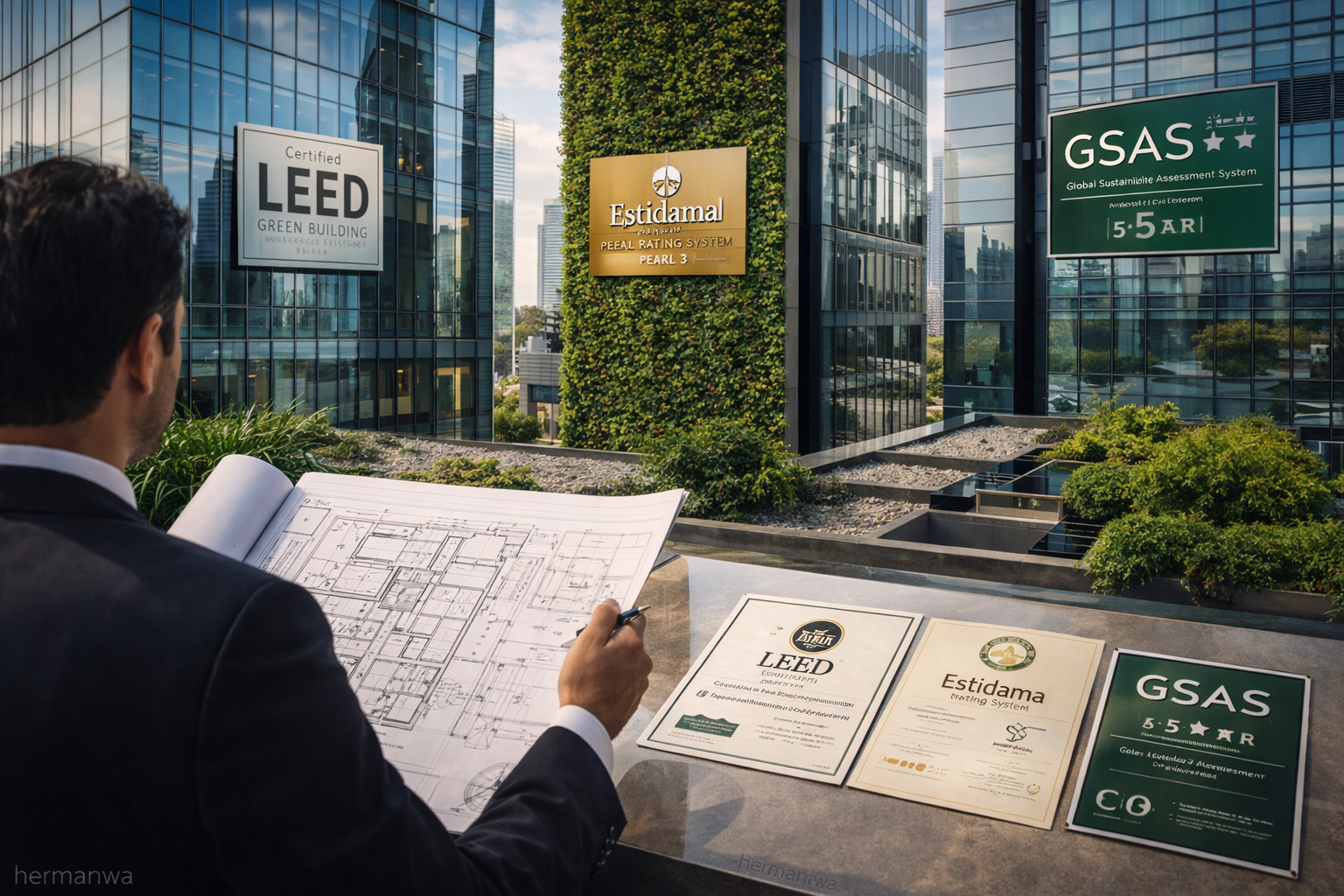
The Middle East's green building certification landscape has evolved dramatically over the past decade. With over 5,000 LEED-accredited professionals now operating across MENA, Abu Dhabi mandating Estidama for all new construction, and Qatar requiring GSAS for public projects, portfolio owners face a critical strategic decision: which certification system delivers the best return for their specific situation?
This comprehensive guide breaks down the three dominant certification systems in the GCC, providing the practical insights you need to make informed decisions about your properties.
Understanding the Three Major Certification Systems
Before diving into comparisons, it's essential to understand what each system was designed to achieve and the context in which it operates.
LEED (Leadership in Energy and Environmental Design)
Developed by the U.S. Green Building Council in 1998, LEED has become the world's most widely recognized green building certification. In the Middle East, LEED adoption has grown substantially, with the UAE ranking among the top 10 countries globally for LEED-certified space outside the United States.
- Certification Levels: Certified, Silver, Gold, Platinum
- Focus Areas: Location and transportation, sustainable sites, water efficiency, energy and atmosphere, materials and resources, indoor environmental quality, innovation, regional priority
- Recognition: Global standard recognized by investors, tenants, and rating agencies worldwide
- Versions: LEED v4.1 for new construction, existing buildings, interiors, and more
Estidama Pearl Rating System
Launched in 2010 by Abu Dhabi's Urban Planning Council, Estidama (Arabic for "sustainability") was specifically designed for the region's extreme climate and cultural context. It became mandatory for all new buildings in Abu Dhabi in 2010.
- Certification Levels: 1 Pearl through 5 Pearls
- Focus Areas: Integrated development process, natural systems, livable buildings, precious water, resourceful energy, stewarding materials, innovating practice
- Recognition: Mandatory in Abu Dhabi, recognized across UAE and increasingly in wider GCC
- Unique Features: Lifecycle approach covering design, construction, and operation phases
GSAS (Global Sustainability Assessment System)
Originally developed as QSAS (Qatar Sustainability Assessment System) in 2009, GSAS has evolved into a comprehensive framework adopted across the Gulf region. It's the preferred certification for Qatar's massive development pipeline, including World Cup infrastructure.
- Certification Levels: One to Six Stars
- Focus Areas: Urban connectivity, site, energy, water, materials, indoor environment, cultural and economic value, management and operations
- Recognition: Primary standard in Qatar, growing adoption in Saudi Arabia, Kuwait, and Oman
- Unique Features: Strong emphasis on cultural preservation and regional economic impact
Market Reality Check
In 2024, the GCC region certified over 800 buildings under these three systems combined. LEED led in voluntary certifications, Estidama dominated Abu Dhabi's mandatory compliance market, and GSAS captured the lion's share of Qatar's development boom. Understanding where your properties are located and who your stakeholders are should drive your certification strategy.
Detailed Comparison: Cost, Timeline, and Requirements
The following comparison is based on a typical 20,000 sqm commercial office building seeking mid-tier certification (LEED Gold, 3 Pearl, or 4 Star equivalent).
| Factor | LEED | Estidama | GSAS |
|---|---|---|---|
| Registration Fees | $3,500-6,000 | $2,000-4,000 | $3,000-5,000 |
| Review/Certification Fees | $25,000-45,000 | $15,000-30,000 | $20,000-40,000 |
| Consultant Costs | $40,000-100,000+ | $25,000-60,000 | $30,000-70,000 |
| Total Certification Cost | $70,000-150,000+ | $42,000-94,000 | $53,000-115,000 |
| Construction Premium | 3-8% | 2-5% | 2-6% |
| Timeline (Design + Construction) | 18-24 months | 12-18 months | 15-20 months |
| Recertification Required | Every 3 years (LEED O+M) | Operational rating ongoing | Every 3-5 years |
| Local Consultant Availability | High (5,000+ LEED APs in MENA) | Moderate (primarily UAE-based) | Moderate (primarily Qatar/GCC) |
Hidden Costs to Budget For
- Energy modeling: $15,000-40,000 depending on building complexity
- Commissioning: $30,000-80,000 for enhanced commissioning requirements
- Documentation management: 500-1,000 hours of internal team time
- Material certification: Sourcing certified materials may add 5-15% to specific material costs
- Post-occupancy verification: $10,000-25,000 for performance verification
Which Certification for Which Situation?
The right certification depends on your property's location, your stakeholder requirements, and your long-term portfolio strategy.
Choose LEED When:
- International investors are key stakeholders. European and North American LPs recognize LEED immediately; regional certifications require explanation.
- You're seeking global brand tenants. Multinational corporations often mandate LEED for their offices as part of global sustainability commitments.
- Your portfolio spans multiple countries. LEED provides a consistent benchmark across UAE, Saudi Arabia, Egypt, and beyond.
- You're targeting GRESB rankings. LEED certification directly contributes to GRESB scores recognized by institutional investors.
- The property is in Dubai or a location without mandatory requirements. LEED provides voluntary differentiation where local codes don't mandate certification.
Choose Estidama When:
- Your property is in Abu Dhabi. Estidama is mandatory; the question is only which Pearl level to target above the minimum.
- You want to minimize certification costs. Estidama typically has lower soft costs than LEED for equivalent recognition in the UAE market.
- The building is designed specifically for Gulf conditions. Estidama credits are calibrated for local climate, reducing the documentation burden for regional designs.
- Government or GRE tenants are targets. Abu Dhabi government entities often prefer Estidama-rated buildings for their offices.
- Long-term operational support matters. Estidama's lifecycle approach and local support infrastructure provide ongoing compliance assistance.
Choose GSAS When:
- Your property is in Qatar. GSAS is mandatory for public projects and preferred for private developments.
- You're expanding into Kuwait, Saudi Arabia, or Oman. GSAS recognition is growing faster than Estidama outside the UAE.
- Cultural and heritage considerations are important. GSAS has the most developed framework for cultural preservation credits.
- You need flexibility in credit pathways. GSAS offers more alternative compliance paths for innovative approaches.
- Regional rather than global recognition is sufficient. For properties focused on GCC tenants and investors, GSAS delivers strong positioning.
The Dubai Exception
Dubai presents a unique case. The emirate has Al Sa'fat as its mandatory green building system, but this doesn't preclude voluntary certifications. For premium Dubai properties, LEED remains the gold standard for international recognition, while Al Sa'fat compliance handles regulatory requirements. This makes LEED the preferred voluntary certification for Dubai's high-end commercial and hospitality sectors.
Dual Certification Strategies
For premium developments, particularly in Abu Dhabi, dual certification with both Estidama (mandatory) and LEED (voluntary) is increasingly common. Here's how to approach it strategically.
Why Pursue Dual Certification?
- Regulatory compliance plus global recognition: Meet Abu Dhabi requirements while appealing to international investors
- Marketing differentiation: Premium positioning in a competitive market
- Future-proofing: As requirements tighten, having both certifications provides flexibility
- Tenant appeal: Attract both regional and international corporate tenants
Credit Alignment Opportunities
Approximately 60-70% of credits overlap between LEED and Estidama when properly planned from the design phase. Key areas of alignment include:
- Energy performance: Both systems reward efficiency beyond code, with similar calculation methodologies
- Water conservation: Indoor and outdoor water reduction credits are highly compatible
- Material selection: Regional material requirements can satisfy both systems with proper documentation
- Indoor environmental quality: Ventilation, thermal comfort, and lighting credits overlap significantly
Budget and Timeline Impact
Dual certification adds approximately:
- 60-70% additional certification fees (not double, due to shared documentation)
- 3-4 months additional timeline for coordinated submissions
- Minimal construction premium increase if planned from design inception
- 30-40% additional consultant costs for integrated certification management
Critical Success Factor
Dual certification only makes economic sense if planned from project inception. Retrofitting a second certification onto an already-designed building can double costs and timeline. Engage certification consultants during concept design, not after construction documents.
Cost-Benefit Analysis: Making the Business Case
Green certification delivers value through multiple channels. Here's how to quantify the return for your stakeholders.
Rental Premium
Research across GCC markets shows certified buildings command rental premiums of:
- LEED Gold/Platinum: 5-12% rental premium in Dubai and Abu Dhabi prime locations
- Estidama 3+ Pearl: 3-8% rental premium in Abu Dhabi
- GSAS 4+ Star: 4-10% rental premium in Qatar
Occupancy Advantage
Certified buildings typically achieve 3-7% higher occupancy rates, translating to significant NOI improvement over a hold period.
Operating Cost Savings
Energy and water efficiency measures required for certification typically deliver:
- 20-35% energy savings compared to code-minimum buildings
- 30-50% water savings through efficient fixtures and landscaping
- $2-5 per sqm annual savings in operating costs for typical commercial buildings
Exit Value Enhancement
Institutional buyers increasingly require or prefer certified assets. Properties without certification may face:
- Limited buyer pool from ESG-mandated investors
- Due diligence complications around climate risk
- Potential capex requirements factored into bids
| Value Driver | Typical Impact | 10-Year NPV (20,000 sqm building) |
|---|---|---|
| Rental Premium (7%) | +$15-25/sqm/year | $2.1M - $3.5M |
| Occupancy Improvement (5%) | +$10-20/sqm/year | $1.4M - $2.8M |
| Operating Savings | $2-5/sqm/year | $280K - $700K |
| Exit Cap Rate Compression (15-25 bps) | +3-6% asset value | $1.5M - $3.0M |
| Total Potential Value | $5.3M - $10.0M |
Implementation Roadmap
Whether pursuing LEED, Estidama, GSAS, or dual certification, follow this structured approach.
Phase 1: Strategy and Registration (Months 1-2)
- Define certification goals based on stakeholder requirements
- Select target certification level with credit pathway analysis
- Engage experienced certification consultants
- Complete project registration with certification bodies
- Establish documentation management systems
Phase 2: Integrated Design (Months 3-8)
- Incorporate certification requirements into design briefs
- Conduct energy modeling and optimization
- Specify certified materials and systems
- Complete design-phase credit submissions
- Receive design-phase certification (Estidama/GSAS)
Phase 3: Construction Compliance (Months 9-20)
- Implement construction waste management
- Track material certifications and receipts
- Conduct indoor air quality management
- Commission building systems
- Complete construction-phase documentation
Phase 4: Certification and Operations (Months 21-24)
- Submit final documentation packages
- Address review comments and appeals if needed
- Receive final certification
- Establish operational compliance systems
- Plan for recertification requirements
Need Help Choosing the Right Certification?
Our team has guided over 50 properties through LEED, Estidama, and GSAS certification across the GCC. Get a personalized assessment for your portfolio.
Schedule a ConsultationSummary: Making the Right Choice
Choosing between LEED, Estidama, and GSAS is not about which system is "better" but which aligns with your specific circumstances:
- Location determines mandatory requirements: Abu Dhabi means Estidama, Qatar means GSAS, Dubai allows choice
- Stakeholders drive voluntary decisions: International investors prefer LEED, regional players accept local certifications
- Cost differences are meaningful but not determinative: The value creation potential far exceeds certification costs when properly executed
- Dual certification makes sense for premium assets: But only when planned from inception
- Implementation quality matters more than system selection: A well-executed 3 Pearl beats a poorly documented LEED attempt
The Middle East's green building market is maturing rapidly. Properties certified today will be well-positioned for increasingly stringent requirements and ESG-conscious capital flows. The question is no longer whether to certify, but how to maximize value from the certification investment.
About HermanWa
HermanWa is an AI-powered building management platform for hospitality and real-estate portfolios in the UAE and UK. It keeps one auditable file per building — health & safety audit findings, maintenance work orders, contractor evidence, energy monitoring, and Scope 1–3 carbon tracking — and its AI assistant, Herman, answers questions about your buildings in plain English. HermanWa tracks compliance deadlines including UAE Civil Defence fire audits, Estidama Pearl, DEWA benchmarking, UK EPC ratings, EICR and gas safety certificates. Learn more at hermanwa.com.
Keep the green rating true after handover
The free UAE green building checklist covers Estidama Pearl and Al Sa'fat: every duty with who enforces it, how often, the published penalty and the official source.
- Estidama Pearl in Abu Dhabi and Al Sa'fat in Dubai
- The waste permit and energy audit that evidence them
- The steps to walk each duty, ready to print or save as PDF
Prefer to talk it through? Book a 20-minute walkthrough