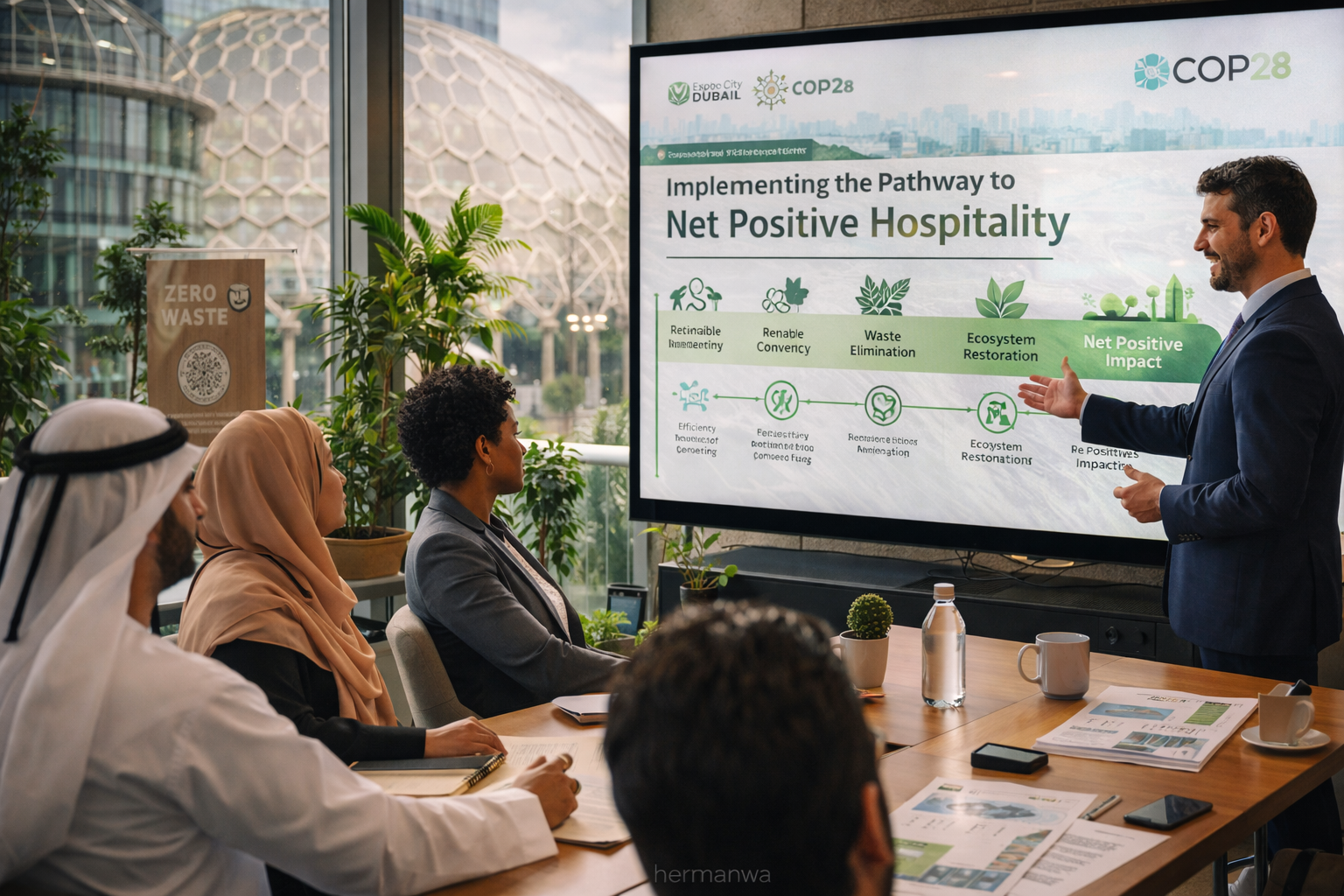
When the Sustainable Hospitality Alliance unveiled its Pathway to Net Positive Hospitality at COP28 in Dubai, it marked a pivotal moment for the global hospitality industry. For the first time, hotel owners and operators had a comprehensive, science-based framework specifically designed for their sector, complete with digital tools to track progress and benchmark performance.
Eight months later, the question facing portfolio owners across the GCC and beyond is no longer whether to engage with this framework, but how to implement it effectively. This guide provides a practical roadmap for turning the Pathway into operational reality.
What COP28 Meant for the Hospitality Sector
COP28's significance for hospitality extended far beyond its Dubai location. The conference marked the first time the tourism and hospitality sector received dedicated attention at a major climate summit, with the UAE Presidency explicitly recognizing the industry's dual role as both contributor to and victim of climate change.
Several outcomes directly impact hospitality portfolios:
- The Global Stocktake confirmed that current commitments fall short of the 1.5 degree target, increasing pressure on all sectors including hospitality
- The transition away from fossil fuels was formally acknowledged, signaling the inevitable shift to renewable energy that hotels must plan for
- Article 6 carbon market rules were finalized, creating clearer mechanisms for offset projects relevant to hospitality operations
- The Loss and Damage Fund established implications for properties in climate-vulnerable destinations
More specifically for hospitality, the Sustainable Hospitality Alliance used the platform to launch tools that translate global climate science into sector-specific action plans.
The Dubai Declaration on Tourism and Climate
Signed by over 100 countries at COP28, the Declaration commits governments to supporting tourism sector decarbonization. For hotel owners, this signals increasing regulatory support and potential incentives for sustainability investments in signatory countries including the UAE, Saudi Arabia, and most European nations.
The Net Positive Hospitality Framework
The Pathway to Net Positive Hospitality goes beyond traditional sustainability frameworks by setting an ambitious end goal: hotels should contribute more than they take from the environment and communities by 2050. This "net positive" concept encompasses four interconnected pillars:
Pillar 1: Carbon
The framework aligns with the Science Based Targets initiative (SBTi), requiring absolute emissions reductions rather than just intensity improvements. Hotels must address:
- Scope 1 emissions from on-site fuel combustion, refrigerants, and owned vehicles
- Scope 2 emissions from purchased electricity, heating, and cooling
- Material Scope 3 categories including procurement, waste, and guest transportation
Pillar 2: Water
Recognizing water stress as a critical issue for hospitality, particularly in regions like the GCC, the framework sets context-based water targets that account for local watershed conditions. Hotels in water-stressed regions face more aggressive reduction requirements.
Pillar 3: Nature
The nature pillar addresses biodiversity, land use, and ecosystem impacts. Hotels must assess their supply chain footprint, on-site ecological management, and contributions to nature preservation.
Pillar 4: People and Communities
The social dimension requires hotels to demonstrate positive community impact through local employment, supplier diversity, cultural preservation, and community investment programs.
Key Milestones and Targets
The Pathway establishes clear milestones that portfolio owners should incorporate into their strategic planning:
| Milestone | Carbon | Water | Nature | Community |
|---|---|---|---|---|
| 2030 | 50% reduction in Scope 1 and 2 | 25% intensity reduction | Supply chain assessment complete | Measurable impact programs |
| 2040 | 75% reduction, Scope 3 addressed | Water neutral in stressed basins | Nature-positive operations | Net positive community contribution |
| 2050 | Net zero across all scopes | Water positive | Regenerative practices | Verified positive impact |
The 2030 Deadline Is Closer Than It Appears
With less than five years until the first major milestone, hotels that haven't established baselines and begun decarbonization efforts are already behind schedule. The 50% reduction target for Scope 1 and 2 emissions typically requires 3-5 years of capital planning and implementation.
Using the Progress Tracker Tool
The Alliance's digital Progress Tracker transforms the framework from theoretical guidance into an operational management system. Here's how to leverage it effectively:
Step 1: Registration and Baseline Setup
Access requires membership in the Sustainable Hospitality Alliance or participation through a member brand. During setup, you'll need:
- Property portfolio details including location, size, and operational characteristics
- 12-24 months of historical utility data (electricity, fuel, water)
- Baseline year selection (typically the most recent complete year)
- Agreement to data sharing principles that enable benchmarking
Step 2: Target Setting
The tool guides you through target setting aligned with the framework milestones. You can choose:
- Framework-aligned targets that match the official milestones
- Accelerated targets for leaders wanting to move faster
- Custom targets with justification for deviation from the standard pathway
Step 3: Quarterly Data Input
The tracker requires quarterly data updates covering energy consumption, water usage, waste generation, and progress on qualitative measures. Automated data feeds can be configured for properties with smart metering systems.
Step 4: Benchmarking and Reporting
The system generates benchmarking reports comparing your portfolio against peer properties by region, size, and service level. Reports can be exported in formats suitable for investor reporting, brand compliance, and regulatory submission.
Data Quality Matters
The Progress Tracker is only as valuable as the data fed into it. Before beginning, conduct a data audit to ensure:
- Complete utility records with no gaps
- Consistent measurement units across properties
- Accurate occupancy data for intensity calculations
- Clear allocation methodology for mixed-use properties
Integration with GCC Regional Requirements
One of the Pathway's strengths is its compatibility with regional regulations. For GCC-based portfolios, the framework aligns with and supports compliance across multiple jurisdictions:
UAE Net Zero 2050
The Pathway's carbon targets align with UAE's national decarbonization trajectory. Hotels implementing the framework will be well-positioned for anticipated mandatory reporting requirements.
Dubai Al Sa'fat and Abu Dhabi Estidama
While these systems focus on building performance, the Pathway's operational focus complements them. Properties can pursue green building certification alongside operational sustainability improvements.
Saudi Vision 2030 Green Initiative
Saudi Arabia's ambitious tourism expansion under Vision 2030 explicitly requires sustainable development. The Pathway provides the methodology to demonstrate compliance with NEOM, Red Sea Global, and other giga-project sustainability requirements.
Regional Water Considerations
The context-based water targets are particularly relevant in the water-stressed GCC region. The framework's requirement for basin-level assessment ensures hotels address local water realities rather than applying generic global benchmarks.
| Regional Requirement | Pathway Alignment | Implementation Note |
|---|---|---|
| UAE Net Zero 2050 | Full alignment on carbon targets | Use Pathway reporting for regulatory submission |
| Dubai Al Sa'fat | Complementary (building vs. operations) | Pursue both for comprehensive coverage |
| GSTC Certification | Strong alignment across all pillars | Pathway data supports GSTC criteria |
| Brand Requirements | Exceeds most brand minimums | Position for premium brand partnerships |
Case Studies: Early Adopters
Several hotel groups have already begun implementing the Pathway, providing valuable lessons for others:
Pan Pacific Hotels Group
As an early Alliance member, Pan Pacific integrated the framework across its Asian portfolio. Key learnings include the importance of property-level champions, the value of starting with quick wins to build momentum, and the need for investment in data systems before attempting comprehensive tracking.
IHG Hotels and Resorts
IHG aligned its Journey to Tomorrow program with the Pathway framework, demonstrating how existing brand sustainability initiatives can be enhanced rather than replaced. Their approach shows how large brands can adapt the framework to their operational reality while maintaining credible alignment.
Minor Hotels
Operating extensively in the Asia-Pacific region and Middle East, Minor Hotels used the framework to standardize sustainability performance across diverse property types and geographies. Their experience highlights the flexibility of the Pathway to accommodate resort, urban, and mixed-use properties.
Common Success Factors
Analysis of early adopters reveals consistent patterns:
- Executive sponsorship ensures resources and accountability
- Cross-functional teams prevent siloed implementation
- Pilot properties allow learning before portfolio-wide rollout
- Integration with existing systems reduces duplicate effort
- Regular communication maintains momentum and engagement
Implementation Roadmap
Based on successful implementations and our experience with GCC portfolios, here is a practical 18-month roadmap:
Months 1-3: Foundation
- Secure executive commitment and budget allocation
- Conduct data audit across portfolio
- Register with the Sustainable Hospitality Alliance
- Select pilot properties representing portfolio diversity
- Begin baseline data collection
Months 4-6: Baseline Establishment
- Complete baseline calculations for all four pillars
- Conduct gap analysis against 2030 targets
- Identify quick wins and long-term capital requirements
- Develop property-level action plans
- Begin Progress Tracker input
Months 7-12: Implementation Launch
- Execute quick-win projects (LED upgrades, operational efficiency)
- Initiate capital planning for major investments
- Train property teams on tracking and reporting
- Establish quarterly review cadence
- Produce first stakeholder report
Months 13-18: Scale and Optimize
- Roll out to full portfolio based on pilot learnings
- Implement automated data collection where feasible
- Begin benchmarking analysis and peer comparison
- Refine targets based on performance data
- Integrate with investor and brand reporting requirements
Ready to implement the Pathway?
Our team has direct experience with Net Positive Hospitality implementation across GCC portfolios. Let's discuss your specific situation.
Schedule a ConsultationCommon Implementation Challenges
Understanding potential obstacles helps you plan around them:
Data Gaps and Quality Issues
Many portfolios discover significant data gaps when attempting baseline calculations. Common issues include missing utility records, inconsistent measurement periods, and unclear allocation between hotel and non-hotel spaces in mixed-use properties.
Scope 3 Complexity
The framework's requirement to address supply chain emissions presents challenges. Start with the highest-impact categories (typically food and beverage procurement, amenities, and laundry) before attempting comprehensive Scope 3 coverage.
Balancing Luxury and Sustainability
Luxury hotels face particular tension between guest expectations and sustainability targets. The most successful approaches find ways to enhance rather than diminish the guest experience through sustainability initiatives.
Investment Prioritization
With multiple pillars and numerous potential interventions, deciding where to invest first requires careful analysis. Prioritize projects with the highest impact-to-investment ratio, considering both environmental and financial returns.
Looking Ahead
The Pathway to Net Positive Hospitality represents a maturing of the hospitality sector's approach to sustainability. Moving from vague commitments to specific, measurable, time-bound targets changes the nature of the conversation with investors, regulators, and guests.
For GCC portfolios, the framework offers several strategic advantages:
- A credible response to increasing investor ESG requirements
- Alignment with regional regulatory direction
- Competitive positioning for premium brands and guests
- Operational efficiency improvements that benefit the bottom line
- Risk mitigation against climate-related disruption
The hotels and portfolios that engage seriously with this framework now will be industry leaders by 2030. Those that delay will find themselves playing catch-up in an increasingly demanding market.
Summary
COP28 marked a turning point for hospitality sustainability, providing the sector with a comprehensive framework and practical tools for action. The Pathway to Net Positive Hospitality offers a clear roadmap from baseline to net positive by 2050, with intermediate milestones that create accountability and enable progress measurement.
For portfolio owners, the priority actions are clear:
- Engage with the Sustainable Hospitality Alliance and its tools
- Establish comprehensive baselines across all four pillars
- Develop implementation plans aligned with the 2030 milestones
- Integrate the framework with regional requirements and brand standards
- Build the data systems and governance structures that enable sustained progress
The hospitality industry's path to net positive is now clearly mapped. The journey begins with a single step, and that step is available today.
About HermanWa
HermanWa is an AI-powered building management platform for hospitality and real-estate portfolios in the UAE and UK. It keeps one auditable file per building — health & safety audit findings, maintenance work orders, contractor evidence, energy monitoring, and Scope 1–3 carbon tracking — and its AI assistant, Herman, answers questions about your buildings in plain English. HermanWa tracks compliance deadlines including UAE Civil Defence fire audits, Estidama Pearl, DEWA benchmarking, UK EPC ratings, EICR and gas safety certificates. Learn more at hermanwa.com.
Walk into your next senior management meeting with the answers
The free Director's Risk Check takes five minutes. No sign-up to see your score.
Run the 5-minute check