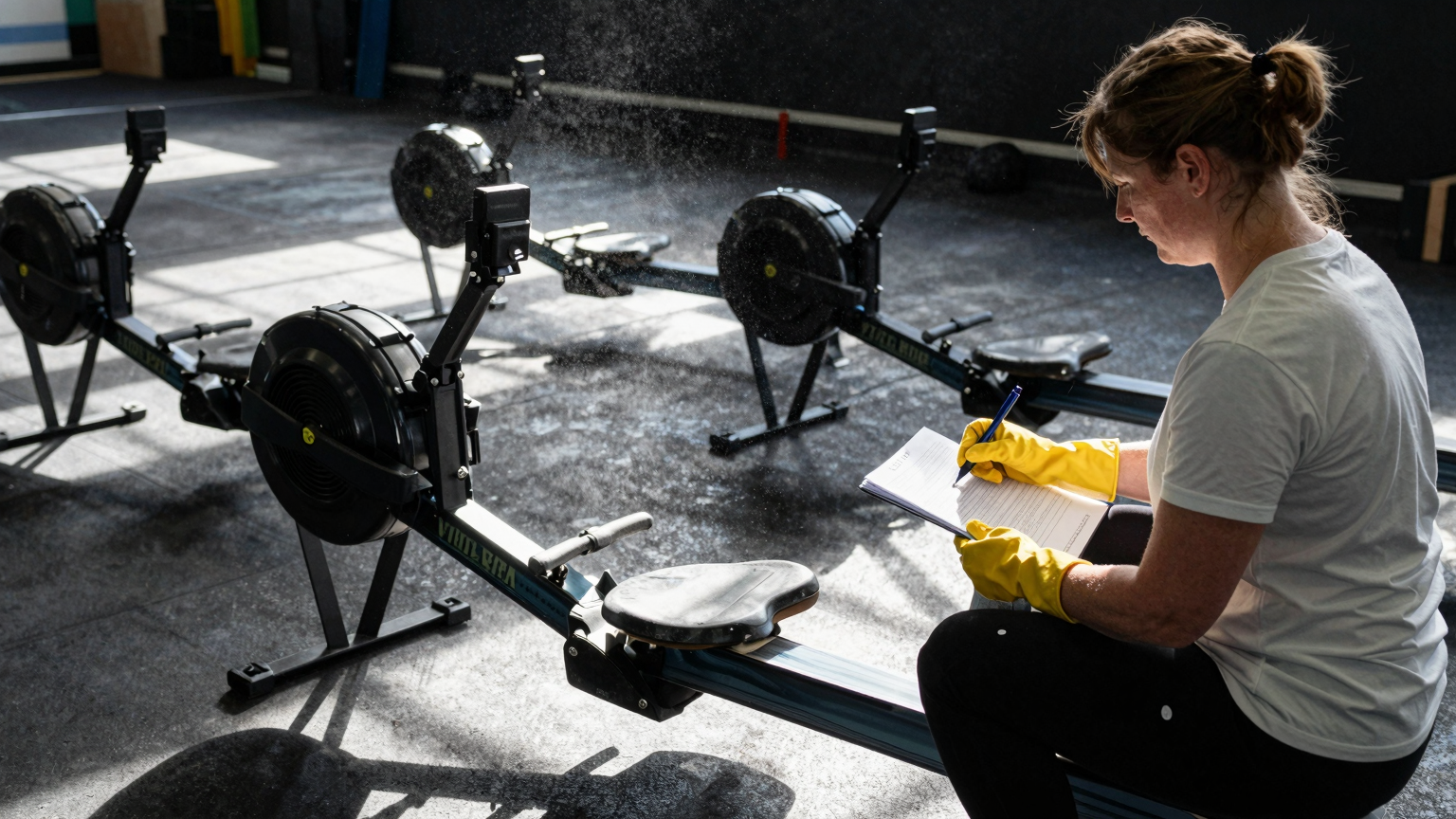

If an inspector asked for your cleaning records for shared equipment and public areas across one shopping centre, could you produce them before the meeting ended?
Most heads of property I know would say yes, then start mentally listing the gaps: the contractor's portal, the site manager's folder, the spreadsheet nobody has updated since the last audit. That gap is the subject of this piece, because a recent incident at a mass-participation fitness event shows exactly how quickly shared equipment and venue surfaces become the centre of a dispute.
The stakes: shared surfaces, shared liability
At a Hyrox event in Beijing, an elite competitor was allowed to continue and win despite a hygiene incident mid-race. The organiser, Hyrox, later apologised and changed its rules. Its co-founder Moritz Fürste said: "Hyrox made a mistake by not reacting immediately during the race. In the end it is my job to foresee these potential incidents – and I did not." The BBC reported the apology and the rule change, and Hyrox China offered full refunds to affected participants after the incident contaminated shared equipment and track surfaces for more than 1,000 subsequent participants.
Read that again as a property director. The organiser had procedures. The procedures existed. What failed was the decision to apply them in the moment, and the evidence trail that should have shown what was done, when, and by whom. In a shopping centre, the same failure mode applies to every shared surface your teams touch: escalator handrails, food court tables, children's play equipment, trolley handles, washroom fittings, and the cleaning records that are supposed to prove all of it happened.
What an inspector, insurer or buyer actually asks to see
When something goes wrong in a shopping centre — a norovirus outbreak traced to a food court, a slip on a contaminated floor, a complaint that escalator handrails were never wiped — the first request is rarely dramatic. It is a request for records. The inspector, the insurer's loss adjuster, or the buyer's due diligence team will ask for the cleaning schedule, the sign-off sheets, the product data sheets, and the incident log. They will ask who was responsible for which area, and what the escalation route was when something was missed.
The money sits in the gap between doing the work and proving it. In October 2024 the HSE fined a housing association £900,000 after a legionella outbreak at sheltered accommodation in Birkenhead — a shared system, a written control scheme that was supposed to govern it, and records that did not show the regime had been followed. Shared gym equipment, shared changing rooms and a shared wet area sit in exactly the same category: the control is only worth what the log can demonstrate afterwards.
The UK government's guidance on food hygiene for businesses is blunt about this: not cleaning thoroughly is one of the most common reasons why food businesses are prosecuted. The same guidance says you must set up a cleaning schedule and record, covering what needs to be cleaned or disinfected, how often, and which products to use. It also says not all cleaning products kill bacteria and viruses, and that disinfectant labels should include either BS EN 1276 or BS EN 13697 codes. That is the standard an inspector will hold you to, and it applies to every shared surface in a retail environment where food is sold or consumed.
Where does that evidence usually live in a shopping centre? In my experience, it is scattered. The cleaning contractor keeps its own records. The centre management team keeps a separate log for common areas. Individual retailers keep their own records for their units. The food court operator keeps another set. Nobody has a single view, and when the inspector asks for the last quarter's records for the food court seating area, the answer involves three phone calls and a wait.
What good looks like is simpler than most software vendors suggest. A named person owns the schedule. The schedule says what is cleaned, how often, with which product, and who signs it off. The records are retrievable in minutes, not days. And there is a clear escalation route when a clean is missed or a surface is contaminated by something unexpected.
The rulebook problem: when procedures exist but nobody applies them
Hyrox had "clear biocontaminant and medical procedures in place," according to its global statement. The problem, in its own words, was that "protocols designed for elite competition and mass participation became blurred, creating ambiguity in how they were applied and understood." That is not a failure of paperwork. It is a failure of decision rights.
In a shopping centre, the equivalent ambiguity is common. Who decides to close a food court seating area when a child is sick on the floor? Who authorises the deep clean? Who signs off that the area is safe to reopen? If the answer is "the centre manager, but only after checking with the retailer, and the contractor needs 24 hours' notice," then you do not have a procedure. You have a discussion.
The new Hyrox rule allows a race director to withdraw an athlete on medical grounds if their "blood, vomit, urine, or contamination poses a welfare or contamination risk to the racer or to other racers." The key word is director. One named role, one decision, recorded on the leaderboard as Did Not Finish. That is what good looks like in a venue: a named decision-maker with the authority to act, and a record that shows they did.
For your portfolio, the check is this: for each shopping centre, can you name the person who decides to close a contaminated area, and can you show the last time that decision was tested? If the answer is no, you are relying on goodwill and memory. Neither holds up in an incident.
Where the evidence usually breaks down
The most common failure I see is not the absence of cleaning. It is the absence of proof that cleaning happened. The contractor cleaned the food court tables at 2pm. The record says 2pm. But the record is a tick on a clipboard that was transcribed into a spreadsheet three days later, and the spreadsheet does not distinguish between a wipe-down and a full disinfectant clean.
The second failure is scope. The cleaning schedule covers the food court, but not the children's play area. Or it covers the play area, but not the escalator handrails. Or it covers the handrails, but not the trolley bay. In a shopping centre, shared equipment is everywhere, and the schedule needs to name it.
The third failure is product. The guidance is clear that not all cleaning products kill bacteria and viruses, and that disinfectants should carry BS EN 1276 or BS EN 13697. If your records do not show which product was used, you cannot prove the clean was effective. An inspector will ask for the product data sheet, and if you cannot produce it, the clean did not happen as far as they are concerned.
What good looks like is a schedule that names every shared surface, a record that shows the product used and the time of clean, and a retrieval system that produces the last quarter's records in under ten minutes. That is the evidence test. It is not about having more paperwork. It is about having the right paperwork, in the right place, with a named person accountable for it.
Further reading: Animal by-product categories, site approval, hygiene and disposal, HYROX Beijing hygiene incident: organiser apology, rule change, refunds.
Your 60-second self-check
- Could you produce the last quarter's cleaning records for every shared surface in one shopping centre today, including the product used and the time of clean?
- Can you name the person who decides to close a contaminated area, and show the last time that decision was recorded?
- Do your cleaning records distinguish between a general wipe-down and a disinfectant clean using a BS EN 1276 or BS EN 13697 product?
If you cannot answer all three with confidence, you are in good company. Most heads of property I speak to can answer the first one for some buildings, the second one for none, and the third one only if the contractor happens to be on site. The free 5-minute Director's Risk Check gives you a control score for your portfolio, so you know where you stand before someone more senior asks for it. You can run the check here and send it to a colleague if you want a second pair of eyes.
Herman's verdict
A cleaning record that cannot be produced on the day is not a record. It is a story you tell after the incident, and the inspector has heard it before. The organiser in Beijing had procedures and still failed the moment because nobody had the authority to act. Your shopping centre has the same exposure, and the only thing that closes it is a named decision-maker and a retrievable trail.
— Herman
Until next time — keep the evidence closer than the deadline.
Walk into your next senior management meeting with the answers
The free Director's Risk Check for UK portfolios takes five minutes. No sign-up to see your score.
- Your control score across compliance, evidence, oversight, cost and renewals
- The breach exposure in your portfolio, with the official source for each penalty
- A board-ready briefing with your three priorities and a 30/60/90-day plan
About HermanWa
HermanWa is a building compliance and operations platform for property and facilities teams in the United Kingdom and Singapore, with portfolios across the Gulf. It keeps one auditable file per building — statutory deadlines, inspection evidence, contractor work, energy and carbon — and its AI assistant, Herman, answers questions about your buildings in plain English. HermanWa tracks obligations including fire risk assessments and fire door checks, Building Safety Act duties, Legionella (ACOP L8), EICR, gas safety and EPC in the UK, and SCDF fire certificates, Periodic Facade and Structural Inspections, lift permits and Green Mark in Singapore. Directors can check their exposure with the free Director's Risk Check.