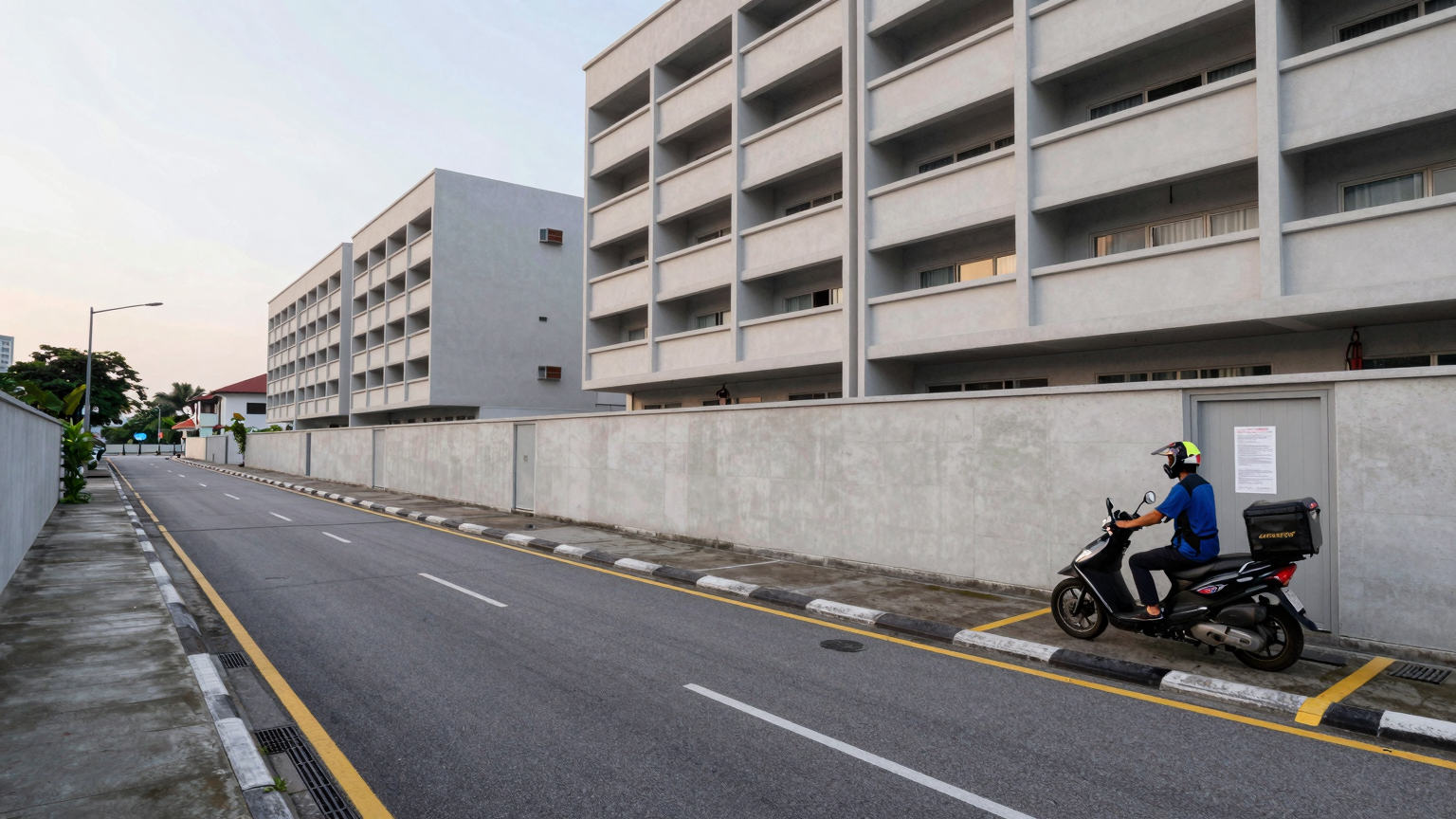

A rider pulls up at your mall's service entrance, parks on the fire engine access route because there is nowhere else, and runs in to collect an order. A security officer moves the bike. The rider comes back, argues, and leaves. The next rider does the same thing. By the end of the week, your building manager is fielding complaints from tenants about blocked loading bays, and the fire engine access route has been obstructed three times.
That pattern is now the subject of formal guidance from two regulators, and it lands on the desk of whoever answers for the building's compliance record. If you are a portfolio manager, that is you.
The LTA and URA have published a Last-Mile Delivery Guide that names building owners and MCSTs as the ones who act
The Land Transport Authority and the Urban Redevelopment Authority have issued new guidelines encouraging building owners and managers to provide dedicated waiting bays for delivery riders using motorcycles, bicycles and power-assisted bicycles. The recommendation sits inside a new Last-Mile Delivery Guide aimed at developers, architects, building managers and Management Corporation Strata Title councils, as reported by Singapore Business Review.
The guide is not a regulation you can be fined under tomorrow. It is a set of expectations from the two agencies that approve your development plans and, in URA's case, your planning permissions. That distinction matters less than it used to, because the same agencies have already issued a circular on this subject, and that circular has been superseded by a newer one. The direction of travel is one way.
For a portfolio manager, the practical question is not whether you agree with the guide. It is whether you can show, building by building, what you have done about delivery access. If an inspector, an insurer or a buyer asks, the answer needs to be a document, not a recollection.
Bay sizes, separation by vehicle type and the 15-minute grace period are the three numbers to carry into your next site visit
The guide recommends specific dimensions. Motorcycles should be given spaces measuring about 0.8 metres by 2.4 metres each. Bicycles and power-assisted bicycles should have about 0.7 metres by 1.8 metres. Those are not generous sizes, which means a bay that was marked out for a car will not do.
Bays should be separated by vehicle type and kept away from vehicular access points, fire engine access routes and fire escape routes. That last point is the one that turns a convenience issue into a compliance issue. A delivery motorcycle parked on a fire engine access route is not a parking problem. It is an obstruction of a route the SCDF expects to be clear.
Building managers are encouraged to offer delivery riders a parking grace period of at least 15 minutes. URA and Housing and Development Board car parks already offer a 15-minute grace period, so the guide is asking private buildings to match a standard the public car parks already meet. If your building charges delivery riders from the first minute, you are now out of step with the published expectation.
URA's earlier circular on this subject, the advisory note on facilitating safe and efficient delivery pick-ups at commercial malls, already encouraged a reasonable parking grace period of 15 to 20 minutes and set out that waiting bays should be clearly delineated with an orange-coloured box and accompanying signage, safely located at-grade within mall boundaries and close to mall entrances. That circular has since been superseded, but the operational detail in it is still the best description of what a compliant bay looks like on the ground.
This week, walk one building and check three things: whether the bay is marked, whether it is separated by vehicle type, and whether the grace period is actually applied by the parking system rather than promised in a memo.
MCST developments already have a statutory access duty, and the guide says lift design is costing riders 10 to 15 minutes per delivery
For MCST developments, the guide states that access for delivery personnel and their vehicles is already required under the Building Maintenance and Strata Management Act. That is not a new duty created by the guide. It is a duty that already exists, and the guide is pointing out that delivery access is part of it.
The guide also calls for adequate lift capacity and access for delivery personnel. It cites feedback from delivery personnel that poor lift design and practices can add 10 to 15 minutes per delivery, cutting into earnings and causing delivery personnel to avoid certain developments. That is a commercial problem as much as a compliance one. If riders avoid your building, tenants notice, and tenants who notice are tenants who mention it at renewal.
Other recommendations include simplifying security registration through building management apps, setting up parcel or food lockers near entrances, and allowing residents and tenants to collect deliveries at ground-floor lobbies. Developments are advised to improve signage, lighting and network connectivity in common areas and basement car parks, with Wi-Fi suggested where mobile coverage is poor.
None of these are capital projects you can approve in a week. But the lift capacity question is the one that will surface in a tenant meeting, because it is the one riders complain about and the one that shows up in how long a delivery takes.
URA and the National Delivery Champions Association have published bay locations on OneMap, and you can submit yours
URA and the National Delivery Champions Association have worked with the Singapore Land Authority to publish delivery waiting-bay locations on OneMap. Building owners can submit new or unmapped bays for inclusion.
That submission route is worth using, because it does two things at once. It puts your bay on a map riders actually use, which reduces the chance they park somewhere you would rather they did not. And it creates a dated record that you have provided a bay, which is the kind of evidence that answers a question before it is asked.
If your portfolio spans the CBD, Marina Bay, Jurong, one-north and HDB estates, the OneMap listing is also a quick way to see which of your buildings already have mapped bays and which do not. That gap list is a useful thing to have in front of you before a compliance review, not after.
The Ministry of Transport has also set out enhanced regulatory measures for private food delivery companies on safety and traffic compliance, including mandatory theory test certification for power-assisted bicycles and e-scooters, lighting requirements, and third-party liability insurance for riders using active mobility devices on public paths. Those measures sit with the platforms and the riders, but they explain why the building-side guidance exists: the safety and traffic picture around delivery is being tightened from both ends.
Your 60-second self-check
- Could you produce, today, a list of which buildings in your portfolio have a marked delivery waiting bay and which do not?
- For each building with a bay, can you show that the bay is separated by vehicle type and clear of fire engine access routes and fire escape routes?
- Can you confirm that every building in your portfolio applies a parking grace period of at least 15 minutes to delivery riders, and that the parking system enforces it rather than a note on a wall?
If any of those three answers is no, plenty of building managers are in the same position, and you are also not yet in a position to answer the question an inspector or an insurer will ask. The free Director's Risk Check takes about five minutes and gives you a control score for the portfolio, the breach exposure with official sources attached, and a board-ready briefing you can send to a colleague to answer. Five minutes now is a small fraction of the time an audit or a renewal will take if the answer is not ready. You can run it here: Director's Risk Check for Singapore portfolios.
Herman's verdict
A delivery bay is not a courtesy to riders. It is the thing that keeps a fire engine access route clear, and the building that cannot show where its riders park is the building that will be asked to explain why. Mark the bay, set the grace period, and put the date on the record.
— Herman
Until next time — keep the evidence closer than the deadline.
Walk into your next senior management meeting with the answers
The free Director's Risk Check for Singapore portfolios takes five minutes. No sign-up to see your score.
- Your control score across compliance, evidence, oversight, cost and renewals
- The breach exposure in your portfolio, with the official source for each penalty
- A board-ready briefing with your three priorities and a 30/60/90-day plan
About HermanWa
HermanWa is a building compliance and operations platform for property and facilities teams in the United Kingdom and Singapore, with portfolios across the Gulf. It keeps one auditable file per building — statutory deadlines, inspection evidence, contractor work, energy and carbon — and its AI assistant, Herman, answers questions about your buildings in plain English. HermanWa tracks obligations including fire risk assessments and fire door checks, Building Safety Act duties, Legionella (ACOP L8), EICR, gas safety and EPC in the UK, and SCDF fire certificates, Periodic Facade and Structural Inspections, lift permits and Green Mark in Singapore. Directors can check their exposure with the free Director's Risk Check.